Saturday, April 27, 2019
True consensus and the power of the micro-minority
Many people use the word "consensus" as meaning a general agreement -- but that is not the original, or primary, definition. The primary definition includes the UNANIMITY of opinion. In other words, everyone must agree. Within the Religious Society of Friends (Quaker), consensus does still mean that -- everyone must agree -- but there is also the concept of "standing aside" such that a person who is not convinced that the majority is correct but is also not convinced that they are NOT correct can allow movement. They "stand aside" so that some decision, or action, can be made.
But, if they feel strongly that the decision, or action, is the wrong one, then they can stop the action -- true consensus must happen. Throughout history, this situation has stopped Quakers from taking action on some items for a period of years or even decades. Sometimes, the final action is the opposite of what was originally expected -- the minority disappears as it is absorbed within the majority.
Although the basis for this practice within Quakers is religious, the principle of the majority not always being correct applies throughout society. This is parallel to the stereotypical parent asking their child "if everyone decided to jump off a bridge, would that mean it was right for you to do it?"
In fact, looking through history and science, this is the "normal" process. One person decides that slavery is wrong but the rest do not. Then a group shifts their viewpoint (and starts becoming vocal about their view) and more and more people change their view and -- at the end of the process -- almost all think that slavery is wrong. One person examines the solar system and skies and applies mathematics to the movements and decides that the Earth really isn't the center of everything -- starting with a minority of one and now almost (rarely ever everyone) everyone understanding that view.
It isn't easy to be that beginning minority of one. Even in situations where such is explicitly allowed and encouraged, it takes a firm grasp on an individual position to stay there. This applies to scientific, business, and social situations. Failure may sometimes be considered a path to learn how to succeed but most people would rather be part of a supporting group than being the dissenting opinion.
Those ultra-minority opinions are often suppressed -- sometimes with legal mechanisms -- more often with disparagement and attacks against the person and ideas. This can be done with the best of motives -- and it may be that the "majority opinion" proves to be the "correct" one such that that ultra-minority opinion SHOULD be removed. Various tricks and movements may be made to suppress the minority, or ultra-minority, opinion. Of course, it can also be done with malicious intent -- such as, within the Harry Potter series, Harry Potter's trial's time and location being changed and Dumbledore is "accidentally" overlooked to be informed.
We often think of people being of majority/minority voices. If 5% believe X, then we think that 95% believe non-X. It seems to make sense, but it is more likely that 5% believe X, 15% believe non-X and 80% follow along with the perceived greater voice. This situation can be looked at as a silver lining or as a forecast of doom. Is it a matter of 80% being "sheep" and unable to make their own decision or is it a situation where 5% only have to convince another 6% in order to move the fulcrum to change the balance? Perhaps both are true. It is even possible that the 5% can shift part of the 80% and change the balance in that manner.
Within a large group, a single individual can always have the potential to see things the most clearly.


Tuesday, April 16, 2019
Responsibility and Fault: Just where does the buck stop?
"The Buck Stops Here". That is probably President Harry Truman's most famous quote. Obviously, he was not talking about a dollar bill. He was talking about responsibility. He recognized that he, as commander-in-chief and chief executive of the United States, was responsible for the words, actions, lack of actions, morality, and so forth for all of the people to whom he had delegated work.
But, even though there is recognition that the final responsibility lies at the top of the management structure -- those that are delegated may likely delegate further -- and those people delegate even further down. Is the CEO of a company with 30,000 employees responsible for the actions of every one of these people?
In the 1800s and earlier (pre-circa 1970) 1900s, it was felt that the head of the company DID have responsibility for all the people that worked for her or him (in those periods of time, usually a "him"). In exchange for taking that responsibility, there was also a lot of control -- dress codes, behaviors out-of-office, fixed and stringent company manuals, and so forth. The responsibility was also connected to employee "loyalty". The company, and head of the company, guaranteed certain things and the employee, in return, agreed to act in certain ways (including productivity within work).
Starting in the later 1900s, work and non-work time began to decouple. Company pensions became rarer and rarer. Length of time of employment shortened. A lifetime of work for the same company became very unusual rather than very common. Employees decided on what they could, or could not, do outside-of-work hours. Within work hours, there were still various expectations of dress and behavior but, outside of work, it was up to the employee as to what they did and how they behaved. In this situation, certainly, a CEO would not be responsible for what an employee did outside-of-work.
From the other point, the head of a company would certainly be responsible for the words and actions of all those she, or he, directly delegated. And, as Harry Truman indicated, the head has some responsibility for all. But if they are truly unaware of what the grand-delegates are doing/saying then it is hard to say they are directly responsible. In the post-1960s, the phrase of "plausible deniability" came into use -- basically a way of saying "you can't prove that I knew about what they were doing so don't try to hang the responsibility on me".
But this blog is about responsibility and fault. Why "fault"? Because when something goes wrong, the break occurs someplace. Similar to a fault line where earthquakes occur, fault occurs at a location and the responsibility lies with a person. But it is not always the person that seems most obvious. If a person fails in their duty because they do not have the knowledge, training, or accessibility to do the job correctly then the fault lies with the one doing the delegating. If the person DOES have (or claims to have) the knowledge, training, and ability then it is that person's fault.
Fault is not blame. Blame is a movement of responsibility. And it is unproductive. If the fault lies on the manager, then they need to correct the lacks. If the fault lies upon the delegate then there is the option of learning, correcting, and improving to not create the fault again. The action of those responsible may depend on the delegate's history. Does the delegate learn from mistakes? Do they correct past behavior or mistakes?
During merit review of someone to whom there have been tasks delegated, errors or faults need to be looked at from the point of who/where/what. Not doing something when they could not do such is not their fault. Once again, it is the manager's responsibility AND fault. Not being willing, or able, to learn from (and correct) errors is the delegate's fault -- and should be considered in the review.
Saturday, March 30, 2019
Public versus Private -- Corporate choices
There is almost always great excitement when a brand recognized company initiates an Initial Public Offering (IPO). We look at the public stock indices and it is sometimes difficult to remember that Google (Alphabet) was once a private company or Facebook or Amazon or ... It is possible that there exists a company that began as a public corporation but I am unaware of it.
There are still a lot of companies that are privately owned. Occasionally, a public company will move back to private ownership (they do this by buying back all stock that has been publicly issued). This movement in both directions indicates that each has its pluses and minuses.
I am not an economist or a lawyer and cannot tell you all of the ins and outs of what is applicable. There are two general sets of regulations. One set is applicable to both private and public corporations. This set is primarily concerned with safety, health, and wellbeing (financial, social, and others) of employees. OSHA (the Occupational Safety and Health Administration) oversees much of this in the U.S. There are also general accounting, environmental, and other laws which apply to all corporations.
The other set of regulations cover the security of stockholders -- those people within the general population who have invested their money in the fortunes of the public corporation. Naturally, since there are no public owners (and are not available for "trading") of private corporate stock, these regulations do not apply to private corporations. This means that private companies have a lot more flexibility in how they use their internal money -- but, depending on size and other factors, may have to treat their employees similarly to that of a public corporation.
What is the attraction of "going public"? As a former small company owner, I can only tell you my views. The first is "exit strategy" -- what do you have once you have left the company. Within a private company, whatever my share of ownership may be, my share has no formal valuation. (If it is the target of being acquired by another company then an informal, estimated, valuation will indeed be made.) I have 40% of Company ABC. If it is private then that is 40% of ??? If an offer is made to acquire the company for $10 million, then my 40% is effectively worth $4 million -- but only if someone pays that. In a similar fashion, an IPO will indicate -- selling X% of the company divided into Y initial shares priced at $Z -- how much my share of the company is worth (once again, assuming someone wants to buy it -- it is not a "liquid" asset).
The second attraction is to bring in additional money (capital) into the corporation for future desires. I have a store that has an estimated (it is still private) value of $2 million based on $200,000 net yearly profits. I want to open a second store but I do not have enough actual money in the bank to do such. Loans for private corporations are largely based on personal assets of the primary owners -- so that may not be attractive. But, if I sell 49% (common to not have the initial offering be a majority of the ownership) of the store, in stock, to people for $1 million then I have money available to purchase/build a second store and, if the faith that the stockholders have placed in me is valid, I can hope to soon have two stores, each worth $2 million for $4 million total. And those wise and brave investors have stock now worth $2 million -- a 100% increase in their investment.
An in-between of private and public is venture investment. They often will insist on getting a majority of the company (almost definitely so if a second round of investment is needed) but the investment is similar to that of public stockholders except that it is still within the private regulations and restrictions of access. The venture company hopes to double their money -- or triple or quadruple. They expect to do this within a finite period of time (say two or three years) and the easiest way for them to realize their profits is to then take the private company public -- or to ready them for an acquisition event. So, venture capital investment is often a route to an IPO. The primary difference is the possibility of rapidly building up value before public regulations take hold.
It should not be needed to be said -- but I'll say it anyway. In the case of investors -- public or private -- not all investments go well. Investors have a bit more protection within public corporations. A venture capitalist will spread their risk -- $10 million spread between 4 companies. One goes bankrupt, two increase their value a little bit (say 10%), and one doubles their investment. This means (depending on division of investment) that they make a good, but not great, return on their investment. If that successful investment triples their investment then they have made a much larger profit (once again, depending on division of investment). They don't expect every investment to work out but, to stay in business and make the profits they want, the average return needs to be attractive.
So why would anyone want to stay private? Well, besides avoiding public regulations, there are also stockholder expectations. Some stockholders can be very patient (such as for Amazon which took many years before it showed a profit -- but its stock value kept rising anyway). Most want some type of increase of value (dividend, rising stock value) every quarter. If it stays level (or goes down) for a couple of quarters "short term investors" are likely to start looking around for a "better" investment. Companies hope for primarily "long term investors" but publicly traded means that almost anyone can invest.
This short-term requirement leads into "next quarter development plans". Long-term development plans, and investment, must be kept limited as the short-term development plans must succeed to keep up the investor interest and stock value. If the company returns to private then they still are expected to make a profit but they can put much more effort, and resources, into longer range plans.
If you plan to privately run a company for the rest of your life and then pass it along to your children, then there are few reasons to go public. In-N-Out is a good example of such a private company. If you want to leave and go on to your next great venture, then public is the direction to head -- with, perhaps, the assistance of a venture capital company to increase your value first. Every founder, or set of founders, has their own dream and priorities. Best of luck in following your particular dreams!
Saturday, March 16, 2019
Does Anybody Really Know What Time It Is?
The United States (most of it) just went through the Spring ritual of changing to Daylight Savings Time. Or, as a cartoon published during my childhood indicated, cutting off one end of the blanket and sewing it on the other end. Along with the changing to DST comes the biannual articles and discussions on whether we should stay with Daylight Savings Time (I assume that it would then become the new "Standard" time and the old "Standard" time would disappear) year round.
Personally, I don't know the "best" answer. But it does call out vividly that time, as displayed on a clock, is arbitrary. What we call time is a human invention. Of course, time as a reflection of entropy (physical movement towards disorder) exists without humans -- but it is unknown whether the manner in which we perceive time (past -> present -> future) is fixed or a matter of perspective.
Within the general human situation, perception of time is generally more important than the numbers with which we associate it. It takes "forever" to receive an anticipated message or event. Children grow up "so quickly". In my experience (I cannot say about yours), looking back at time seems much shorter than looking ahead.
I have a personal theory that perceived length of time is proportional to one's chronological age. Thus, for a five-year-old, a year is an enormous amount of time because it is 1/5 of their life so far. But, for a 60-year-old, a year seems much shorter.
Perception of time is also cultural. Some cultures (stereotypical for the Swiss citizen) are "ruled by the clock" -- everything must be done exactly "on time" and the schedule rules. Other cultures (it is supposed to be traditionally true for many in the First Nations) see it as a general framework. Thus, "tomorrow morning" may vary plus or minus a day. And yet other cultures make an assumption of inherent delays in most planned events -- so a plane that takes off at "7pm" might actually take off sometime between 6:30pm and 9pm (or later, if mechanical or staffing problems intercede). And that is OK because punctuality is not expected.
Another variable of perceived time is focus. If I am focused on doing something -- because of a deadline or because I really love doing it -- then I am concentrating on the task and not on the time and time will go "fast". If I am thinking of things other than the current task, "waiting" for something "better", or trying to keep in mind multiple things that should happen within the same period, time goes "slowly".
One more parameter to the perception of time is emotion. If you are dreading something, time usually seems to go faster. If you are looking forward to something, then it "just never arrives". Perception of time seems to be the inverse of how much you want the event to arrive. I don't want it, it happens "faster". I do want it, it happens "slower".
So, to answer the original question -- no, probably no one really knows what time it is. Does anyone really care?
Sunday, March 3, 2019
The KISS philosophy: Forgotten but still needed.
As an engineering executive/manager, I had a developer once come to me and say "here it is. I have fixed the last bug". I smiled and said "well, I can't wait for the next-to-last bug" recognizing that, if we counted that way, we would never reach the first bug.
All software has problems (not isolated only to software -- but it is particularly prevalent in software). Even if somehow the program was simple enough and used for a long enough period that all of the problems within the program were fixed, a program does not exist in isolation. It will interact with other programs and the hardware. Change those and problems may easily surface.
The primary criterion that creates the situation where software always has problems (or "bugs") is complexity. A five line program may eventually get all possible interactions tested and all known problems fixed. A 200,000 line set of programs (or processes) has little chance of even having all the problems known.
There is an anecdote about Bill Gates talking to a developer at Microsoft. He is said to have said "Don't worry about the size or the amount of memory needed. By the time it is finished, we will have faster processors with greater amounts of memory." A side effect of this (loved by sales, disliked by consumers) is that new programs usually require new software and hardware to perform at their best.
On the flip side of this issue, Soviet developers used to have a reputation as being very good programmers. They were required to use older computers with much less memory and they had to share equipment such that they had only certain time slots in which they could compile and test their programs. These constraints in equipment forced them to be much more careful in their programming as well as making the programs small and efficient.
In the world of programming and marketing, complexity is also sometimes referred to as "Creeping Featurism". Marketing and Sales demand new features that can be used to distinguish a program from that of the competition. However, each new feature increases the complexity of the program and the system -- and the complexity does NOT go up linearly -- an increase of 5% in the number of lines of code may double the number of initial problems to debug.
This might eventually be of general benefit if it wasn't for the fact that many features go unused by most people. They may not even know they exist -- or, if they do know about existence, they don't know how to use it. If this is so, why add the extra features? The answer to this is that word "most".
Assume that a program has 200 features. Twenty of those features are used by almost everyone. One user makes use of 40 features. Another user makes use of 50 features. But only 1 of the 20 "extra" features of the first user is the same as user 2's 30 "extra" features. The others are used only be the particular user.
When I was a beginning programmer in the 1970s, all of our courses emphasized using the KISS philosophy. The acronym KISS stood for "Keep It Simple S_____" (substitute your own favorite S-word). It was a reminder of the discipline that was expected (and that the Soviet programmers had to have as a requirement). 100 lines of code that did a function was much better than 300 lines of code that performed the same function. It was easier to debug (and usually had fewer bugs in the first place), faster, and required fewer system resources. KISS fell victim to the expectation that Moore's Law would always hold -- that processor power WOULD continue to increase and that memory would be cheaper and cheaper. But being ABLE to function does not imply that is was written as well as it could have been.
Although the KISS principle was created in connection with software development, the same holds true for other complicated, interconnected things -- such as laws and regulations or industrial factory processes.
Do you work with the KISS principle? If so, why? If not, why not?
Saturday, February 9, 2019
Going to the robots: a shift of workforce
People sometimes say that we are "going to the dogs" -- well, I would say that we are really "going to the robots". Robots were named in 1920 by the Czech playwright, Karel Čapek, within his hit play "R.U.R" -- or Rossums UniversalRobots. The word robota initially was used to indicate servitude or forced labor. So, in accordance with the original usage, there are quite a few humans who would qualify. Within the play, the manufactured robots were described as soulless humans -- manufactured biological creatures without access to feelings or independent thoughts.
Current usage applies to non-living mechanisms (with in-betweens of Cyborg and Android). In the past, it has been primarily used for non-living mechanisms which retain the general shape and capabilities of living humans. It has now expanded to mechanical reproduction of actions previously only possible by humans -- "robot arms", ATMs (replace bank tellers), self-check counters (replace cashiers), "humanoid" (adjuncts to healthcare, services -- huge future potential), and so forth. Robots are classified in various ways -- methods of movement, category of use, versatility (programmed for one use, capable of multiple uses, or adaptive (AI)), and others.
Leaving out definitions of Artificial Intelligence (AI) and potential challenges therein, there are many consequences of a shift of labor to robots. By definition, a robot capable of performing a human duty, or action, displaces the human -- the human is no longer needed for this duty. However, the robot needs to be designed, built, programmed, and maintained. One can put together formulas of sorts. (#Robots * useful lifetime) replace workers (net negative of workers). (#people needed for design, building, programming, and maintenance * time needed) required by robots (net positive of workers). Design, building, and programming takes a finite (limited -- it stops at some point) amount of time and the efforts during that time may create a large number of robots. Maintenance is ongoing but one person might take care of dozens, or even hundreds, or robots.
The final effect is that robots replace workers but require more highly skilled people for a smaller amount of time. This means that, as robotization of society occurs, people will need more and more education and technical and focused training. And, for each specific number of robots put into the workplace, fewer people are needed for support activities. The more robots, the fewer (but more highly educated and trained) people needed.
This type of shift of workers occurred in the "Industrial Revolution" (mid 1700s to mid 1800s). Very early robots such as automated looms displaced traditional weavers from their professions. In response, there were riots which were stopped with considerable violence. Eventually, workers learned new trades and shifted up in education to take new roles which developed.
This same shift will be needed for the new "robotic revolution". Greater amounts of education and training for people but, since fewer people will be needed to attain the same results, fewer hours of work per person. This could conceivably iterate (the process continues with additional, more highly educated, workers displaced) until one has a similar situation as posed by Isaac Asimov in The Naked Sun, where there are plantations of robots with isolated humans having few required tasks.
I am not ready to anticipate robot plantations as of yet. But, we may very well be entering into a period where active labor is done by fewer and fewer people with higher levels of education and training. If so, there will be a strong need of greater emphasis (and availability and affordability) on continued education, more deliberate labor policy oriented at reducing the number of work hours per worker, and methods of distributing savings and benefits across the entire labor pool.
Saturday, February 2, 2019
Going to Waste or Going to Waist: the dilemma of food distribution
For many in my generation, our parents (usually mothers) implored us to "clean our plates", people were starving (at that time, "in China") and would love to have the food on our plates. Although not inherently a bad thing to not waste food, such requirements often caused problems by teaching us to ignore our body signals as to whether or not we were hungry. And thus, by trying not to waste our food, it often accumulated around our waists.
Another aspect of this (which occurred to myself and, I am sure, many other children) is how did my finishing up my food help those in other places who did not have enough food? Portion control (especially countering the economics of supersizing) is an excellent goal to achieve -- eating the amount that is best for our health and with the correct composition and nutrition. But portion control only keeps us more likely to have healthy bodies (exercise and general lifestyle still factor in). It does not allocate more food to those who do not have enough.
Assume that we each eat only what we healthily should. In the U.S., that would mean a net reduction in the average amount of food eaten. Less food eaten means less food purchased and a surplus of food produced. That surplus can be addressed by reducing the amount of food produced or by finding other markets for the food. Reduction of food production hurts the farmers (though many have already been shoved aside by the mass food producers) -- much better to find other markets.
After correcting our portion sizes, we now have additional (the U.S. is already a net food exporter) food to send out to those who do not have enough. Raw food items, which are globally produced and imported and exported, are considered to be commodities. The price of commodities goes up and down but is about the same all over the world. However, the price of prepared food sold to people varies tremendously around the world.
On December 31, 2018, the price of wheat in Kansas (in the U.S.) was about $5 per bushel. One bushel of wheat produces about 60 pounds of whole-grain flour or 42 pounds of "white" flour. Each pound of whole-grain flour is about 3 1/2 cups which is about the amount needed to make one loaf. Thus, each bushel of wheat can make about 60 whole-grain loaves and each loaf would have about 8 cents ($0.0833) of flour in it. If you insist on white bread -- it will have about 12 cents ($0.12) of flour in it.
Eight cents of flour in a whole-grain loaf! Do you pay eight cents for a loaf of bread? Probably not. There are a number of factors that increase that price to what you pay. First, of course, a loaf of bread is not JUST flour. Depending on the recipe, there may be oil (or butter), yeast, salt, sugar, milk solids, and whatever. In addition, there are also equipment, labor, fuel/energy, and time needed to convert the ingredients to the loaf of bread. Second, the price of the raw material is not what you will pay at the market (either used within a product or by itself). There are transportation costs added, profit margins for each person/company which handles it, and storage costs.
Of these costs, labor is the most variable between countries. Also, the general cost of housing, fuel, and taxes will vary. So, a loaf of white bread in Nigeria will cost about 1/3 the price in the U.S. In France, that loaf of white bread will cost about 40% of that of a loaf in the U.S. In Sweden, the price is about the same as in the U.S.
Okay -- we have (in possibly overly verbose detail) shown that bread costs different prices around the world. It ranges from 1/3 to the same as in the U.S. We now have to compare world income. Bread costs 1/3 in Nigeria as compared to the U.S. but average household income in Nigeria is 1/28 that of the U.S.. This means that that loaf of bread has an effective cost (amount of household income) of 28/3 (9 1/3) of that of the U.S. In other words, buying a loaf of bread in Nigeria takes the share of average household income as equivalent of those in the U.S. paying $10 to $40 for a loaf of bread (lowest cost white bread is around $1 and higher, fresh-baked, bread may cost $4 for a loaf). On the other hand, average income in Sweden is about 90% of that in the U.S. so the difficulty of buying a loaf of bread in Sweden is fairly close to buying such in the U.S.
We have now achieved a general knowledge of both cost and affordability of food within the world. How do we transfer that surplus of food from the U.S. to other countries (in particular, to those with low average household incomes)?
In brief (finally, you may say!), the food must be either sold or given to the people. Selling to people in a higher income country is not a big deal. But those people about whom our parents referred when we were urged to "clean our plates" are much less able to purchase it. Many worldwide charitable organizations donate food to where needed in such cases but the food reaching the people in need usually depends on political stability and honesty.
So, it is a significant problem. The people most in need have the least capability to purchase and, often, political obstacles to receiving it even if it is given to them freely. Cleaning our plates does not help them. It also does not help us if the portions are not appropriate. The problems and solutions about getting food to those who need it are primarily at the desired receiving end.
Sunday, January 6, 2019
Economic reevaluation: From GDP to the donut
The Gross Domestic Product (GDP) has been maintained as the holy grail of the world of economic evaluation for around 75 years, since it was given a modern definition by Simon Kuznets in 1934 and then adopted as the primary method for measuring a country's economy at the Bretton Woods conference in 1944. Even as Kuznets was making use of the term, he warned against overusing it and making it more important than it really was.
Alas, humans often prefer to take the easy route rather than more troublesome, but more accurate, methods. Thus, the GDP -- which was relatively straight-forward (although requiring huge masses of data) to calculate became the primary indication of a country's economic health. An increasing GDP was "good", rapidly increasing GDP was "better" and a stagnant, or decreasing, GDP was "bad". An example of such a graph follows ("real" GDP compensates for inflation and graphs according to a certain monetary index at a fixed period of time):

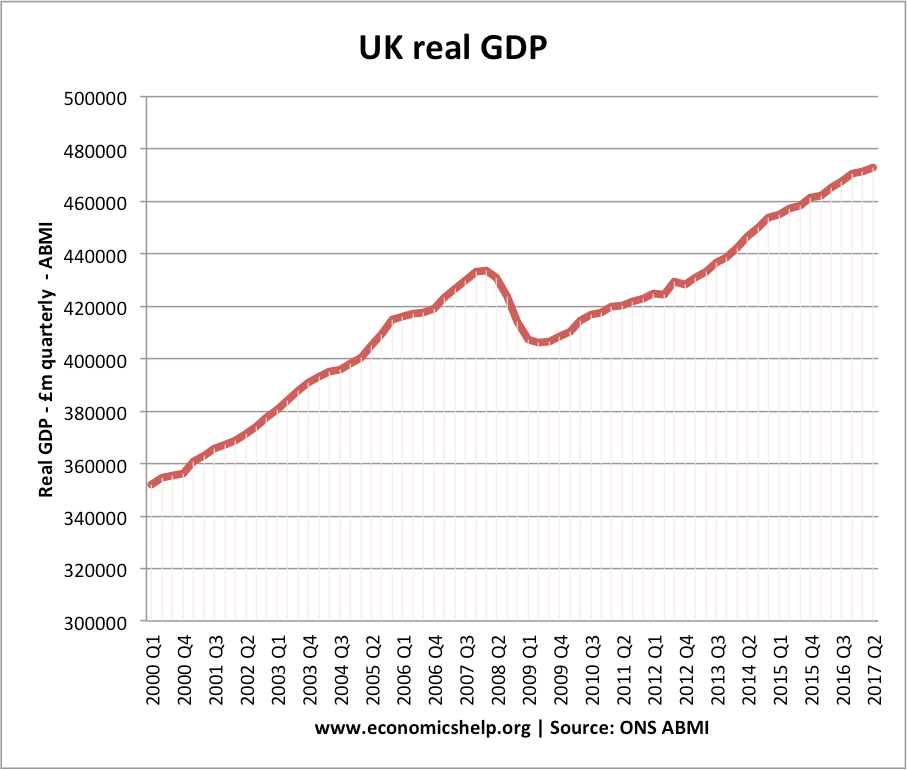
Many criticisms have been made about the GDP but it was simple, came with an apparently exact number, and there was no alternate proposal to take its place. Complaining about something that is bad is useless unless you have something better that people can agree upon to take its place.
Some of the primary criticisms of the GDP as a primary economic index are:
- It leaves out a lot of the economic activity of a country -- probably the majority of activity. It only counts activity where "money" (or economic credit) is transferred from one entity (person, corporation, country, ...) to another. This leaves out all of the work done by "non-paid" workers -- including parenting, "housewives" and "househusbands", inter-generational childcare and other family work (such as within a business or on a farm), and so forth. Think that shouldn't count? Think about how many minutes a country would survive without it.
- The model relies on continued growth. Growth of population, growth of numbers of consumers, growth of production, growth of monetary supplies according to GDP status (a bit circular there), and on and on. This emphasis on growth also pushes the economy towards consumerism and nonrenewable wastage of resources. In a finite world, with finite resources, and the need to protect the environment and economy for future generations, the idea is counter-productive and destructive.
- GDP aggregates the economic transfers within a country. Thus, if one company (or individual) controlled all official economic activity, the GDP could be the same as for a country where economic transfers were spread out equally among all the people within a country. Accurate numbers but largely meaningless in terms of economic health.
- Economic credit transfers is a poor indicator of a country's health by itself. There are many other "soft" factors -- "happiness", income distribution, access to food and water and clean air, and so forth. Thus, you can easily have a strongly positive GDP growth rate in a country in which no one wants to live.
Kate Raworth came up with a model that has limits -- the limits are indicated by an "outer" limit where human activity uses up resources faster than can be renewed and an "inner" limit beyond which human activity cannot achieve the minimum needed to live. These upper and lower limits are expressed as two concentric circles or -- in the shape of a donut (doughnut for some).

One real-life example that has come out of this model is that of reorienting sales from products to services (which is compatible with many business strategies). There is an airport (I believe in Germany) that now pays a company for light -- a certain amount of lumens distributed across certain living areas in the airport. This is instead of paying for light fixtures, light bulbs, and electricity. Thus, since the provider wants to maximize their profits -- it is to their advantage to have the most long-lasting, energy-efficient light production as possible AND to recycle older materials as they are replaced (rather than throw them out). Profits on services makes the provider want to make them as efficient as possible -- and that tends to fit into the donut model better than the continuous growth/consumption GDP model.
Saturday, December 8, 2018
The poor are from Earth; the born rich are from Jupiter
Once upon a time (now over 25 years ago), John Gray wrote a book called "Men are from Mars, Women are from Venus". The primary precept was that most men have very different communication styles, history/usage of words, emotional needs, and modes of behavior from that of most women. Of course, the book was only an abridged version -- the full explanation of such is actually a multi-volume series that competes in length with, or exceeds, a set of the old Encyclopedia Britannica and goes out-of-date within weeks.
Similar to George Washington's "cherry tree", it is highly unlikely that Marie Antoinette ever said "let them eat cake". But the concept that people might not have enough to eat was incomprehensible to her. Food had always just appeared (it was never visibly raised, purchased, transported, or prepared) for her. From the viewpoint of the poor, they felt they were being mocked and could not conceive of anyone being unaware of the pain, and work, needed for daily survival.
Such a clash brought about the French Revolution and earnest use of the guillotine. The disjoint environments of the lowest class from the higher classes in Russia brought about the Bolshevik Revolution (followed by the Communist Revolution). In the United States, being a division of income rather than social class, it brought about the Great Depression.
In an explicit class system (such as Britain, or India, or many other areas) each social class is clearly trained in expectation of their eventual roles. Certain language, and usage, is taught from an early age. Clothing has its clear do's and don'ts and has its own (usually unwritten -- but passed along from generation to generation) appropriateness depending on the situation. Most important, accepted behavior within the social class, as well as accepted behavior between levels of the social classes, are firmly indoctrinated. These social class behaviors and expectations are not directly associated with wealth but the lack of sufficient money can sometimes cause situations where it is difficult to properly meet the expectations of the social class.
Movement between social class levels is very difficult. There is certainly a lot of explicit exclusion ("you cannot interact with them") but much of it is a severe discomfort which results from not having been raised from birth into the sub-societal expectations. Always a "fish out of water" and never fully accepted.
In the case of income classes, movement is possible -- although presently becoming more and more difficult. Once again, however, if a person has never been an active part of an income class, it is a different world for them. We have heard millionaire politicians make statements very parallel to the mythical "let them eat cake" (in particular, not knowing how much a gallon of milk costs, the cost of rent in a local city, or how living costs are paid).
If you have never been involuntarily hungry and have never worried about whether there will be food to eat then it is not a concept that is easily understood. If health care has been always available and never questioned then the idea of others not having health care is not understood. In even more severe form, if one has never even wondered how they have food, clothing, vacations, houses, and so forth then the innate assumption is that is true for everyone. Not only is it difficult them to understand -- but many fall back into the false assumption that "it must be their fault".
Note that people who HAVE moved between income classes ("rags to riches" or "lost everything") can have a direct understanding of those income classes that they have been an active part of. People BORN within an income class have to deliberately self-educate (being part of the Peace Corps for a couple of years might help a lot for the wealthy to have some relevant experience) to understand other income classes.
In the case of democratically elected governmental representatives, it is important to bypass the advertising, and campaign snapshots, and remember that they are there to REPRESENT you -- born millionaires (or born billionaires) will be severely crippled in the ability to understand, and represent, the general non-wealthy masses. Allowing non-representative people to represent the voters is a CHOICE and must be remembered as such. If you want your representatives to represent you, then you must choose people who understand, and have experienced, the problems that they need to address.
Monday, November 19, 2018
Competition -- the good, bad, and the ugly
Competition exists in all aspects of our lives. Sometimes it is not obvious -- which apple looks the best to eat? Do I like the green shirt or the red one? What is my favorite subject in school? Choices involve competition even if the things among which one must choose are not actively competing against each other. In these cases, the choice is usually made by our subconscious acting from our personal histories.
Competition can be eliminated via monopolies -- either regulated or unregulated. An unregulated monopoly is the only source and it can disperse it's products in any way, and at any price, at any usable quality. A regulated monopoly provides the only source but there are outside agencies that determine the parameters of its ability to sell -- quality, price, availability.
Even if there are two or more sources for a product, competition can be avoided if the sources make agreements between themselves about conditions of each of their production and distribution. Splitting the market, agreeing on certain lower limits on price, active sharing of research, and so forth can give an appearance of competition while the reality is just that the market is shared to enable all sources to maximize their profits.
If a product is not wanted, there can be no competition. Of course, most new products start as an unwanted entity in a condition of unregulated monopoly. They now have to persuade people that they want or need the product. This establishes the market and the introducing source can take advantage of their situation to establish their association with the product. Once the market has been established, then competition will appear (unless squashed by the introducing, or largest, company -- suppressing competition legally or illegally).
Each source for a competing product (and the product can be merchandise, services, political candidates, locations, or any other item from which one must make a choice) wants to persuade the buyer that they have the "best" product. Advertising and marketing attempt to create a specific positive perception -- which may, or may not, be in agreement with measurable, and verifiable, qualities.
The grand prize for an advertising/marketing division is to establish a brand such that people will choose according to the brand and only minimally (or not at all) evaluate the qualities of the products. On the scales of evaluation, a positive brand image is a heavy weight on the side of choosing that sources products. This can be reasonable, as brands are established by satisfying people with products on a consistent basis. However, if the brand becomes the only criterion, there is no longer any need of any positive qualities. Eventually, a product that has only brand recognition and is a poor product will lose its brand reputation and effectively have to start over within the market.
During the phase of true competition (no brand loyalty, no monopolies, required by the consumers) between two or more sources, competition can achieve continuous improvement of the products. One source "wins" and the other examines the reasons and improves their product to the point where they start "winning" and then the OTHER source starts improving their product. Once again, this can apply to many different products -- social and business. So, during this phase, there may be a "lesser evil" or "less bad" but making a choice towards that direction still continuously improves the choices from all sources.
Saturday, October 6, 2018
"Normalizing" -- when the abnormal is ignored to emphasize the rest
"Normalization" is spoken of quite a lot these days -- primarily by those criticizing the traditional media. But just what is normalization? Well, not too surprisingly, it is the process of ignoring parts of a person or a situation that would NOT meet the description considered "normal" and emphasizing (usually quite out of proportion to the abnormal portion of the situation or person) what is expected -- or "normal". Distortion of reality -- whether to make it appear "normal" or to make it appear "dangerous" or "oppositional" -- is very dangerous because the reactions that might make sense, if it was real, are normally inappropriate and counter-productive for a distorted reality.
As an instance of description, attributes of a leader might include diplomatic, patient, assertive, charismatic, hard-working, reliable, moral, stable, competent, mature, respectful, logical, eloquent, honest, responsible, sharing of credit, ... It is rare for a leader to have ALL such desired characterizations but -- if someone in the position of leadership has only one or two of these attributes and these are emphasized while the others that they don't have are ignored -- that is "normalization".
The following are a couple of historical examples of the general scenarios where normalization took place. In the first, there is an attempt to make someone, or something, which is quite abnormal seem normal by ignoring that which is not desired. In the second, the abnormal is not ignored but it is ridiculed and minimized (it will become obvious to everyone so it's not something about which to worry). There is a third type where the normalization is used to squeeze someone, or something, back into a stereotype when the story, fully described, actually contradicts the stereotype; going into such an example requires a lot of back-story and, perhaps, might be done in a future blog.
One example from history of the first category concerns that of Benito Mussolini. In 1922, with 30,000 of his "blackshirts", he marched into Rome and declared himself "leader for life" -- that is, totalitarian dictator. He was the leader of the Fascist movement at that time. The press (mostly printed newspapers -- some radio) of the time mostly gave him either neutral or mildly positive coverage. Why? There were two significant factors -- one was that Italy, relatively newly coalesced into a single country, was in turmoil and undergoing both economic and infrastructure chaos. The other is that the U.S., and much of western Europe, was in the midst of the unregulated ultra-capitalism phase which led to the Great Depression. Strong, enforced, control of a chaotic populace seemed to be a generally beneficial thing.
Yet, there were many parts to both Mussolini's personality and political behavior which were strongly against the declared values of the U.S. and western Europe. He strictly controlled the press and dealt severely with any criticism of himself or his actions. He did what he wanted without regard to any existing written, or common, law and often used violent means to eliminate (murder) anyone in direct opposition.These aspects of his rule were rarely reported (Ernest Hemingway and The New Yorker were a couple of exceptions). By leaving these out, Mussolini was presented as a "normal" leader.
Mussolini's contemporary -- and part of the World War II "Axis" -- was Adolph Hitler. His treatment by the media was somewhat different from the positive slant given Mussolini, and is closer to the second form of "normalization". Hitler was able to have some of the positive reactions adhere to him as the "German Mussolini" as he was portrayed as being with him and like him.
However, his actions were so outrageous that the media literally refused to believe them. In addition, they were faced with a situation of a choice between self-censorship and not being able to report at all. This leads to a very important, and difficult, question -- which is more useful -- having to report things that are known to be false or not being able to report at all?
Finally, they kept assuming that the people of Germany would "soon" recognize what an outrageous monster that he was -- but by that time, his control was so firm that anyone who objected to him or his actions was promptly shot or sent to the concentration camps. The majority of Germans was willing to just do whatever they needed to do to survive.
They had moved past the point where the general citizenry could easily stop him -- they had probably passed that point in 1933 when Germany's equivalent of the U.S. Congress -- the Reichstag -- gave Hitler unlimited "emergency" powers to bypass the law via the "Enabling Act". Before that, they could have voted out the Nazi party and restored democracy. Instead, we had World War II and casualties of 50 to 80 million people.
Subscribe to:
Posts (Atom)