Showing posts with label growth. Show all posts

Thursday, February 22, 2024

The Shark Must Move: Investment for the Future


     A shark breathes by having the water flow past its gills so that it can extract oxygen. If it stops moving, fresh oxygenated water does not continue to flow past its gills and it dies. Unless outside factors are supporting them, companies, groups, and individuals must keep moving or they will not prosper. Perhaps they will linger but they will not thrive. 

     Once a company goes public, there are strong expectations. They come from analysts, from stockholders, from a board of directors. Very few of them have the benefit of a long-range view. Tell them that you'll have something amazing in three or four years and they may say "that's nice, what do you have for me now?" Thus, the pressure is steady to accomplish within the short term -- a quarterly viewpoint.

     Within a family, the range of returns stretches out a bit. As long as there is a known goal to be approached and some type of progress, towards that goal, which can be recognized then all is smooth on the front.

    We have three aspects of preparing for the future. First is to understand the goal we wish to approach. Note that a goal must include the definition of a journey but it does not always include a requirement to reach the destination. Perhaps it is an iterative goal and process. Second, we need to commit to doing what is needed to move towards that goal. Third, we need planned activity and movement to go towards that goal. Definition, commitment, movement.

     There is a dream. It may not be reached but it is a direction. My company died because we had no direction of growth beyond providing the best current product and support that we could. That is NOT a bad "mission statement" but it doesn't keep the shark moving. As our market shrank so did the company.

     Doing what you currently do is great for the day to day -- until it isn't. Sometimes a company, or individual, will succeed in being able to just continue to provide small improvements and, if the market remains strong and competition weak, that can keep the shark moving enough to stay alive. But, if the market changes or the competition becomes stronger and better funded, it is not enough and you can only look forward to dwindling results.

     Assume you have decided upon that goal. First living person on Mars perhaps? Are you willing to commit? Will you allocate enough resources to realistically move towards the goal? Resources may include time, money, labor, thought, negotiations, etc. A company may succeed in deciding upon a goal but be so restricted in outlook towards the next quarter's profit and production that there is no true commitment toward any long-term goal. 

     Sometimes people find themselves devoting all their time and energy to staying alive. Just like providing a great product and support, staying alive is devotion to the present and it is NOT a bad thing. But it won't move you towards your goal. "Success stories" are often about people who commit more than they thought they had in order to move towards a goal. Night classes? Writing that great novel in the hour before sunrise each day? Finding a job that allows study during the time one is watching over an incoming queue?

     Commitment is recognition that the future cannot be ignored.

     Having decided upon the direction (recognizing that you might not achieve the final goal) and committing to do what is needed to move towards that goal, you now have to move. Further education? Active networking? Setting aside income for savings? Reducing quarterly dividends to allow for more research and development? Possibly (but not as a first step) your commitment and belief is strong enough that you decide to hasten the accumulation of money by taking out a loan. Many businesses have begun with an extra mortgage on a house (or of the founder's parents' house).

     And if you achieve that goal? Start the process over again. Keep the shark moving.

Wednesday, November 9, 2022

Plan for Success requires a different mindset than planning for problems


     Failure often seems to help itself be planned for -- because it is an ongoing, inevitable process of life. People get sick. Equipment breaks. Contracts are not obtained. Someone drives a car through the front store window. And so forth.

     But, even though we (all) want to achieve success, we rarely explicitly plan for it.

     When a business is starting out, it is a good thing to be "mean and lean". This means that people are putting lots of effort into it with as few people as possible. Many do multiple jobs. When I, and my business partner, started our business, I was Vice President of Engineering, head of client support and training, head of sales support, coordinating head of project development and product management, and I was also in charge of cleaning the restroom when it was necessary. We all worked 60 to 70 hours a week -- because we all had a dream of being able to build something that we could profit from and which would provide a useful societal service.

     At Bell Labs, we had a department head who was a very strong technical person and also had a lot of extra energy. He had been quickly promoted from Member of Technical Staff to manager. While at managerial level, his team did great -- because he did all of the work assigned to his team. He had no managerial, or delegating, skills and he chose to not develop them. He did what he did best -- produce products. Not quite as quickly, he was promoted from manager to department head. And there he stuck. He no longer could do all the work (it was amazing he could do the work of seven people -- 40 people was just too much). He slowly developed some managerial skills -- enough to keep his department from falling apart (and he had some good managers reporting to him) but he had reached the top for him.

     Mean and lean -- until you can't do that anymore. People can work 60 hour work weeks for a while -- but not forever. Putting more wicks on the candle just means the wax will be used up more quickly. Juggling tasks can be done when there's only a bit to be done on each -- past that and things will be dropped.

     The "best" time to plan for growth, and success, is when you aren't in the process of running as fast as you can. If you have to do several different roles, clearly identify them, decide on processes that can be used when you are dealing with much larger amounts. Be prepared to split and expand. Tools that are overkill at the beginning can be indispensable as you grow. When we started our company, we were strong on marketing and sales and technical development. We were weak on management and finances. Management skills we succeeded in developing as we went along -- though I am certain that having good, strong, managers would have greatly helped us to build the company. Finances -- that is what eventually doomed us. We made believe that we knew what we needed to do and when we needed to do it. We didn't.

     The first part of growth, and success, in business is structure and function. The second part is product. We had a great portfolio of products. Well respected in the field. An architecture that expanded and met our needs for more than fifteen years. A general base that we could continue to expand in kind -- until we couldn't. At some point, the market gets saturated or technological directions change. "The shark must keep moving or it dies."

     What did we need to do to succeed in this area? Networking would have been number one. It is vital to know what is actually being deployed, what is being marketed, in the field. You can read about maybes in technical and business magazines but the conferences and market displays is what companies are actually investing in and betting on. Second would be partnerships. They aren't vital -- but they disperse the risk in going after the "next great thing". With partners, perhaps you can have four irons in the fire rather than one or two. It is similar to venture capital. Lose on a couple, break even on a few, and hit a home run on one. It is partially a matter of numbers.

     Finally, luck is still part of the business. Luck, as defined as things happening about which we have no known control. Bet on three possible new product lines. All three can fail. Design a new widget that everyone has been demanding. A major company -- with which you don't have the least chance to compete -- brings out a parallel product three months after your launch. Things happen.

     But you can minimize the risk.


Friday, May 13, 2022

The way you frame goals will mold how you achieve them


     "I want our team to work our hardest and do our best." "I want our team to win the contract." Are these two statements the same thing? I don't think so. There are so many ways a team can win a contract but stating "I want us to win" puts the situation into a win/lose category.

     There are two (probably more) ways for the "win the contract" scenario to come about. The first is that your team wins. The other is that the other team loses.

     There can be a concentration on hoping the other team does things such that they lose and ways to make the other team lose. The focus is a negative one and energy is spent concerning the other team.

     Their lead worker gets hurt, an important paper gets mislaid, your team steals important confidential information from them that gives you an edge, your team gives false information about the other team that influences the purchaser's opinion and decisions, you promise things you cannot fulfill knowing that the other team wouldn't make such promises, and so forth.

     These may be "skills" and "techniques" that you can use many times in the future, but they do not make your team better. They do not make your product better. It may improve your "bottom line" in the short-term but they do not make your team continue to improve for the long haul.

     How about the other way -- "I want our team to work our hardest and do our best." First, it may still end up being a win/lose but it does not preclude the possibility of win/win. Next, how do you achieve these goals? The goals of "working our hardest and doing our best"? You are now concentrating on your own team efforts. That doesn't mean you close your eyes and ears to what the competition is doing -- that is a legitimate part of work. But you are concentrating on your own team. Keeping realistic work/life balance in mind and the reality that overextending is counter-productive, you try to make each 8 hours of work include 8 hours of useful work. And, within that work time, you want to help your team function at their best. People work according to their strengths, overhead is minimized, obstacles are removed, and coordination and communication is made as directly useful as possible.

    You can, of course, substitute in the words appropriate for other competitive situations in life -- personal, business, political, and so on.

     At the end of the period, you will have gotten the contract or not. But if you have worked hard and done your best then you won't have any regrets. You can shake the hands of your competitors, smile, and say "Congratulations. Wait until next time." And sleep well.

Tuesday, April 26, 2022

Weeds: The survival of the inconvenient


     Weeds. What in the world are weeds? They always seem to be disliked -- almost a synonym for unwanted. But what are they really? I would propose that weeds are plants/things that prosper better than other plants/things that we WANT to cultivate.

     People can admire, and enjoy, the benefits of dandelions -- dandelion salads, dandelion wine, dandelion vinegar, dandelion soap, ... But, if you want a yard full of Kentucky bluegrass and, instead, you have half of the yard with little yellow flowers turning into floating seed farms then that is when the definition of "weed" comes into play. We are (many of us, anyway) willing to poison ourselves, and the environment, with glyphosates in order to gain a measure of pretended control over our yards to get rid of that persistent survivor.

     There are the tradeoffs of economics. If you can sell tulips for $100/bushel (I'm making up these numbers) and dandelions are only worth $10/bushel -- IF you can find the appropriate market and transfer the dandelions in fresh enough condition -- then you do what you can to focus your resources on raising tulips and denying the dandelions the right to survive.

     But there may also be the affront to our pride. It is OUR yard and we want that Kentucky bluegrass to run from sidewalk to house. So, when dandelions (and possibly crabgrass, and sand burrs, and thistles, ...) decide to invade, we marshal our resources and try to have our own choice win out in the battle of the yard.

     Note also that those "weeds" -- those undesirably successful plants/things -- may have negative aspects too. In such cases, we might be forgiven our dislike of them. I remember not being able to walk barefoot through the lawn because of the proliferation of sand burrs. Designed to attach to feathers and fur in order to spread throughout the universe, they don't feel that good to bare feet.

     When we want to plant a particular crop in a field, the first step is to clear out everything that existed there before -- which was probably a viable ecology built up over time to live the best for the environment -- both weather and varieties of plants and animals that existed in that area. We do our best to eliminate all of the old and that which continues to survive, we call "weeds".

     The same can happen within societal and business cultures. We want to change an aspect of that culture -- eliminate past biases or practices, change orientation of business development, change to a different product line, allow for change in business needs or circumstances, etc. And the old culture will continue to permeate, with old behaviors and attitudes popping back up.

     Within a different, perhaps older, culture those would be acceptable but, within the desired modified culture, they are "weeds". If there is a commitment to the new, then the old must be pruned if they cannot be modified. In their time, they were acceptable and appreciated -- remember that when pruning and modifying.

Thursday, March 18, 2021

Structures: Scaffolds for growth


     For many startups, the total rule is "lean, green, mean". Do what you most need to do, as fast as you can, with as little excess, or non-mandatory, work as possible. When I was co-founder of our company, it was not unusual to be working 80-hour weeks. We knew what we had to produce and we had a few methods to try to get it into the hands of people who would pay us for them. (We soon needed to expand that "marketing and sales" aspect of the business.)

     That is the basics of trade in a nutshell -- produce what is of value to others who will give back things of value to you.

     That works in a barter economy as well as in an industrialized, capitalistic, economy. It is also true within other viable economic systems. As the business, or economy, or government, grows it can often end up "abstracted" where it is difficult to say exactly what things of value are being exchanged.

     Leap ahead and start imagining a business that has thousands of people working to provide tens of thousands of things of value and having to keep track of a hundred thousand purchases and transactions. If it all works smoothly then it could be done in the same manner as when the trade was just between you and someone else -- that simple, basic, barter agreement.

     But this is reality. There are few one-to-one relationships between any person and any proceeding from start to finish. Person A does one part to process C and Person B does something different to process G which directly influences process C but A has no direct visibility to process G.

     Confusing? Absolutely. And this is still only a very simple situation. There needs to be some type of documentation -- method of communication -- between Person B and Person A that provides insight into relevant aspects of Process G without inundating Person A with all of the other knowledge and systems that Person B is handling.

     So, simple transactions have need of simple processes. High numbers of interrelated transactions, people, and processes have need of much better access to, and keeping track of, relevant information. How do you succeed in growing the business from simple to complex?

     The base answer is "structures" which can be loosely defined as ways to organize information about what is being done, (who/what/when/where/why) by the people who originate the information, to have it accessible to those who need to know that information. The other leg is "processes" -- which is involved with how that information is processed, saved, distributed, and otherwise not lost in the cascading effects of a successful large business.

     Processes can (and do) make use of various apps and programs. But without structures, the processes cannot do much of anything because they don't have the data with which to use those processes. Also, processes differ with every aspect of the business. A process for generating ideas. A process for estimating, and keeping track of, work. A process for manufacturing inventory and supply control chains. And so forth. But all of the processes rely on structures.

     The primary importance of determining just what information is needed for the business is that it remains approximately the same no matter how large the company gets. (Yes, as a business reaches certain growth points, new regulations may come into play.) This facilitates growth. The information has to be there but, when the company is small, it can be retained within various people's memories. Just like it seems to be true to a teenager, all employees of a startup are deemed to be immortal and those valuable data are always available.

     Absurd? Certainly. But it is so very easy to eliminate those items, that seem to not immediately affect the bottom line, when you are small, focused, and overworked. Resist. The data can be written on a large notepad or, for transitory data, on a white board. But get it written down. As the company grows, you are going to run out of room on those notepads or they will become too many to search through easily. So, you develop (or obtain) new processes and applications that help you to manage that data. But you already are used to getting, and documenting, that data. You are prepared for growth.


Sunday, January 6, 2019

Economic reevaluation: From GDP to the donut


     The Gross Domestic Product (GDP) has been maintained as the holy grail of the world of economic evaluation for around 75 years, since it was given a modern definition by Simon Kuznets in 1934 and then adopted as the primary method for measuring a country's economy at the Bretton Woods conference in 1944. Even as Kuznets was making use of the term, he warned against overusing it and making it more important than it really was.
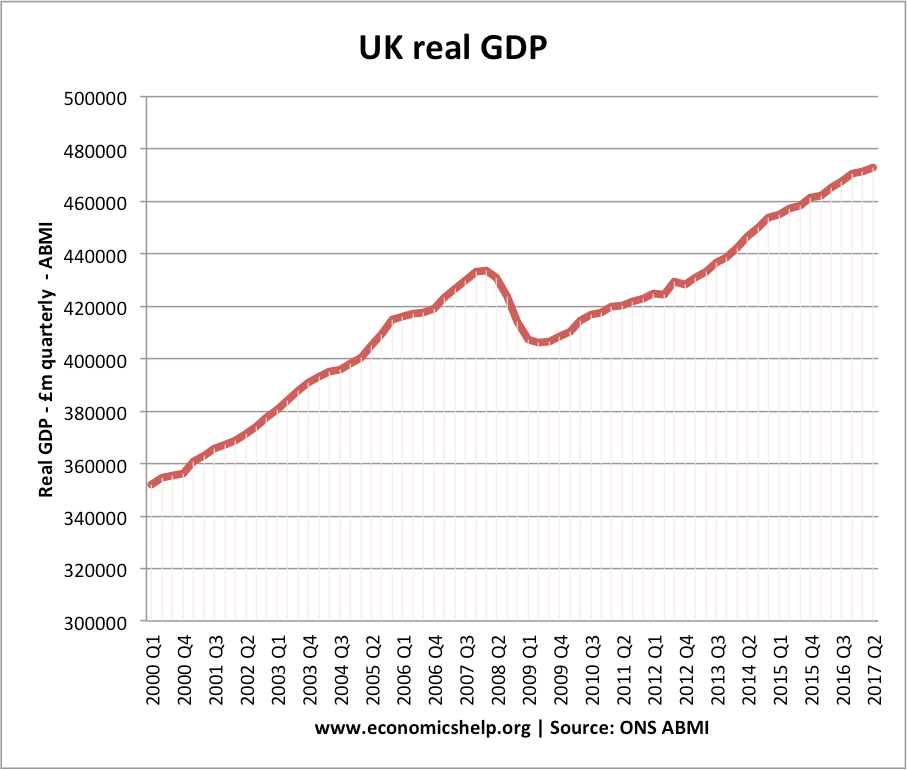
     Alas, humans often prefer to take the easy route rather than more troublesome, but more accurate, methods. Thus, the GDP -- which was relatively straight-forward (although requiring huge masses of data) to calculate became the primary indication of a country's economic health. An increasing GDP was "good", rapidly increasing GDP was "better" and a stagnant, or decreasing, GDP was "bad". An example of such a graph follows ("real" GDP compensates for inflation and graphs according to a certain monetary index at a fixed period of time):


     Many criticisms have been made about the GDP but it was simple, came with an apparently exact number, and there was no alternate proposal to take its place. Complaining about something that is bad is useless unless you have something better that people can agree upon to take its place.

Some of the primary criticisms of the GDP as a primary economic index are:
  1. It leaves out a lot of the economic activity of a country -- probably the majority of activity. It only counts activity where "money" (or economic credit) is transferred from one entity (person, corporation, country, ...) to another. This leaves out all of the work done by "non-paid" workers -- including parenting, "housewives" and "househusbands", inter-generational childcare and other family work (such as within a business or on a farm), and so forth. Think that shouldn't count? Think about how many minutes a country would survive without it.
  2. The model relies on continued growth. Growth of population, growth of numbers of consumers, growth of production, growth of monetary supplies according to GDP status (a bit circular there), and on and on. This emphasis on growth also pushes the economy towards consumerism and nonrenewable wastage of resources. In a finite world, with finite resources, and the need to protect the environment and economy for future generations, the idea is counter-productive and destructive.
  3. GDP aggregates the economic transfers within a country. Thus, if one company (or individual) controlled all official economic activity, the GDP could be the same as for a country where economic transfers were spread out equally among all the people within a country. Accurate numbers but largely meaningless in terms of economic health.
  4. Economic credit transfers is a poor indicator of a country's health by itself. There are many other "soft" factors -- "happiness", income distribution, access to food and water and clean air, and so forth. Thus, you can easily have a strongly positive GDP growth rate in a country in which no one wants to live.
     As mentioned above, one objection to discarding the GDP as a primary economic indicator has been the lack of anything "better" to take its place. In this case, "better" means something that, at the least, takes into account the above criticisms of the GDP model.
     Kate Raworth came up with a model that has limits -- the limits are indicated by an "outer" limit where human activity uses up resources faster than can be renewed and an "inner" limit beyond which human activity cannot achieve the minimum needed to live. These upper and lower limits are expressed as two concentric circles or -- in the shape of a donut (doughnut for some).


     So, what does it mean to have a new model? Will this new model solve all of the world's problems? No. However, in order to THINK about a situation, or an idea, it is very useful to have a visualization of the concept. A person must have words, or some other representation (such as images), to properly manipulate an idea.
     One real-life example that has come out of this model is that of reorienting sales from products to services (which is compatible with many business strategies). There is an airport (I believe in Germany) that now pays a company for light -- a certain amount of lumens distributed across certain living areas in the airport. This is instead of paying for light fixtures, light bulbs, and electricity. Thus, since the provider wants to maximize their profits -- it is to their advantage to have the most long-lasting, energy-efficient light production as possible AND to recycle older materials as they are replaced (rather than throw them out). Profits on services makes the provider want to make them as efficient as possible -- and that tends to fit into the donut model better than the continuous growth/consumption GDP model.

Smoke Gets in Your Lungs (updated)

     This is an article that I published in here on February 22, 2013. I try to make my articles “timeless” as I try to work with “foundatio...