Showing posts with label energy savings. Show all posts

Friday, November 20, 2020

Secondary effects: don't stop before the hows and whys


      When I am buying an oven, I look over the "self-cleaning" ovens. Why? It really isn't that much trouble to clean an oven (though my preference is to avoid the harsher chemicals which make it the easiest to do). Self-cleaning ovens do it by allowing very high (higher than most cooking is done at) temperatures to burn away drips and spills and leave only ash and easily cleaned residue. In order to do this, it is necessary that the oven walls be durable against both extreme heat and changes in temperature. It is also necessary to have good insulation around the oven so that the surrounding cabinetry does not catch fire or otherwise be damaged.
     So, I don't care that strongly about an oven being able to self-clean. But the characteristics of a self-cleaning oven -- the insulation and solidity of the oven walls -- provide energy saving side effects, and a more uniform internal heat, that I DO want.
     I am not a personal fan of cosmetics, preferring the unmodified beauty that exists in almost all people. But, since cosmetics are often applied in the same areas that also need protection from the sun, they can be modified to provide the Sun Protection Factor (SPF) that is useful to prevent aging, and damage, of the skin. Note that, in this case, the side effect is deliberate -- as normal cosmetics have rather low sun blocking capabilities.
     Back in 2017, Neil deGrasse Tyson, for whom I have great respect as a scientist and as an advocate of science, decided to put in his oar concerning the value and/or potential problems of Genetically Modified Organisms (GMOs). His bottom line was simple -- we've been modifying the genetics of plants and animals for thousands of years -- there is no reason to be afraid of them now. The larger science associations agree with him -- American Association for the Advancement of Science as well as the National Academy of Sciences and the European Commission,
     While I have disagreements about modern GMO creations being in the same category as those in the older traditions of hybridization and selective breeding and other "natural" methods -- I will not claim to have the scientific knowledge or backing to argue against the general safety of GMOs. Note, I still say "general" -- I still think that proper testing should be done against all foods, medications, and other items that will come into either internal, or external, contact with our bodies.
     But, the investigation of Neil deGrasse Tyson stops too soon. To the best of my knowledge, he never went further into the "why" of GMOs and the potential dangers posed by that.
     There are many reasons why a zygote may be genetically modified. Perhaps the manipulator wants to make the food tastier, or more resistant to grasshoppers, or larger, or have a greater percentage of protein produced. All good reasons (though some other qualities may degrade when one quality is improved). But many food crops are presently being modified primarily for the purpose of being able to better survive applications of herbicides and pesticides. In that way, an herbicide can be applied (perhaps rather heavily) to a food crop and it will survive while the "weeds" (undesired thriving plants) cannot.
     So, on a first order, perhaps the GMO crops pose no danger to people eating them. But, on a second order, the modifications are often done to allow large amounts of pesticides and herbicides to be used -- which ARE, by definition, harmful to living organisms. In particular, glyphosate-based pesticides, considered to have quite bad effects on people, are banned in many parts of the world. Glyphosates have been found in (relatively) large amounts in human and other tissues.
     I am sure that you can think of other examples where one needs to go beyond the "what" to the "why". Or go beyond the "what" to the "how". We often think of side-effects as not predicted -- but sometimes the side-effects are the primary long-term effects of a process. This can apply to physical products, software, business, or social interactions.

Sunday, January 6, 2019

Economic reevaluation: From GDP to the donut


     The Gross Domestic Product (GDP) has been maintained as the holy grail of the world of economic evaluation for around 75 years, since it was given a modern definition by Simon Kuznets in 1934 and then adopted as the primary method for measuring a country's economy at the Bretton Woods conference in 1944. Even as Kuznets was making use of the term, he warned against overusing it and making it more important than it really was.
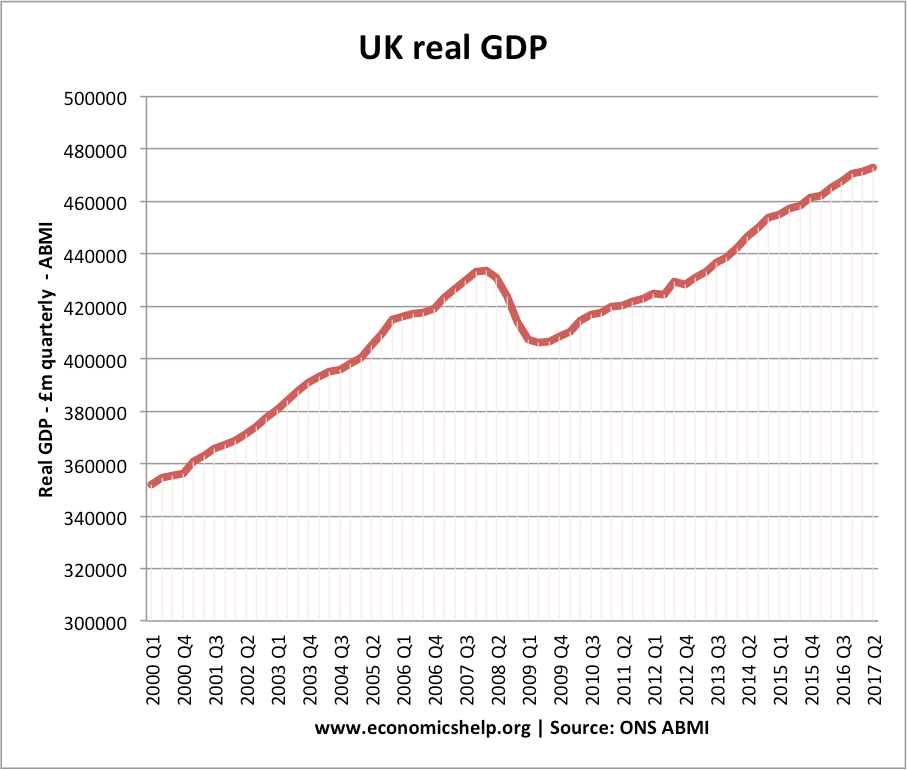
     Alas, humans often prefer to take the easy route rather than more troublesome, but more accurate, methods. Thus, the GDP -- which was relatively straight-forward (although requiring huge masses of data) to calculate became the primary indication of a country's economic health. An increasing GDP was "good", rapidly increasing GDP was "better" and a stagnant, or decreasing, GDP was "bad". An example of such a graph follows ("real" GDP compensates for inflation and graphs according to a certain monetary index at a fixed period of time):


     Many criticisms have been made about the GDP but it was simple, came with an apparently exact number, and there was no alternate proposal to take its place. Complaining about something that is bad is useless unless you have something better that people can agree upon to take its place.

Some of the primary criticisms of the GDP as a primary economic index are:
  1. It leaves out a lot of the economic activity of a country -- probably the majority of activity. It only counts activity where "money" (or economic credit) is transferred from one entity (person, corporation, country, ...) to another. This leaves out all of the work done by "non-paid" workers -- including parenting, "housewives" and "househusbands", inter-generational childcare and other family work (such as within a business or on a farm), and so forth. Think that shouldn't count? Think about how many minutes a country would survive without it.
  2. The model relies on continued growth. Growth of population, growth of numbers of consumers, growth of production, growth of monetary supplies according to GDP status (a bit circular there), and on and on. This emphasis on growth also pushes the economy towards consumerism and nonrenewable wastage of resources. In a finite world, with finite resources, and the need to protect the environment and economy for future generations, the idea is counter-productive and destructive.
  3. GDP aggregates the economic transfers within a country. Thus, if one company (or individual) controlled all official economic activity, the GDP could be the same as for a country where economic transfers were spread out equally among all the people within a country. Accurate numbers but largely meaningless in terms of economic health.
  4. Economic credit transfers is a poor indicator of a country's health by itself. There are many other "soft" factors -- "happiness", income distribution, access to food and water and clean air, and so forth. Thus, you can easily have a strongly positive GDP growth rate in a country in which no one wants to live.
     As mentioned above, one objection to discarding the GDP as a primary economic indicator has been the lack of anything "better" to take its place. In this case, "better" means something that, at the least, takes into account the above criticisms of the GDP model.
     Kate Raworth came up with a model that has limits -- the limits are indicated by an "outer" limit where human activity uses up resources faster than can be renewed and an "inner" limit beyond which human activity cannot achieve the minimum needed to live. These upper and lower limits are expressed as two concentric circles or -- in the shape of a donut (doughnut for some).


     So, what does it mean to have a new model? Will this new model solve all of the world's problems? No. However, in order to THINK about a situation, or an idea, it is very useful to have a visualization of the concept. A person must have words, or some other representation (such as images), to properly manipulate an idea.
     One real-life example that has come out of this model is that of reorienting sales from products to services (which is compatible with many business strategies). There is an airport (I believe in Germany) that now pays a company for light -- a certain amount of lumens distributed across certain living areas in the airport. This is instead of paying for light fixtures, light bulbs, and electricity. Thus, since the provider wants to maximize their profits -- it is to their advantage to have the most long-lasting, energy-efficient light production as possible AND to recycle older materials as they are replaced (rather than throw them out). Profits on services makes the provider want to make them as efficient as possible -- and that tends to fit into the donut model better than the continuous growth/consumption GDP model.

Thursday, August 13, 2009

Smart plugs, dumb plugs, and dumb designs


I read a lot of emails, and articles in the magazines I read, about the next way to save electricity.

Some of these are related to the problem of passive power loss. This occurs when an electrical appliance is plugged in but is not actively in use. If designed well, then they will not use any power when they are turned off -- but what is off?

Any device that can be turned on by a remote is not completely without power. Any device that maintains an active clock (not powered by batteries) is not completely without power. And, in today's world, that makes up a large percentage of the electrical devices in our houses.

A "smart" electrical strip is designed to have one unit on a power monitoring circuit. The remaining outlets are triggered to provide power only if the monitored outlet starts consuming electricity beyond a certain level. For example, a television might be plugged into the monitored outlet. When it is "off", it only requires a certain level of power but, when on, it greatly increases the electricity needed. At this point, the other outlets become active. A DVD player, for example, might be plugged into a "client" outlet and the television into the monitored outlet. Until the television is turned on, no power is given to the DVD player (and the remote will not work with it).

Unfortunately, this is very limited in its uses. A DVR cannot be plugged into a client outlet because it runs timed events (an active clock). Same is true with a VCR. It MIGHT be useful with an amplifier or receiver but not with a satellite receiver which requires passive checks for updates of data over the phone lines. Every potential scenario must be carefully examined.

I purchased a "Kill-A-Watt" power monitor via a "Gold sale" on amazon.com. It seems to be designed well (with a few not-too-important caveats) but I have been unsuccessful in tracking down the largest electrical uses within the house. I thought that my study -- with four computers, a printer, LAN, and quite a few other individual devices (such as hard drives and powered disk readers) was surely the culprit. But it wasn't -- so the "Kill-A-Watt" was useful to disprove that. I now believe that the main drains are the pool pump and the house fans -- usually direct wired and often badly inefficient and expensive to replace.

So, how to reduce electricity use? Unplug those items not in use (some DO use power even when "off"). Run as many items though an Uninterruptible Power Supply (UPS) as possible in a study -- a UPS will act as a buffer for items on reduced power demand. Reduce the number of internal clock devices. Keep the lights off when not in use. Use fans that have energy star ratings if possible -- and keep energy use in mind when purchasing new items.

Smoke Gets in Your Lungs (updated)

     This is an article that I published in here on February 22, 2013. I try to make my articles “timeless” as I try to work with “foundatio...