The economy, whether for a household, a country, or the world, is a game with money as the tokens. Granted, it is a very serious game where the losers may lose their lives, in addition to anything else they possess, without “extra lives” or the ability to reset the game. Some people treat it ONLY as a game and forget that most of the players are everyday people. As a game, it becomes extremely important, and dangerous, when the great majority of the tokens are available only to a few people. Those people have learned to manipulate the rules of the game to take advantage of them for personal triumph but their goal is incorrect and deadly. The proper goal for an economy is to maximize the ability of ALL the people to participate.
An overview of an economy
As I wrote about in 2014, money is an abstraction of resources and energy. At the very foundation, the basis is about the things that you directly interact with — eat, drink, feel comfort, enjoy, and so forth. The larger the community, the more specialization that occurs and the more abstract money becomes.
There is a “spider web” that casts out from the specific item to foundational societal, and personal, uses. For example, getting a screwdriver involves a store, sales people, sales environment, stockers, distributors, manufacturers, parts manufacture and assembly, and raw material sourcing. Once upon a time, during a Google interview, I proposed that a tool that worked with the interactions of all such ladders could be of great use for planners and the economy. It could help to answer such questions as “how does moving the economy from private automobiles to public transportation affect jobs?” “How does moving from fossil fuels to renewable energy affect jobs?” Nowadays, the question might be “How will GenAI affect jobs?” but we may not know enough to be able to be sufficiently specific in our questions. GenAI, itself, might be able to do the interconnections but, first, it requires the data.
A part of the economy that hits most of us week on week is income. One of my sons has gotten a job which does NOT use his bachelor’s degree in Computer Science. It is in a deli for a local grocery store. It is a good company, good people, and the work is work that he does well and for which he is appreciated. But, he is already in the work by the week, counting until the weekend (for him, that is Wednesday and Thursday). In spite of his B.S. and six years as a coordinator at a grocery store in Maryland, he is making minimum wage which is not quite enough to meet his desires to leave home and be on his own. (However, it is better in the state of Washington than many others.) He is definitely not alone. Other forms of income are interest and dividends but those are usually something that exists for older workers or those that come from wealthy families.
His outgo is like most of ours. Living within the family household, he doesn’t face the corset of a true budget yet but he does know he must live within his means and he has tasted the stock market and wishes to dive back in. For others, not in his situation, they have a “most important first” budget which often does not quite include things most feel are normal. For the rich, and mega-rich, outgo is not really of any importance. All required things are just bloops upon the income/outgo stream. For most of us, the outgo must be monitored closely to not exceed the income. Sometimes we don’t succeed.
The tokens of the game circulate. The true foundation lies with the material world. That includes food, raw materials, and infrastructure. Without them, the economy would collapse quickly. Other things that we now consider “necessary” for everyday life truly are not although our reliance on the digital economy could indeed crash everything with a few dozen strategically located electromagnetic pulses (EMPs).
The parts of the economy associated with taxes
“The only things certain are death and taxes”. Just what are taxes and why are they so ubiquitous? Taxes are an allocation of resources for local or national group usage. There are many services that are common worldwide for people to pool resources (often via taxes) to serve the general populace. Such areas include infrastructure (roads, electrical networks, dams and reservoirs, water treatment plants, sewage treatment). Sometimes these are subscription services where individuals, who are willing to do so, pay for service. But, since they are for the common good, they are more often public services paid for by taxes. Can you imagine the situation if only 60% of the community decided to subscribe to waste services? It would leave 40% of the waste lying around causing health problems for everyone — possibly even another Black Death or other epidemic.
Other services, often paid for by taxes, include improvement of life areas. These may include police service, fire fighting service, libraries. These have a more haphazard payment situation however if (for example) fire fighting was a subscription service then a fire occurring to your next-door neighbor’s house would endanger your own house (and others) if you had private insurance and they had none. It is safer for the community if fire fighting is available for all people and all property. Perhaps you might say “I never use the library, why should my taxes be used to pay for it?” Perhaps you don’t, personally, make use of it but the fact that it is available to your neighbors helps to reduce juvenile delinquency, general unemployment, community estrangement, and social malaise. In other words, your community is healthier.
National taxes are traditionally used for national services. These include infrastructure that helps transportation from community to community (airports, roads, etc.). It also includes “defense” spending which should be used almost totally for protection of the general citizenry. There is a category of social spending that involves bringing in taxes and then redistributing them according to needs. Retirement and associated disabled benefits is another community support that is spread back among communities. Finally, an increasing expense is interest which is paid on debt owed by the national government to pay out on the budget.
The national budget, very simply, is a matter of money in and money out. It has been very popular over the past 40 years to pursue the fantasy of “trickle down”. This has led to a general lowering, and flattening, of income into the treasury without corresponding reduction of outgo to non-social services (such as defense). Note that social services such as “food stamps” are such a small portion of the budget that, even if politically appealing, they don’t really make much of an impact to the budget.
One can look at the budget deficits over the years and recognize that those yearly deficits continue to accumulate into our national debt.
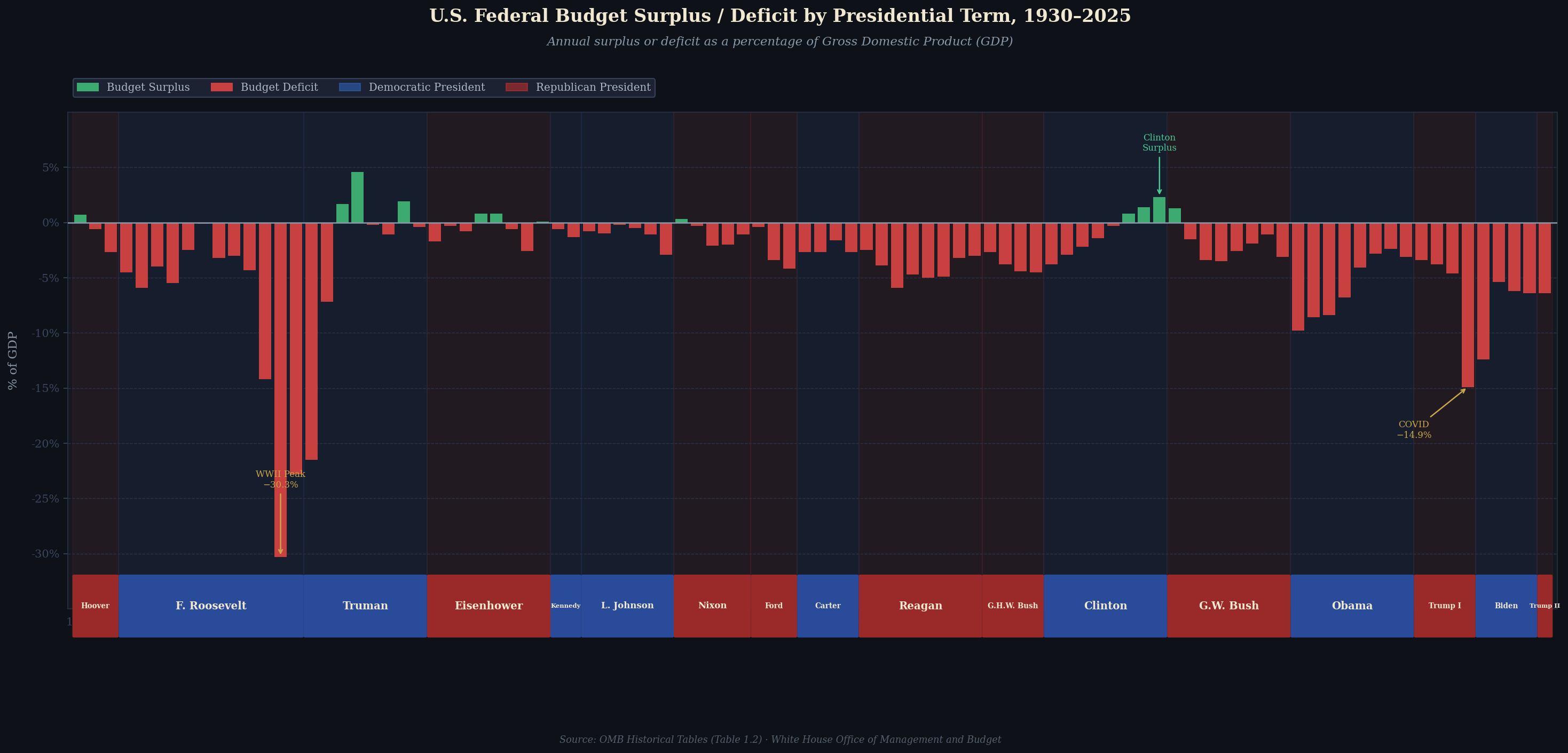
The three biggest deficits shown (in order) occurred for WWII, the COVID pandemic, and the “Great Recession”.
Money, as a resource, must keep in motion to be useful.
Money has many attributes similar to that of physical resources such as water or air. As a representation of resource, it must be distributed and redistributed to keep the economy healthy.
“Trickle-down” creates dams and spill over which don’t serve the purpose of circulating money through the economy. Having lots of people able to afford other people’s services and products is what keeps money circulating. That cannot happen if it is jammed up into the pockets of a few.
Repeating some of the information from the old blog/newsletter. Money started when society outgrew barter. During barter, some type of conversion rate was agreed upon. One dozen eggs equals one fish. A cord of firewood equals one yard of woven fabric. Once the group of people grew larger, it had to be abstracted as someone who could provide a wall hanging might not need, or want, two cords of firewood. The conversion/barter rate needed to be converted into tokens which eventually became coins and money. It was the ability to easily transfer the coins that established the basic mechanisms of money and an economy.
Without movement of the money, the economy gets stuck and no longer is healthy and able to fulfill its purpose.

