Showing posts with label money pool. Show all posts

Thursday, June 4, 2026

The economy: A set of interconnections

     The economy, whether for a household, a country, or the world, is a game with money as the tokens. Granted, it is a very serious game where the losers may lose their lives, in addition to anything else they possess, without “extra lives” or the ability to reset the game. Some people treat it ONLY as a game and forget that most of the players are everyday people. As a game, it becomes extremely important, and dangerous, when the great majority of the tokens are available only to a few people. Those people have learned to manipulate the rules of the game to take advantage of them for personal triumph but their goal is incorrect and deadly. The proper goal for an economy is to maximize the ability of ALL the people to participate.

An overview of an economy

     As I wrote about in 2014, money is an abstraction of resources and energy. At the very foundation, the basis is about the things that you directly interact with — eat, drink, feel comfort, enjoy, and so forth. The larger the community, the more specialization that occurs and the more abstract money becomes.

     There is a “spider web” that casts out from the specific item to foundational societal, and personal, uses. For example, getting a screwdriver involves a store, sales people, sales environment, stockers, distributors, manufacturers, parts manufacture and assembly, and raw material sourcing. Once upon a time, during a Google interview, I proposed that a tool that worked with the interactions of all such ladders could be of great use for planners and the economy. It could help to answer such questions as “how does moving the economy from private automobiles to public transportation affect jobs?” “How does moving from fossil fuels to renewable energy affect jobs?” Nowadays, the question might be “How will GenAI affect jobs?” but we may not know enough to be able to be sufficiently specific in our questions. GenAI, itself, might be able to do the interconnections but, first, it requires the data.

     A part of the economy that hits most of us week on week is income. One of my sons has gotten a job which does NOT use his bachelor’s degree in Computer Science. It is in a deli for a local grocery store. It is a good company, good people, and the work is work that he does well and for which he is appreciated. But, he is already in the work by the week, counting until the weekend (for him, that is Wednesday and Thursday). In spite of his B.S. and six years as a coordinator at a grocery store in Maryland, he is making minimum wage which is not quite enough to meet his desires to leave home and be on his own. (However, it is better in the state of Washington than many others.) He is definitely not alone. Other forms of income are interest and dividends but those are usually something that exists for older workers or those that come from wealthy families.

     His outgo is like most of ours. Living within the family household, he doesn’t face the corset of a true budget yet but he does know he must live within his means and he has tasted the stock market and wishes to dive back in. For others, not in his situation, they have a “most important first” budget which often does not quite include things most feel are normal. For the rich, and mega-rich, outgo is not really of any importance. All required things are just bloops upon the income/outgo stream. For most of us, the outgo must be monitored closely to not exceed the income. Sometimes we don’t succeed.

     The tokens of the game circulate. The true foundation lies with the material world. That includes food, raw materials, and infrastructure. Without them, the economy would collapse quickly. Other things that we now consider “necessary” for everyday life truly are not although our reliance on the digital economy could indeed crash everything with a few dozen strategically located electromagnetic pulses (EMPs).

The parts of the economy associated with taxes

     “The only things certain are death and taxes”. Just what are taxes and why are they so ubiquitous? Taxes are an allocation of resources for local or national group usage. There are many services that are common worldwide for people to pool resources (often via taxes) to serve the general populace. Such areas include infrastructure (roads, electrical networks, dams and reservoirs, water treatment plants, sewage treatment). Sometimes these are subscription services where individuals, who are willing to do so, pay for service. But, since they are for the common good, they are more often public services paid for by taxes. Can you imagine the situation if only 60% of the community decided to subscribe to waste services? It would leave 40% of the waste lying around causing health problems for everyone — possibly even another Black Death or other epidemic.

     Other services, often paid for by taxes, include improvement of life areas. These may include police service, fire fighting service, libraries. These have a more haphazard payment situation however if (for example) fire fighting was a subscription service then a fire occurring to your next-door neighbor’s house would endanger your own house (and others) if you had private insurance and they had none. It is safer for the community if fire fighting is available for all people and all property. Perhaps you might say “I never use the library, why should my taxes be used to pay for it?” Perhaps you don’t, personally, make use of it but the fact that it is available to your neighbors helps to reduce juvenile delinquency, general unemployment, community estrangement, and social malaise. In other words, your community is healthier.

     National taxes are traditionally used for national services. These include infrastructure that helps transportation from community to community (airports, roads, etc.). It also includes “defense” spending which should be used almost totally for protection of the general citizenry. There is a category of social spending that involves bringing in taxes and then redistributing them according to needs. Retirement and associated disabled benefits is another community support that is spread back among communities. Finally, an increasing expense is interest which is paid on debt owed by the national government to pay out on the budget.

     The national budget, very simply, is a matter of money in and money out. It has been very popular over the past 40 years to pursue the fantasy of “trickle down”. This has led to a general lowering, and flattening, of income into the treasury without corresponding reduction of outgo to non-social services (such as defense). Note that social services such as “food stamps” are such a small portion of the budget that, even if politically appealing, they don’t really make much of an impact to the budget.

     One can look at the budget deficits over the years and recognize that those yearly deficits continue to accumulate into our national debt.
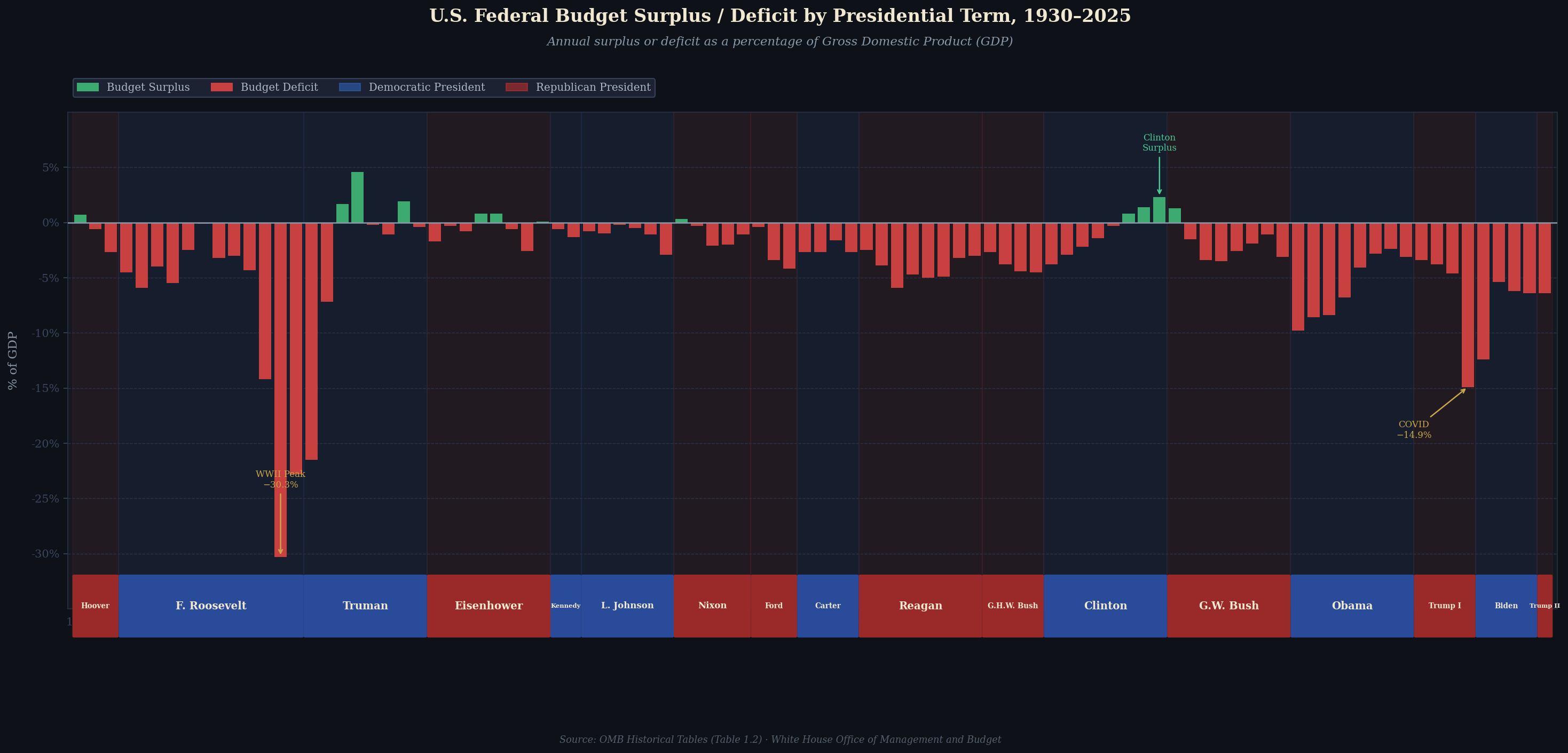
The three biggest deficits shown (in order) occurred for WWII, the COVID pandemic, and the “Great Recession”.

Money, as a resource, must keep in motion to be useful.

     Money has many attributes similar to that of physical resources such as water or air. As a representation of resource, it must be distributed and redistributed to keep the economy healthy.

     “Trickle-down” creates dams and spill over which don’t serve the purpose of circulating money through the economy. Having lots of people able to afford other people’s services and products is what keeps money circulating. That cannot happen if it is jammed up into the pockets of a few.

     Repeating some of the information from the old blog/newsletter. Money started when society outgrew barter. During barter, some type of conversion rate was agreed upon. One dozen eggs equals one fish. A cord of firewood equals one yard of woven fabric. Once the group of people grew larger, it had to be abstracted as someone who could provide a wall hanging might not need, or want, two cords of firewood. The conversion/barter rate needed to be converted into tokens which eventually became coins and money. It was the ability to easily transfer the coins that established the basic mechanisms of money and an economy.

     Without movement of the money, the economy gets stuck and no longer is healthy and able to fulfill its purpose.

Ideas & Interpretations is a reader-supported publication. To receive new posts and support my work, consider becoming a free or paid subscriber. Posts are free and will continue to be free but paid subscriptions will help to maintain my momentum.

Saturday, February 21, 2015

A Living Wage : it's not that difficult to figure out


    It used to be that discussion was about the "minimum" wage. That was always a difficult discussion because it is totally subjective. If a person is starving and you agree to give them a sandwich and a glass of water if they work for you for eight hours then it is a minimum wage (anything less and they would die and be unable to do the work). Then there is the official "minimum" wage -- which is completely fictitious. People are paid less than the minimum wage all the time -- sometimes legally and sometimes not but it definitely is not the least amount of money people are paid.

    However, when we come to the concept of the "living" wage, it is really easy. One thing to recognize up front is that there is not a single living wage. A living wage will depend upon the expectations within a society. It will depend upon the general cost of living in the area. It will depend on individual circumstances -- do you have children or others dependent upon you, do you have additional needs that others do not have (blind, deaf, mobility impaired, ...), and so forth.

    So, there is not a single living wage for all people. But it is easy to determine. Add up the costs of everything it is needed to live over a year and divide that by the number of hours that are considered reasonable in your society. Let's put together a case example for an "average" city in the U.S.

    There are a number of categories that MOST people would agree on. There are also a number of other categories that people would not agree on (is a phone required? is recreation required? is television required? is air conditioning really needed? is a personal car required? is it necessary to be fashionable? ...) Minimum requirements will include such as:


  • Shelter
  • Utilities (water, heat, sewage, power)
  • Food
  • Clothing
  • Health-related Costs (incl. toothbrushes, toilet paper, clothes washing, etc.)


    There's a certain range within each category that is required. Sometimes you might find a great deal on an apartment (or live with your parents). Sometimes you can find used clothing that is acceptable. Specific numbers can definitely be argued about and I won't say that you're incorrect. However, here are some (not the only) realistic numbers.


  • Shelter -- a studio apartment; $900/month -- $10,800/year
  • Utilities -- basics for a small apartment; $100/month -- $1200/year
  • Food -- for one person, no fast food, no eating out; $8/day, $250/month -- $3000/year
  • Clothing -- 3 pairs of pants, 2 underwear, 4 shirts, 5 pairs of socks, 1 pair of shoes, 1 coat -- $200/year
  • Health-related Costs -- [# taken for an Affordable Cost policy for an unemployed single person] -- $340/month plus $40/month for medications/co-pays;  approx. $4500/year.


   This totals $19,760 for a year. For simplicity, round it up to $20,000. If we assume that working a 40-hour week for 50 weeks/year is reasonable then that is 2,000 hours. So, a "living wage" for a person with no special needs is $10/hour NET. I emphasize NET because this is what they have to have in order to pay for it all. If they have to pay country/local taxes or union dues or anything then that is added to the NET requirements.

    So, we have determined a "living" wage. Even assuming that you agree with the above estimates the numbers can be moved around. If you qualify for food stamps, you might reduce your needs for food. If you can get subsidized housing, you might pay $500/month. But the foundation needs stay the same. Note also that there are no costs for childcare listed -- this is for a single person with no additional needs.

    But society cannot afford to pay such!!! This is the statement that is echoed by businesses and wealthy politicians. It the next blog (hopefully -- I get distracted ) I will discuss the realities of paying living wages.

    Meanwhile, what things do you consider needed to live? Do you currently live on less? How do make it happen?

Monday, December 29, 2014

Money as Energy: Increasing the pool of money


    In the previous post, I talked about how money is basically an abstraction of the combination of resources, labor, and energy. We are fortunate that we do, presently, have more than adequate amounts of each. Distribution of such, however, is very uneven and, thus, causes areas of poverty, famine, and other physical and social lacks.

    I ended the previous post with the idea that -- although our current problems are more concerned with distribution rather than actual shortages -- the New Age idea of an unlimited pool of money is not currently a reality. Is there anything to be done about that? Is there actually a way that everyone can have more (even with distribution problems)?

    To address that question, it comes back to the three components of money -- resources, labor, and energy. It also requires a fourth "catalyst" which is technology. By using technology, energy can be converted into additional resources and increased labor availability. This argues that energy is the prime limiting factor within economics.

    We can look around at the world and see how the availability of energy (applied via technology) has increased the "wealth" of the world. Farmers, via the use of equipment (using energy and technology to create and energy to keep active), can produce much greater amounts of food than what one person working the ground with manual labor can do. Harvesting of material resources -- trees, ores, fish -- are possible on a much larger scale than a single person could do making use only of manual labor (allowing a hand-built boat and fishing equipment).

    The above paragraph indicates how energy (with technology assistance) can increase the amount of labor. It does NOT increase the amount of resources. But the amount of food for people has been increased -- isn't that an increase in resources? No, it isn't -- because the ecological pyramid has not changed. The amount of base-level food has not increased. The plankton, plants, and other solar-using food plants have not increased. The labor has been used to change the varieties of food harvested and the distribution of the food (from other animals to people). In fact, due to pollution and other side-effects of application of energy to increase labor, the total amount of food resources may go down (decrease in sea life in general, decrease in fish population, decrease in non-human animal population).

    Can energy increase resources available to us? Yes, in two ways. The first is a continuation, and expansion, of what we presently do -- redistribution. We find other, more energy intensive, methods of accessing resources. However, this often has negative environmental effects and is also just speeding up the use of resources. So, although it increases resources available on a short-term basis, it does NOT increase the amount of resource. A second aspect of this (still redistribution) is to bring resources from other places -- the asteroid belt, for example, is a potential area from which to redistribute resources.

    The second method of increasing resources requires much higher levels of energy. Besides the potential of alchemy (changing one element into another -- possible with huge amounts of energy), there are many endothermic reactions possible with increased energy available. Endothermic means "requiring the absorption of heat". Thus, it is possible to convert raw elements into more complex molecules and, finally, into "organic" materials needed for human eating, or use for furniture, or such. This is actually a metamorphosis of resources and not an increase -- but it's "close enough" for our uses.

    So, with energy, the pool of "money" becomes bigger. Distribution remains a major problem. A larger problem is making sure that the energy is renewable -- we do not want to empty the bank as that would cause widespread catastrophe for the existing economy. The other problems aren't directly concerned with energy-as-money but are related to social, and environmental, responsibility for using it in a life-affirming way.

Smoke Gets in Your Lungs (updated)

     This is an article that I published in here on February 22, 2013. I try to make my articles “timeless” as I try to work with “foundatio...