Showing posts with label applied sociology. Show all posts

Sunday, January 21, 2018

Income Inequality: How does it create a tightening spiral?


     With the new tax "reform" in the United States in the news, the topic of income inequality resurfaces as something of interest. As will have been noticed, the way that the economy actually works is something that I find continuously fascinating. As for income inequality, just what is it? How does it begin? How does it accelerate or become less?

[Please note that the numbers used within this blog are snapshots and may be different in a different year's snapshot.]

     In the first place, there are two different inequalities within a capitalistic economy -- income inequality and wealth inequality. These are often discussed as if they were the same thing. While it is true that there is often a correlation they are not the same. Income inequality is the difference in the amount of usable income in a given period (usually a year) between different income divisions (see my blog about income groups if you are interested). Wealth inequality is the total control of capital associated with a particular division. Generally, wealth inequality is even worse than income inequality because wealth both accumulates and compounds (wealth generates more wealth).
     If we look at the following graph of income inequality in the United States:
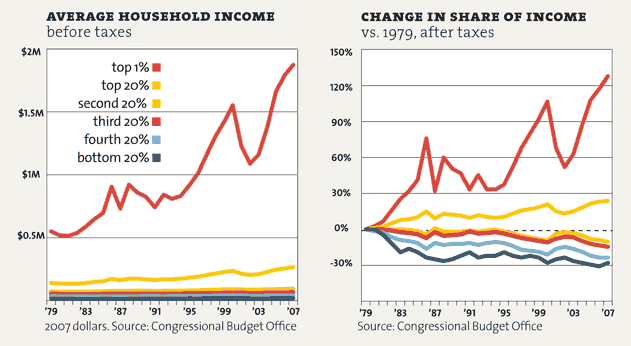
First note that these graphs only continue up until 2007. The general trends have continued through the present year. Next, note that the increase is much higher with the top 1% than the next 19%. The bottom 80% actually indicate a DECREASE in income.
     Income inequality arises out of the difference between income and required outgo. For the lowest income groups, the amount of income is less than the required spending. This deficit is dealt with by supplements from the general tax pool and by dropping budget items that are not immediate for the family -- dental care, general medical care, and so forth. Eventually income rises to the point where the income matches what is required for spending for essentials.
     We have now reached the bottom of "middle income". This continues until there is extra income beyond essentials. This is the point at which there is actually a voluntary potential of the family being able to accumulate additional wealth. In other words, there is an amount of money that has discretionary spending possible. It could be put into savings, or invested in stocks and bonds -- or it can be spent on more expensive cars, long vacations, fancy clothes, and so forth. In the first situation, the family has the potential of raising their overall wealth (and income). This is the historic "rags to riches" story -- but it requires having enough income to have excess and the number of people in this category continues to shrink and, for better or worse, an expensive car often wins out over extra savings.
     Finally, we hit that upper income category. This is where both survival and initial spendable extra income have been exceeded. It has to be either hoarded or invested. This is complete "gravy" and has nothing to be done with except to expand it. This is where the tax laws can be written to help the vast majority who generate the income or to help those who already have more than they need.
     There is no "trickle down" -- no lower levels that make 1/4 or 1/3 of what the higher level employer makes (and then continuing on down with the next level making, perhaps, 1/8 or 1/6 of the highest level). Only a "splash over" occurs -- lots of service people employed to do things that those with excess income do not want to do themselves. (Of course, the service people are still grateful to have income.)
     So there is the summary. Those who don't have enough to survive and must be helped, those who do have enough to survive but are faced with choices on spending and often spend the additional income beyond survival, and the third category with excess that has no choice but to keep growing unless compensated for with tax laws that re-distribute the money back to the people who generate it.
     Beyond fairness, however, there are reasons why it is very dangerous to allow working capital to be concentrated in the hands of a small percentage. First, the rich are not particularly different from the poor (except where nutritional situations have caused permanent damage) -- they have a "normal" distribution of intelligence from not very to average to very smart. If the top 0.1% of the population (about 160,000 families in 2015) families in the United States have control of 22% of the nation's wealth (2015 statistics) -- that means that 80,000 families of below average intelligence are controlling 11% of the nation's wealth. Even more, the top 10% (16 million families) control 78% of the nation's wealth -- giving us 8 million families of below average intelligence controlling 39% of the nation's wealth. In other words, there is a lot of economic power concentrated in the hands of people who have no particular special quality about knowing how to make use of it.
     The second part of the danger is that, with 16 million families (out of approx. 160 million) controlling 78% of the nation's wealth, we have a situation of a capital circulation problem. If 160 million have the capacity to equally spend on goods and services, the capital flows freely. If it is concentrated in the hands of a few, it is more parallel to a tourniquet being applied to part of the body.
     We have a continued concentration of wealth in the hands of a few and the recent tax "reform" act will accelerate this concentration. We have two major demonstrations of this situation (I do not claim ONLY two demonstrations) -- the Great Depression and the French Revolution. Both were situations where income got overly concentrated in the hands of the wealthy.
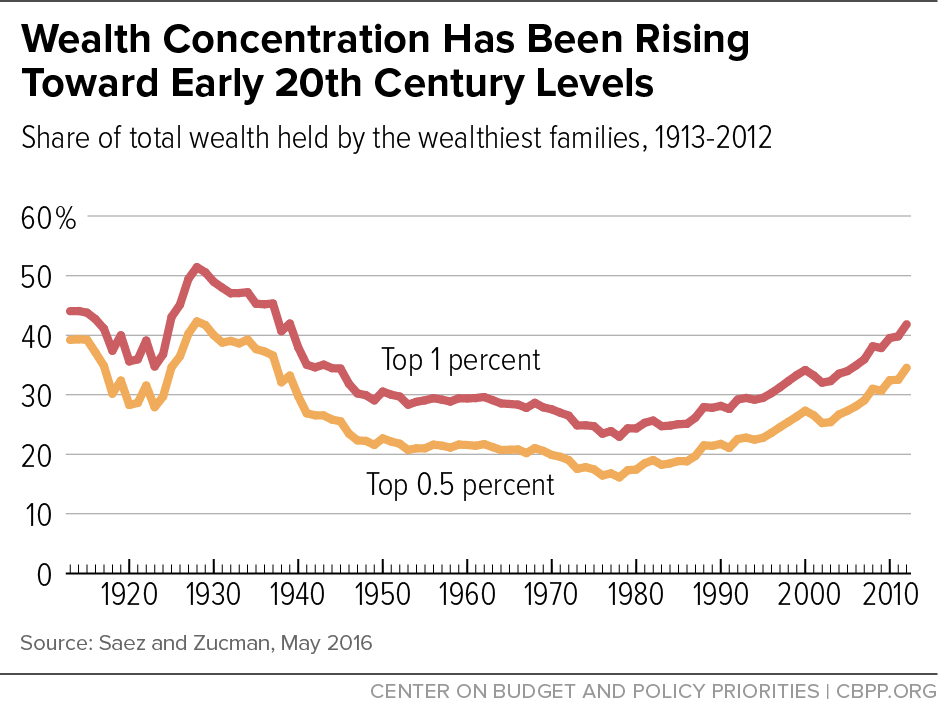
We have now surpassed the point in history of the end of the 1920s and are rapidly heading to the point in 1929 where someone, who had a lot of capital and power in his (or her) hands made a mistake and started the dominos falling.
     Will this happen again? I don't know but we have few documented cases where income concentration exceeded these levels and a stable society continued. These cases were demonstrated primarily in pre-colonial Europe and an outlet existed  (unfortunately for the existing native populations of Australia and the Americas) for the poor and desperate. Where is that outlet -- that safety valve -- now?

Saturday, September 23, 2017

Economic Interconnectivity and Big Data


     The world economy is a huge set of interconnections. One type of job depends on other types of jobs; if a job type disappears it is likely to affect many other job positions. Scarcity of resources of one type can affect the prices of many cascading products. If the world does shift from fossil fuels to renewable energy sources, new jobs will appear and old ones will change or go away.
     The interconnectivity also causes great fragility as the world gets larger and there are more dependencies. Imagine, if you can, people waking up tomorrow and deciding that the Internet is no longer of interest (I can easily remember when it didn't exist) -- how many products would no longer have a market, how many people would no longer have a job, how would it affect others (advertising, for example -- and printed newspapers might surge back into dominance)?
     Once upon a time, I was interviewing with Google and, as part of the telephone interview, we discussed potential projects and interests. I put forth the idea that, since Google was well designed to integrate knowledge and had such massive data storage and access, they would be well able to create an economic model of interconnected occupations and salaries. At this point in time, I would like to also add in products and localized market prices.
     Why bother with any type of tool? Why not just make the change and see what happens? The main advantage of such a tool is to have a better ability to forecast the effects of policy changes. What really happens if minimum wage is increased to a living wage? What happens if the illegal immigrants who are largely responsible for hand harvesting of our fruits and vegetables are kept away -- what will be the effects on produce prices, truckers, grocery stores, and so forth? What jobs are affected if private transportation is minimized and public transportation maximized?
      Such a project would be impossible if every individual, unique job, discrete part, and location had to be tracked. Luckily, items can be aggregated -- 500 Blue F-150 trucks should only have a quantity value change over 1 Blue F-150 truck (but, at the same time, there needs to be a way of describing Red F-150 trucks without having a fully different item). There is a lot of work to be done and it would still be a difficult project but certainly within the capabilities of many of the larger data handling companies -- Google, Facebook, Amazon, IBM, Microsoft, ... What would be the Return On Investment (ROI) for such a project? It's really difficult to know but it would be a valuable service/project that should be of use to governments and businesses around the world.
     I would suggest architecting such  a project as an iterative accretion of data. Start with something relatively small -- a loaf of bread. The loaf of bread has a set of occupations associated with it -- baker, packers, delivery people, stockers, advertising, payroll, Human Resources, etc. It also has a set of ingredients -- flour, yeast, filtered water, possibly milk, salt, and so forth. Each ingredient has an amount which acts as a ratio of strength in the links to the bread. Each ingredient has its own delivery and production chain which each have associated costs and value. It would be considerable in itself but the greatest value would be the fact that it is still small enough to be thrown away. New links and new data structure values will be discovered to be needed as the database develops. Now do it over (iterate) with those better values and links. Do it again if needed. Now add butter to the bread and continue on.
     There are also usability concerns. The bread company may start off selling only white bread and then add rye bread -- each with their own percentage of sales. How does one substitute recipe ingredients? How do you change the dependencies and the ingredient ratios? What happens if a problem ruins the rye crop for the year? If modelling an auto, how easy is it to change the model from gasoline to electric? Not only is there a substitution of an "ingredient" but the interconnections to suppliers, dealers, raw materials (batteries, possibly lithium) change. The model must be able to be changed easily because modelling the existing situation may be interesting but comparisons are what gives the most value.
     How would you address such a problem? What do you see as specific practical benefits from such an economic model? Is there some subset of such a model already in existence that could be used as the core of expansion? How are unpaid people incorporated into the model, recognizing that the system falls apart without them -- even if they are not considered to be part of the Gross Domestic Product (GDP) or a paid occupation?
     While I find the project fascinating just from a theoretical basis, I keep finding more and more potential uses as I consider the matter.

Sunday, August 7, 2016

Magic numbers: Society and what is "normal"


I was involved in a thread once upon a time and got trolled (expected if you talk about anything of significance -- and sometimes even if you are just talking about the weather). This was a thread talking about one of society's "magic numbers".

These are part of a group of numbers which we use based on statistical information. As Mark Twain once said (he said that the British Prime Minister Disraeli said it first): "There are three kinds of lies: lies, damned lies, and statistics."

For example, in current society a number called the Body Mass Index (BMI) is used to determine whether you are overweight, underweight, or in a "good range". This number is a ratio of height to weight and provides reasonable results for 80 to 85% of the population. For the other 15% to 20% of the population, the number just doesn't work well. If you are an athlete (or work out a lot and have more muscle) it doesn't work well. If you are a total couch potato with almost no muscle it will actually give you a better result than you "deserve". If you truly do have "thick bones" you will be at a disadvantage. This doesn't matter that much except if people are basing other things on that number -- insurance companies and computerized social services for example.

Why do we use this "magic number"? It is quick. It is easy. It is cheap compared to other, more accurate methods of body fat percentage calculations. However, even if one used a more accurate measure than that of the BMI, it would STILL not be accurate for everyone because there is no "one body shape fits all". For some, to hit that "ideal", one part of their body would have to be UNDER-weight in order for the average to be correct.

There are other "magic numbers" used. The "age of consent" is a magic number which, in more technical society, indicates that a child has become an adult. They are able to sign contracts, do things without permission from parents or guardians, get married and so forth. This magic number ranges from 13 in Japan to 21 in Bahrain. In some non-technical societies, it depends on the age when menarche sets in for women and "rites of passage" for men.

Many people get the direction of "age of consent" backwards -- thinking that a higher age of consent protects the child more from society. In reality, the family, church, or government usually have many options to do what they want with children at the age they think is right. The "age of consent" is what gives people the right to control, for themselves, decisions that affect their lives.

These numbers are set for two principal reasons. One is to prevent abuse of others by pushing them into activities (such as marriage or other things) before they can really make good decisions for themselves. The other is to determine an "age of emotional and mental maturity" which is taken to be an indication that they can make good decisions.

This type of magic number is determined almost solely by societal norms. It is usually lower in agricultural societies and higher in societies that require a longer period of education and social adjustment. It is also higher in societies where familial, and religious, control of women is greater. But, as is true with the BMI, it is (at best) a statistical reflection. Some will not be ready at age 30 to properly make decisions for themselves. Some might be ready at a very young age. There have been no psychological studies and are unlikely to be such.

Even the "age of consent" is not for everything. There are separate "magic numbers" for voting, being drafted for war, being able to drive, being able to work full-time, for purchasing and using legal drugs, and so forth. In many instances, the society would like to prohibit the activity but do not have sufficient backing from the populace to do such. Therefore, they set an age which most of society agrees is appropriate.

In all of these areas (and more), the "magic number" is sometimes determined by a statistical averaging and sometimes determined by societal norms. It is rare that the number is backed up by thorough, and consistent, studies -- which is why it is "magic".

What other "magic numbers" are you aware of within society? Do you know of any that have a researched background reason? Others that do not have such a background?

Saturday, October 3, 2015

What is Critical about Mass: having enough to sustain a process


    There is a phrase used from time to time -- "critical mass". This phrase was initially used in regards to the manufacture of nuclear weapons. In order for a nuclear device to be able to start a fission (splitting atoms) reaction, there must be enough material that each splitting of an atom creates enough energy to allow for the splitting of additional (at least one more) atoms. So, the critical mass is enough radioactive material to allow for the process to continue once it is started.

   This concept is central to the creation of weapons because a bomb is created such that two, or more, amounts that are less than critical mass are kept close together -- when it is desired to detonate, the smaller amounts are pushed together to create the critical mass and the reaction can take place. A bomb is "clean" if it has the opportunity to split most of its radioactive material before spreading apart and "dirty" if it ends up spreading the radioactive material (not fissioned) into the surrounding area.

   This concept is also important with the design of nuclear power plants -- rather what NOT to do when designing a plant. A properly designed plant will maintain control of how much radioactive material is allowed to be near each other (with the addition of materials called "damping" rods which absorb excess energy). This is important not only for safety but also for the economic operation of the plant. If a plant is not designed this way then it is just a one-time-use bomb. Thus, nuclear power plants (though there may be other dangers) are almost impossible to cause nuclear explosions.

   One more term that is very important to this topic is the "tipping point". This is the very small range that exists between NOT having a critical mass and the amount reaching a critical mass. Just a bit more and it becomes critical. Remove just a bit and it becomes inoperative. Before the tipping point is reached, the process requires continued external energy to maintain progress towards the critical mass.

   All that is just a preamble to this blog [smile]. The concept of critical mass enters into many areas of our society -- political, economic, sociological, and so forth.

   One area of present interest and, which is entering the region of the tipping point, is that of electric cars. Electric cars have been around for quite a while (according to the Net, 1834). However, we do not see electric cars everywhere -- it is mostly internal combustion (gas or diesel) engine cars. Cars, by definition, are used for movement. This means that the source of their energy must be carried along with them. In the case of gasoline engine cars, this means tanks of gas. In the case of electric cars (actually, electric engine powered cars), this means batteries (or an awfully long electrical cord [smile]).

   Batteries have traditionally not been very powerful or very efficient. This continues to change and, although not specifically a critical mass, they are now reaching the point of efficiency to be able to be used more practically. (Note that the same idea is involved with the efficiency of solar cells for solar power.)

   Even with more efficient batteries, they still must be charged on a regular basis and the means to charge them must be close enough together (driving range) such that an electric car can go from one charging station to another. Additionally, the time needed to charge the battery must be relatively short or timed such that the charging can reliably be done at "non-use" times (such as night).

   So, the technology needed to have practical electrical cars on the roads requires three things: sufficiently efficient batteries to provide workable range, charging stations within that range, and technology sufficient to compete with other alternatives. This is now beginning to happen. We are close to the tipping point. The external energy causing us to reach this point has come from the dedication of various people who want the end result. Note that the same process happened to make the internal combustion car practical in the early 1900s.

   Another area of critical mass is concerned with political, or social, matters. Let us take the matter of the ability to vote, within the United States, for women. Within the democratic process, one group cannot grant themselves additional authority, privileges, or rights. They must be granted such by the people who already have that power. This means a process of change of thoughts and attitudes. The energy to achieve that came from dedicated people who worked towards that goal. They achieved critical mass when enough of the existing authorized voters were convinced that women should be granted the right to vote.

   There are many areas where the ideas of a tipping point, and critical mass, are important. They are both involved in areas of change. The change may be a chemical, or physical, process. The change may be a social process. The change may be a political process. But they each have stages and move from one to another by approaching the tipping point, reaching critical mass, and effecting the change.

    What areas of critical mass do you see approaching and which ones do you see from the past?

Monday, March 16, 2015

Living Wages are not only affordable -- they help businesses


    It is often said by spokespeople for businesses that "we cannot afford to pay our workers living wages". However, there seems to be no difficulty in paying for increased costs for materials, or energy, or advertising, or increased costs of real estate, or any other such item. As I discussed in my blog about "supersizing", there are a number of things that go into the cost of an item versus its price.

    The composition, or gathering of different parts, of the cost of an item will vary depending on the item. Some things are "labor intensive" which means that labor costs are a higher percentage of the cost. Others are based on scarcity -- or an aspect of "we have what you want -- who is willing, and able, to pay the most for it". In general, for many items, the amount of labor cost within the total cost for things that are actively made by people is a minority of the cost -- call it 30%. For stores that have high "turnover" (things sold quickly and new, replacement, items put on the shelves for sale again), labor costs are much less (such as for mass merchandizing stores) -- perhaps 10%.

    For our discussion, let's just say that labor costs are 25% of the cost of the item.  Doubling the labor costs would NOT double the base cost of the item to sell. It just adds an extra 25% -- so the base cost is now 125% of the former price. Let's say that the retail price (price charged to a general customer) was twice that of the base cost -- or an extra 100%. This means that the price is 112.5% of the original price (100% original cost + 100% original profit + 25% extra labor costs gives 225% which is "normalized" (brought down to a comparison against 100%) to 112.5%.

    Now it is possible (even likely) that the merchant might want to keep their percentage profit rather than the actual amount. So, in the above comparison, the merchant got the same amount of profit as base cost. If we increase the base cost by 25%, the total amount doubled ends up at 125% of the original price (100% of original cost + 25% extra labor costs is equal to 125%; doubled gives us 250% and normalized brings it back to 125%).

    We can see that even doubling the labor costs does not add a huge percentage to either the base cost or a retail price without penalizing the retailer. It can be argued that a 25% increase is still something that people are not willing to pay. After all, people do comparison shopping and retailers have sales, and price cuts (temporary or permanent). If Item X is sold at one store for $1.25 and the very same item X is sold at another store is sold for $1 then many people will choose to buy for $1. What would make people able, or willing, to pay more for products?

    The first reason is that the above analysis is a simplification. Labor costs are NOT the same as wages. Although the blog on "supersizing" uses labor costs as a lump sum, labor costs are actually a combination of wages, benefits, the cost to find someone to work at the job, training, and other matters. Thus, doubling wages does not double labor costs. In reality, it will reduce "turnover" within the workplace and reduce the amount needed to find people to do the job and the training. So, a doubling of wages may actually only cause an increase of 20% overall (these numbers are all examples but probably in a reasonable range) so the product would only cost $1.20.

    The second reason is what do people do when they make more money? Well, hopefully they will save some more. But almost everyone would also spend more. The products may cost a bit more but the business is also creating more customers and a percentage will buy from their store.

    A third reason is that it creates a positive image. I am sure you can think of a company who does not treat their employees well and relies on charities and the benefits paid by taxpayers to subsidize the wages of their employees. Similarly, we can also think of companies who pay their people more than what is "required" and are known for treating their employees fairly and well. Because of these three reasons (and other reasons) these "good neighbor" companies often make a better profit than the ones who sponge off of the taxpayers to increase the owners' wealth.

    The last reason leads into a future blog (maybe the next one). And that is -- it isn't always a matter of "nice people finish last". The above three reasons come into play to help people who do the good, proper, thing benefit financially. Regulations also help -- because the companies who care about people (and environment, and health, and ...) are not penalized because they operate "on a level playing field". That is, if everyone is required to do something good then no company is at a financial disadvantage for doing what is good. Everyone has the same requirements.

    Can you think of other benefits to a company for paying living wages?

Saturday, February 21, 2015

A Living Wage : it's not that difficult to figure out


    It used to be that discussion was about the "minimum" wage. That was always a difficult discussion because it is totally subjective. If a person is starving and you agree to give them a sandwich and a glass of water if they work for you for eight hours then it is a minimum wage (anything less and they would die and be unable to do the work). Then there is the official "minimum" wage -- which is completely fictitious. People are paid less than the minimum wage all the time -- sometimes legally and sometimes not but it definitely is not the least amount of money people are paid.

    However, when we come to the concept of the "living" wage, it is really easy. One thing to recognize up front is that there is not a single living wage. A living wage will depend upon the expectations within a society. It will depend upon the general cost of living in the area. It will depend on individual circumstances -- do you have children or others dependent upon you, do you have additional needs that others do not have (blind, deaf, mobility impaired, ...), and so forth.

    So, there is not a single living wage for all people. But it is easy to determine. Add up the costs of everything it is needed to live over a year and divide that by the number of hours that are considered reasonable in your society. Let's put together a case example for an "average" city in the U.S.

    There are a number of categories that MOST people would agree on. There are also a number of other categories that people would not agree on (is a phone required? is recreation required? is television required? is air conditioning really needed? is a personal car required? is it necessary to be fashionable? ...) Minimum requirements will include such as:


  • Shelter
  • Utilities (water, heat, sewage, power)
  • Food
  • Clothing
  • Health-related Costs (incl. toothbrushes, toilet paper, clothes washing, etc.)


    There's a certain range within each category that is required. Sometimes you might find a great deal on an apartment (or live with your parents). Sometimes you can find used clothing that is acceptable. Specific numbers can definitely be argued about and I won't say that you're incorrect. However, here are some (not the only) realistic numbers.


  • Shelter -- a studio apartment; $900/month -- $10,800/year
  • Utilities -- basics for a small apartment; $100/month -- $1200/year
  • Food -- for one person, no fast food, no eating out; $8/day, $250/month -- $3000/year
  • Clothing -- 3 pairs of pants, 2 underwear, 4 shirts, 5 pairs of socks, 1 pair of shoes, 1 coat -- $200/year
  • Health-related Costs -- [# taken for an Affordable Cost policy for an unemployed single person] -- $340/month plus $40/month for medications/co-pays;  approx. $4500/year.


   This totals $19,760 for a year. For simplicity, round it up to $20,000. If we assume that working a 40-hour week for 50 weeks/year is reasonable then that is 2,000 hours. So, a "living wage" for a person with no special needs is $10/hour NET. I emphasize NET because this is what they have to have in order to pay for it all. If they have to pay country/local taxes or union dues or anything then that is added to the NET requirements.

    So, we have determined a "living" wage. Even assuming that you agree with the above estimates the numbers can be moved around. If you qualify for food stamps, you might reduce your needs for food. If you can get subsidized housing, you might pay $500/month. But the foundation needs stay the same. Note also that there are no costs for childcare listed -- this is for a single person with no additional needs.

    But society cannot afford to pay such!!! This is the statement that is echoed by businesses and wealthy politicians. It the next blog (hopefully -- I get distracted ) I will discuss the realities of paying living wages.

    Meanwhile, what things do you consider needed to live? Do you currently live on less? How do make it happen?

Monday, December 29, 2014

Money as Energy: Increasing the pool of money


    In the previous post, I talked about how money is basically an abstraction of the combination of resources, labor, and energy. We are fortunate that we do, presently, have more than adequate amounts of each. Distribution of such, however, is very uneven and, thus, causes areas of poverty, famine, and other physical and social lacks.

    I ended the previous post with the idea that -- although our current problems are more concerned with distribution rather than actual shortages -- the New Age idea of an unlimited pool of money is not currently a reality. Is there anything to be done about that? Is there actually a way that everyone can have more (even with distribution problems)?

    To address that question, it comes back to the three components of money -- resources, labor, and energy. It also requires a fourth "catalyst" which is technology. By using technology, energy can be converted into additional resources and increased labor availability. This argues that energy is the prime limiting factor within economics.

    We can look around at the world and see how the availability of energy (applied via technology) has increased the "wealth" of the world. Farmers, via the use of equipment (using energy and technology to create and energy to keep active), can produce much greater amounts of food than what one person working the ground with manual labor can do. Harvesting of material resources -- trees, ores, fish -- are possible on a much larger scale than a single person could do making use only of manual labor (allowing a hand-built boat and fishing equipment).

    The above paragraph indicates how energy (with technology assistance) can increase the amount of labor. It does NOT increase the amount of resources. But the amount of food for people has been increased -- isn't that an increase in resources? No, it isn't -- because the ecological pyramid has not changed. The amount of base-level food has not increased. The plankton, plants, and other solar-using food plants have not increased. The labor has been used to change the varieties of food harvested and the distribution of the food (from other animals to people). In fact, due to pollution and other side-effects of application of energy to increase labor, the total amount of food resources may go down (decrease in sea life in general, decrease in fish population, decrease in non-human animal population).

    Can energy increase resources available to us? Yes, in two ways. The first is a continuation, and expansion, of what we presently do -- redistribution. We find other, more energy intensive, methods of accessing resources. However, this often has negative environmental effects and is also just speeding up the use of resources. So, although it increases resources available on a short-term basis, it does NOT increase the amount of resource. A second aspect of this (still redistribution) is to bring resources from other places -- the asteroid belt, for example, is a potential area from which to redistribute resources.

    The second method of increasing resources requires much higher levels of energy. Besides the potential of alchemy (changing one element into another -- possible with huge amounts of energy), there are many endothermic reactions possible with increased energy available. Endothermic means "requiring the absorption of heat". Thus, it is possible to convert raw elements into more complex molecules and, finally, into "organic" materials needed for human eating, or use for furniture, or such. This is actually a metamorphosis of resources and not an increase -- but it's "close enough" for our uses.

    So, with energy, the pool of "money" becomes bigger. Distribution remains a major problem. A larger problem is making sure that the energy is renewable -- we do not want to empty the bank as that would cause widespread catastrophe for the existing economy. The other problems aren't directly concerned with energy-as-money but are related to social, and environmental, responsibility for using it in a life-affirming way.

Saturday, December 6, 2014

Economics and the Meaning of Money


    I usually look at the economy as a form of applied sociology. Money is only worth something if people believe that it is worth something. This applies equally to gold and jewels as much as it applies to pieces of paper with people's pictures printed on it. In a similar fashion, money is distributed according to the rules (explicit or implicit) that people decide upon.

    A barter system works when each person (or family) is capable of doing most things needed for survival on their own. They then trade things that they have in excess for things that others have in excess. I give you an extra chicken and you give me a bushel of potatoes. I give you a length of material that I have woven and you give me a chair. Barter is a mixture of labor, materials, difficulty, and time combined into value.

    When each person can NOT do most things they need for survival, the barter system becomes very inconvenient. It is necessary to keep records/charts of equivalences. One type A chair is equal to two meters of cloth. Two type B chairs are equal to one type A chair. Ten chickens are equal to one meter of cloth. This complexity arises out of the need for each family unit to trade for many different types of things. Once this happens, the next step is to equate the value to something in common. Ten seashells represent the value of one chicken. A meter of cloth is equivalent to 100 seashells. Every item of value can be represented by a certain number of seashells. This representation of value is called money.

    Once the value of work and things have been "abstracted" into money, it is very easy to lose sight of real value. The work done by an experienced, talented teacher is probably worth more to society than that of a software developer -- but the software developer probably makes a higher salary. In "capitalistic" societies, the control of money is considered to have value in itself. That is, if I possess one million seashells then I no longer have to produce anything of value myself -- the circumstances (earned and saved, gifted, or inherited) of having the seashells allows me to distribute some portion to other people who then produce the actual value (plus more for me to hold).

    Within "new age" philosophy, it is popular to think that the economy is no longer a "zero sum" game. That is, each and every person, can earn as much money as she/he wants -- that there is not a "fixed pot" of X seashells in the pot and each can have as much as they want without reducing the amount that others are able to have. That's a happy philosophy but is it true?

    Although money makes lots of games possible with the distribution and use -- the basis of money still goes back to production and use. If 100 people each want a fish but there are only 50 fish then the value of each fish will rise until the 50 people who most want a fish have them and the other 50 do not have them. If 100 people want a fish and there are 1000 fish, then the value should (the concept of money makes direct value difficult if not impossible) be equated to that combination of labor, materials, difficulty and time mentioned above. An abundance of resources (fish) causes value to go back to basics.

    Our global economy makes distribution of resources extremely unequal. Most people estimate, however, that there are enough resources (food, labor, energy) to support everyone currently on the planet. The fact that that does not happen is a problem with distribution and allocation. But, there is still a limit. Perhaps at twice the population there would NOT be enough for everyone (in an ideal world). This argues that it is a "fixed pot" -- there is a limit of resources to be distributed. In order to eliminate the fixed pot, it is necessary to get rid of the limitations of resources.

    Is there a way to eliminate the limitations of resources? I will look at that possibility in the next blog.

Smoke Gets in Your Lungs (updated)

     This is an article that I published in here on February 22, 2013. I try to make my articles “timeless” as I try to work with “foundatio...