Showing posts with label wealth inequality. Show all posts

Friday, August 15, 2025

Wealth: When the needs of the many are more important that the desires of the few

     There is a peculiar mindset for many people about the distribution of wealth. There is a feeling that those that have it must deserve it — or have earned it. Those without it don’t deserve it, haven’t earned it, won’t work to get it. But, in reality, that is not how wealth works.

     Let’s use the name “capital” as a parallel to “wealth” to fit in better with the dominant economic system in the “West” — capitalism. When we work, we get paid according to the amount that our society has determined. If we have more than we spend, we can save it as “working capital” or “savings”.

     The following discussion primarily applies to the United States but there are aspects that apply to other countries and systems. Only you know how much and where.

     Within a capitalist (not officially feudal) system, people can be separated into three groups.

The poor (group 1). This group is always struggling to achieve the “standard of living” for where they are. Note that the precise income boundary will vary from location to location, country to country, area to area. In the US, those in this category must forego something(s) that many consider “normal, everyday” items — such as permanent housing (ie., they are homeless), clothes that fit, healthy food (junk food is cheaper), a car (public transit in the US, where available, is useable but not convenient, or easy, as it is in many other countries in the world), and so forth.

     For the poor, any savings needs to be set aside for emergencies (flat tire, car accident, faulty tooth, …). There are many working for minimum wage (in the US — even assuming a higher state minimum wage rather than the sub-livable federal wage) who have NO extra. Each week is a matter of what they must forego. This percentage of “surviving working poor” has increased each year since 2009 when the U.S. federal minimum wage was last raised (for most people) to $7.25/hour. Living expenses have gone up 53% since 2009 and this means that “rags to riches” story has become more and more of an urban legend. In the US, about 11% of the population are at the official poverty level but there are many more “working poor” doing without and living payday(s) to payday.

     So, the reality is that people who earn less than a certain amount (greater than official minimum wage) often have no savings above expected living needs. Is this what they deserve? They worked, they earned, they just don’t have any “extra”.

Middle income (group 2). This group can meet the “standard of living” for their area and have some extra. The extra, however, is often reserved for making retirement more enjoyable.

     Working the way up the wage ladder, we get to the vanishing segment called “middle income”. In this case, there are truly choices. Any “extra” income above needs is called “discretionary” income. People can CHOOSE how to spend it. They COULD save it as “working capital” but there is always the temptation to enjoy life at present rather than save for the future and the attractions of a consumeristic society makes it easy to find something to do with the “extra” income. There are also desires to help the members of the family — paying for schools, degrees, vacations, cosmetic work, … .This group may not work any harder (perhaps even less hard) than the poor but, because of the higher wages allocated for their job positions, they have extra capital.

     It is very difficult to move from group 1 to group 2 but much easier to move from group 2 to group 3 as long as they have good financial and investment skills and reduce their discretionary spending as much as possible. No second home, no boat or rv, no special catered vacations,

The rich (group 3). They have so much that they don’t even know how much basic living expenses cost. Considering oneself rich, or not, is subjective. People threw themselves out of windows during the Great Depression because they lost 80% of their wealth — putting them back into the rank of middle income. And, after having had all of the excesses of being rich, they were scared to death (literally) to have their income reduced so far and to lose their cook, maids, butler and so forth.

     In this group, income is primarily via unearned salaries and bonuses or dividends/capital gains from investments. Earned income is not a substantial part of their income. (Bringing in $500,000+/year ($250+/hour) can, in no manner, be justified as having been earned in my opinion.) And their requirements for living are such a small percentage of money available that costs aren’t even considered when making purchasing decisions.

     Thus, wealth is concentrated in group 3. Group 1 is being made larger and larger via mandated lower wages in comparison to living costs. Group 2 is getting smaller each year. And group 3 stays about the same size.

     How is the ability to gather wealth determined? The first factor is salaries. It is fantasized that salaries are market determined. In other words, they are paid what they are “worth”. This isn’t really the case. There is a lot of “lip service” about this but teachers still start off with very low pay (because of unions, they may leave their careers, upon retirement, with a decent income level). The low end is determined by legislation and not the market. The higher income levels for “blue collar” workers is dependent on education, certifications, and experience — often with a union interceding with management. The gradation of what experience and what education is “worth” is a crystal ball type of situation.

     In some instances, “appropriate” wages and benefits are determined by comparisons to how much money in sales per employee is achieved For example, if the company figures that an employee, in a specific job position or category, brings $300,000 into the company, then allocating $200,000 for salary and benefits is “reasonable” for the company. But this works only as long as the need exceeds the number of qualified employees (“market driven” — paid what they are “worth”).

     In the US, about 21% of all millionaires had inherited money as part of their foundational wealth. About 60% of all billionaires started with inherited money. The other 79% of millionaires built up their worth by saving, and investing (sometimes starting successful companies), for many years.

     How could we spread more fairly and equally? First, the starting point needs to be set at a living salary (meets some predetermined minimum “standard of living”), with automatic increases based on cost-of-living. Next, salaries need to be more transparent so that, eventually, comparative salaries will seem more in keeping with our official beliefs in freedom and equality. Last, the non-material (cash, stocks, bonds, and so forth) transfer of inherited wealth (transfer of properties, intellectual properties, or unrealized collections need to have special acknowledgement and allowances in order to preserve family farmers, children of artists, and so forth) must have much higher taxes. “Progressive” taxes need to come back into fashion — with a severe closing of loopholes. (Social Security and Medicare taxes should have no “cap” on wages — everyone should contribute and, later, get their investments back.)

     Changing the status quo is dependent on the wills of those who presently benefit from the existing status quo. Women being able to vote depended on the males who already had such rights. Blacks got the ability to vote via the ballots of approved voting people. The voting age changes arose out of protests during draft registration and a reflection of rights associated with responsibilities.

     It is very difficult to change any system from the status quo. But it needs to happen to have a society that cares for, and honors, each of us for the spirit which resides within.

Ideas & Interpretations is a reader-supported publication. To receive new posts and support my work, consider becoming a free or paid subscriber.

Friday, July 13, 2018

Real Estate Inflation -- an income wedge


     Investing in real estate is not always a sure bet -- the "bubble" in the U.S. in 2008 is a recent indication of a "correction" when real estate prices were rising much faster than demand would normally expect -- and when people were going beyond the point where they could truly afford to buy real estate. But, in general, real estate prices continue to rise.
     This is something very pleasant for the real estate owner. Over the long run, the value of the land or property (a "parcel") is expected to rise. In the short run, it may be difficult to sell. It is not "liquid" -- it can only be exchanged for money or other value if someone else happens to want it. But, if it is a good piece of land or property, it will probably find a buyer at a good price.
     What defines a "good price"? What are the components of the rise in value of land or property? Realtors are likely to say the phrase "location, location, location". That is actually only half of the criterion -- the other half is "distinctive". By building high or covering a wide area, the specific location can be widened and a specific property or land area becomes less valuable. However, with increasing density and encroaching natural borders (such as hillsides or rivers) or supportive resources (water, power, sewage, ...), there is a limit to the number of parcels that can be available at the same approximate location. Each, of course, will have their own view and orientation which may make them more, or less, valuable.
     Another component of the price can be quality. A well-built, or designed, home should be of greater price. If the person/company that designed, or built, it is well known (Frank Lloyd Wright?) then that automatically adds to the price. History can add to the price -- if Abraham Lincoln slept there then the price should go up (assuming it can be proven).
     Yet another aspect of pricing is determined by the general income level of the neighborhood. There will be a lower limit of reasonable pricing determined by the cost of materials (not applicable in the case of land) and local labor -- but that lower price limit may be voided in cases of desperation or foreclosure. However, the price will float upwards as the prices of the parcels around are rising (for whatever reason) as competition between realtors, owners, and buyers start to change the lack of sufficient property into higher prices
     All of these parts of determining value are indicative of why housing prices vary -- more expensive in some locations and less expensive in other areas. A 2,000 square foot house in San Jose, California will cost a lot more than a 2,000 square foot house in Mobile, Alabama. (Even though the quality of the house will probably be less in San Jose.) Within Wichita, Kansas, a 2,000 square foot house in a wealthy neighborhood will cost more than that within a lower income neighborhood (although neither will come close to the price of a house in San Jose).
     Once upon a time (when I was growing up -- not quite the dark ages), my architectural drafting instructor told us about an expected ratio of land to square footage of a house. As I recall, the "footprint" (the amount of land the foundation required) of a house was supposed to be no more than 1/9 of the lot size (land). (It was never indicated as to any rule-of-thumb on apartments or townhouses.) With a reduced expectation, and use, of land -- as well as an increased percentage of the total price spent on land -- it is now not unusual to have a house occupy 1/3 of the lot (sometimes even less in urban areas).
     In addition to the house occupying more of the lot, there is incentive for the builder to increase the size of the actual house. Houses are listed, and compared, by $xxxx/square foot (in other areas Money/square meter). The price to build is NOT the same for all sections of a house. Kitchens and restrooms are more expensive. By adding more square footage to the "living" areas, builders can squeeze out more profit without increasing the price per square unit of area.
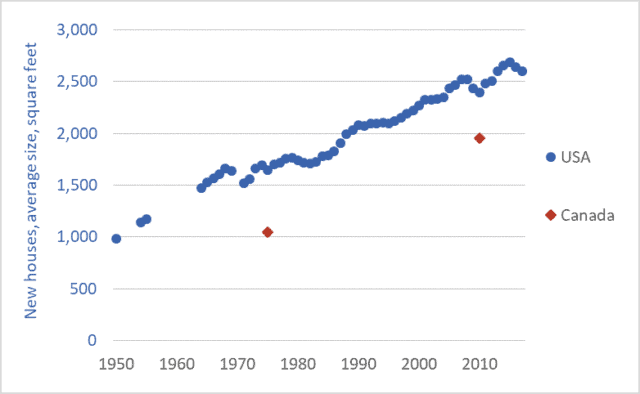
A chart of this increase in house size can be seen from Darrin Qualman's post.


     Perhaps this is not particularly egalitarian -- people who have more income (or more inherited wealth) can buy larger houses in more desirable locations with better views, schools, climates, landscaping, local attractions and such than those who are poorer. But such has been the case since land and property started "belonging" to people and is likely to continue.
     The greater problem is having the AVERAGE housing price go up faster than the AVERAGE wage. As time goes on, a smaller and smaller percentage of the population can afford to buy housing. This also reflects upon the situation for renting since renting is the process of fostering out to others property that has been purchased by someone. In other words, rents are loosely based on the amounts of mortgages for the property.
     Before I started researching to double-check facts for this blog, I thought that real estate prices were rising much faster than inflation. It does not appear to be the case. Even wages are reasonably stagnant (decreasing only a small amount, on average, against inflation) from amhill.net's post (you may find other sections of the post of interest, also).


     But, since house prices are per square foot and the average size of a newly built house has increased by 250%, many fewer people can afford a house. What they can afford is an apartment (or maybe a townhouse) which shifts the size back to that of a house built in the 1950s. That may not be that unreasonable -- the increased size is a factor of literal "inflation" but it does mean that the "American dream" of a stand-alone house with its own yard is more and more out of reach for many people.
     One new trend against this flow is for that of the "tiny house" movement. Note that, although the square footage is quite a bit smaller than the typical newly built house of current days, the price per square unit of area actually goes up (once again, the cost of kitchen/bathroom is more expensive and there is less "living area" to offset that cost). Of course, people can still buy their own lots and have their own "moderate house" built. It just doesn't seem to be currently popular -- which means that it may prove hard to sell in the future.
     In summary, part of the lack of ability for people to afford housing is an illusion. Since the size of houses has increased (and the prices accordingly) and wages have remained stagnant then fewer people can buy the houses currently being built. However, if the size of the living area is kept constant -- and the form of the living space is allowed to change from that of a "dream house and yard" -- then people's ability to afford housing has not changed. Unfortunately, the numbers of housing units built of an affordable size is not keeping pace with the percentages who can afford them -- causing housing and rental shortages.

Sunday, January 21, 2018

Income Inequality: How does it create a tightening spiral?


     With the new tax "reform" in the United States in the news, the topic of income inequality resurfaces as something of interest. As will have been noticed, the way that the economy actually works is something that I find continuously fascinating. As for income inequality, just what is it? How does it begin? How does it accelerate or become less?

[Please note that the numbers used within this blog are snapshots and may be different in a different year's snapshot.]

     In the first place, there are two different inequalities within a capitalistic economy -- income inequality and wealth inequality. These are often discussed as if they were the same thing. While it is true that there is often a correlation they are not the same. Income inequality is the difference in the amount of usable income in a given period (usually a year) between different income divisions (see my blog about income groups if you are interested). Wealth inequality is the total control of capital associated with a particular division. Generally, wealth inequality is even worse than income inequality because wealth both accumulates and compounds (wealth generates more wealth).
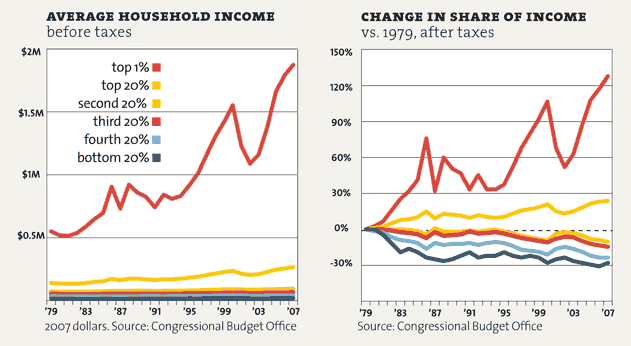
     If we look at the following graph of income inequality in the United States:

First note that these graphs only continue up until 2007. The general trends have continued through the present year. Next, note that the increase is much higher with the top 1% than the next 19%. The bottom 80% actually indicate a DECREASE in income.
     Income inequality arises out of the difference between income and required outgo. For the lowest income groups, the amount of income is less than the required spending. This deficit is dealt with by supplements from the general tax pool and by dropping budget items that are not immediate for the family -- dental care, general medical care, and so forth. Eventually income rises to the point where the income matches what is required for spending for essentials.
     We have now reached the bottom of "middle income". This continues until there is extra income beyond essentials. This is the point at which there is actually a voluntary potential of the family being able to accumulate additional wealth. In other words, there is an amount of money that has discretionary spending possible. It could be put into savings, or invested in stocks and bonds -- or it can be spent on more expensive cars, long vacations, fancy clothes, and so forth. In the first situation, the family has the potential of raising their overall wealth (and income). This is the historic "rags to riches" story -- but it requires having enough income to have excess and the number of people in this category continues to shrink and, for better or worse, an expensive car often wins out over extra savings.
     Finally, we hit that upper income category. This is where both survival and initial spendable extra income have been exceeded. It has to be either hoarded or invested. This is complete "gravy" and has nothing to be done with except to expand it. This is where the tax laws can be written to help the vast majority who generate the income or to help those who already have more than they need.
     There is no "trickle down" -- no lower levels that make 1/4 or 1/3 of what the higher level employer makes (and then continuing on down with the next level making, perhaps, 1/8 or 1/6 of the highest level). Only a "splash over" occurs -- lots of service people employed to do things that those with excess income do not want to do themselves. (Of course, the service people are still grateful to have income.)
     So there is the summary. Those who don't have enough to survive and must be helped, those who do have enough to survive but are faced with choices on spending and often spend the additional income beyond survival, and the third category with excess that has no choice but to keep growing unless compensated for with tax laws that re-distribute the money back to the people who generate it.
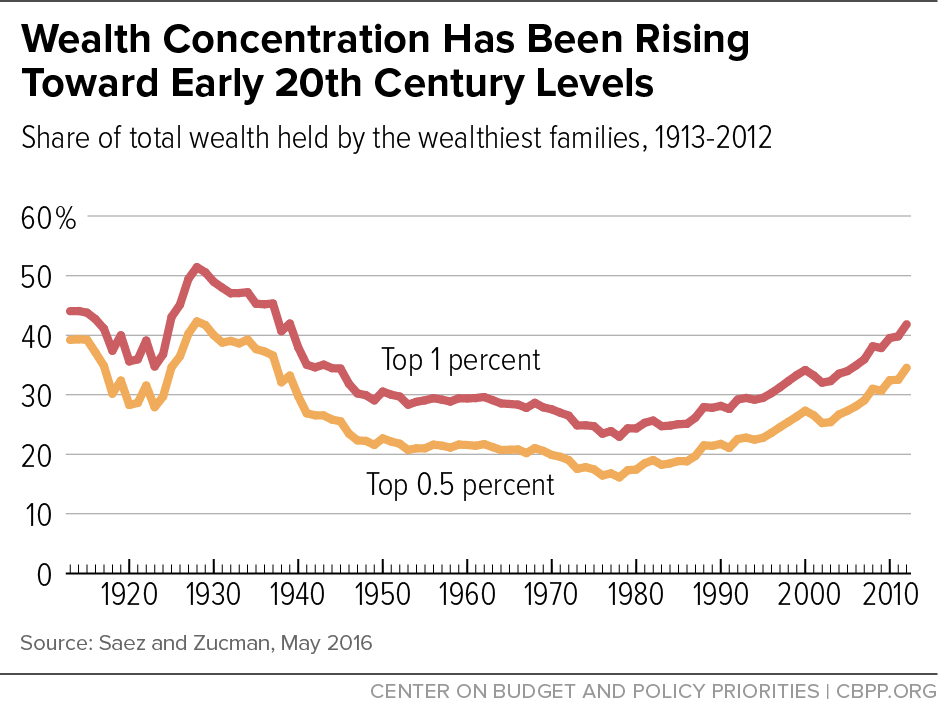
     Beyond fairness, however, there are reasons why it is very dangerous to allow working capital to be concentrated in the hands of a small percentage. First, the rich are not particularly different from the poor (except where nutritional situations have caused permanent damage) -- they have a "normal" distribution of intelligence from not very to average to very smart. If the top 0.1% of the population (about 160,000 families in 2015) families in the United States have control of 22% of the nation's wealth (2015 statistics) -- that means that 80,000 families of below average intelligence are controlling 11% of the nation's wealth. Even more, the top 10% (16 million families) control 78% of the nation's wealth -- giving us 8 million families of below average intelligence controlling 39% of the nation's wealth. In other words, there is a lot of economic power concentrated in the hands of people who have no particular special quality about knowing how to make use of it.
     The second part of the danger is that, with 16 million families (out of approx. 160 million) controlling 78% of the nation's wealth, we have a situation of a capital circulation problem. If 160 million have the capacity to equally spend on goods and services, the capital flows freely. If it is concentrated in the hands of a few, it is more parallel to a tourniquet being applied to part of the body.
     We have a continued concentration of wealth in the hands of a few and the recent tax "reform" act will accelerate this concentration. We have two major demonstrations of this situation (I do not claim ONLY two demonstrations) -- the Great Depression and the French Revolution. Both were situations where income got overly concentrated in the hands of the wealthy.
We have now surpassed the point in history of the end of the 1920s and are rapidly heading to the point in 1929 where someone, who had a lot of capital and power in his (or her) hands made a mistake and started the dominos falling.
     Will this happen again? I don't know but we have few documented cases where income concentration exceeded these levels and a stable society continued. These cases were demonstrated primarily in pre-colonial Europe and an outlet existed  (unfortunately for the existing native populations of Australia and the Americas) for the poor and desperate. Where is that outlet -- that safety valve -- now?

Choices: Often, we are not able to change a situation, but we can almost always make a choice about our response

     I have a long list of possible newsletter ideas which keeps getting longer. Sometimes, I go back to a topic I put on the list ten years...