Showing posts with label inflation. Show all posts

Wednesday, February 14, 2024

Buy One Get One: bulk orders and changes in size


     I don't know how in the world the US government gets their inflation numbers, but our grocery bills have gone up about 35% since pre-pandemic period. No changes in menu, number of people eating, or any such thing. This is all anecdotal -- it is a reflection of MY experience and it doesn't necessarily apply to anyone else (but it probably does).

     It does seem that the increases have been erratic and different between items. Russet potatoes went from $0.99/pound to $1.29/pound and have recently come back down (hurrah) to $1.19/pound. The cost of most oils went up quite a bit. I don't restock cooking oils that often so my memory is more likely to be fuzzy but I believe they went up more than 50% and possibly as much as 75%. One might say -- who cares about oil -- but I think that the increase in the cost of cooking oils has influenced processed food prices quite a lot as processing foods often requires cooking oil.

     On to processed foods, including the ultraprocessed  ("junk") foods. We try to keep those limited but they certainly are still a part of our diet. In one way, the increased prices of those is "good" as it gives incentive to not eat them or, at least, reduce the amount they are in our diets. One famous brand of stackable potato chips went from $1.69 pre-pandemic to $2.65 post-pandemic (a 57% increase). A carton of 12 cans of soda went from $5.25 to $9.25 (a 75% increase). One of my sons, who goes grocery shopping with me, is currently attempting to wean himself off of canned sodas -- in part due to the prices.

     I do not have the background knowledge on the reasons for the various price increases. I can read media articles but I haven't read anything that goes back to source material. So, I can only go according to the reports of "supply chain" failures and lack of people for various manual needs in food production. Certainly, a small amount of it has been due to reducing the underpayment of various people doing those manual needs in order to entice them to come back to work (before it was safe to do such, in some cases). But the source of the majority of the increases is a mystery to me. But, let's say they were real and caused the "laws" of supply and demand to move those prices up.

     Besides that ten cents per pound decrease in the price of potatoes, I cannot think of many items that have gone back down. Can you? Whatever causes there were to increase prices are likely gone, correct? There is at least one case in Europe right now that is confronting a food producer to give justifications for their continued price increase. At least the prices seem to have stopped their rampant growth though I noticed, yesterday, an additional ten cents per pound for ground beef (about a 2% increase -- insignificant though still raising questions).

     One method that grocery stores and food producers use to avoid reductions in prices is SALES. Rotate the sale prices among the various items. Some sale prices are as much as 60% off. A local grocery store often has a 'buy two, get two "free"' sale on cartons of soda. Lately, it has been 'buy two, get three "free"'. Snack chips have 40% sales and 'buy one, get one "free"'. These heavy discounts do two major things. They give the illusion that prices have gone back down (without officially causing "deflation") and they keep the demand moving which would normally decrease with the increases of prices.

     Another thing that food producers can do to influence perception is to change amounts per item or general size. Prices I have a reasonable chance of remembering and comparing (recognizing that memory is one of the most precarious things). But, do you remember how many ounces of potato chips were in that bag three years ago? I sure don't. I am pretty sure the sizes of the sack containers have decreased but that does not necessarily mean the amount inside of the sacks has reduced.

     In our economic, and political, situation in the US there isn't much that can be done about increased prices. We live with them and hope that prices aren't raised again for several years -- when general inflation has moved up enough to justify current prices. In the meantime, bulk purchases and sales discounts and bundling are our best bets to stretch the food budget.


Tuesday, February 7, 2023

Back to basics: Supply and demand


     The economic theory of capitalism has, as one of its basic aspects, the idea of supply and demand. This blog may be "old news" to many -- but not to others.

     The amount of product (supply) at a given price tries to reach a balance of demand and willingness/ability to pay. Under many conditions, this works as a self-maintaining mechanism. There are quite a few cases -- sometimes called "edge conditions" -- in which it does not work well. These cases include newly introduced products, pandemics, shortages, monopolies/cartels, and other cases where the balance gets thrown off rapidly.

     No company wants to sell a product below the cost needed to manufacture and provide. However, there are cases where this may be to their advantage. One is when demand has gone down so much (temporarily or permanently) that they have the cost of storing a large amount of inventory from which they don't expect a profitable return on investment. Another is as a "loss leader" -- making the price attractive to attract potential buyers of other, higher profit, items (often done by grocery stores). The final one mentioned here is that of forcing the competition to quit. A company with "deep pockets" (money available in reserve) can force their competitors to stop making competitive products. Usually this is legal but will often leave widespread bad feelings.

     Newly introduced products will require development, marketing, and promotion. The creator of the products hopes that these costs will be covered by eventual sales. But, at the beginning, they will likely need to sell below cost while building a market. When Honda introduced the higher-end Acura line, they priced the cars very close to that of their Honda line -- increasing the price as the brand-name recognition developed.

     Pandemics are special cases where both shortages and surplus can exist -- even at the same time. When most people stopped driving and stayed at home, the need for gasoline plummeted and the price of gas went down (not to the same extent). But fewer trucks on the road, and ships and trains moving product, and fewer people to staff the fields and factories can (and did) lead to shortages.

    Shortages indicate less supply than potential demand. In addition to pandemics, it can be part of a situation where production is reduced on purpose (oil, for example), because of disease (bird diseases causing reduction in chicken numbers), because of environmental problems (droughts, floods, unexpected hot or cold temperatures, ...), and deliberate reduction in cases where there is little competition (arson of facilities and other methods). There is usually no inherent requirement to raise prices when supplies are not enough to meet the demand. But, with only some product available to a larger set of potential consumers, how is the final market determined? By lottery (this does happen for certain products -- like the PS5, for example)?

     More often, the company increases the price. The higher the price, the fewer people want/are able to buy the product. At some price, those willing and able equal the amount of product. Record profits can be made and the supply and demand balance. For optional products, this works well. For required items (such as food), lower income people are greatly penalized. Note that, for longterm production shortages,  it is expected that other companies will start manufacturing (not true if it is caused by limited resources) and the competition will force prices back down as the supply increases.

      Monopolies and cartels allow companies to control the supply and price directly while eliminating (through agreements, buyouts, or less legal methods) competitive pressures. In the US, many laws were enacted following the Great Depression hoping to bring such under control.  A desire to increase or decrease such laws and the proactivity of enforcement of such laws depends upon current political vision. Other than those laws, business practices and prices are (in the US) controlled solely by the companies.

     In theory, the number of products at a particular price will (eventually) balance against the number of people willing and able to purchase at that price. But there are many detours around theory.


Wednesday, May 4, 2022

US taxpayer-paid post-secondary education: why is it needed now?


     I ran across a message the other day which basically said "I worked very hard to pay for my school costs and my parents worked hard and we all worked hard to pay off student loans and I don't see any reason why current and future students shouldn't have to do the same thing."

     I can empathize -- that's a lot of work that had to be done -- a lot of sacrifice. It should not have been required or necessary but it was.

     But things are different now. For one thing -- as my children love to remind me -- the times are not the same as when I was going to college. In 1975-76 (my first year of college), it cost $540/yr, on average, for tuition and fees at a public university ($2290/yr for private college.) For 2018-2019, that cost for public university was $10,280/yr and private university was $35,830/yr. Now, of course, because of inflation, that $540/yr would be $2521/yr (4.47x inflation factor between 1975 and 2018). But $2,521 is still 1/4 of what it costs per year in 2018. University costs have gone up four times as much as inflation. Or, take minimum wage -- which was $2.10/hr in 1975 and $7.25/hr in 2018 (these are unadjusted dollars -- if you use inflation-adjusted dollars, minimum wage went DOWN). That is, minimum wage went up by a factor of 3.45 in the same period that the cost of college went up by a factor of 19.

      So, tuition and fees within the US have risen extremely over the past 50ish years and growth in wages and the ability to pay has not come even close to catching up.

     This does not include room and board. I haven't found a good analysis of that cost but, for my son, room and board at a public university is about 130% of the tuition and fees. So, a grand total of about $24,000/yr. Because of general increases in costs for private schools, a 220% cost total for private giving about $78,800/yr.

     But, college is still worth it, right? The investment will pay one back in income over the post-graduation years? Well, the answer to that is -- it depends. In spite of words of appreciation, beginning teachers are not paid well -- an average of $39,000/yr just starting out as a secondary school teacher in the US. On the other hand, a computer science bachelor's degree in the US (not true in other countries) may bring in $94,000/yr as a cybersecurity analyst. And students that land a job on Wall Street might get $300,000+/yr.

     Assume that you went to a public school and borrowed to get your degree. It cost you $100,000 ($330,000 for private). At 5% interest (may not stay that low for long), you will pay about $6,441/yr ($21,155/yr for private) to pay it off in 30 years. For a starting secondary school teacher, that would be about 1/6 (or 55% for private) of their GROSS salary -- not even allowing for taxes, medicare tax, social security, local taxes, etc. Maybe possible but very hard to do. Not nearly as hard for the cybersecurity analyst and pocket money for the Wall Street person. But, what about the many who are not able to use their degrees in a directly applicable career area? What about those who are getting minimum wage and working full-time (unusual -- most minimum wage jobs are part-time)? That $15,080/yr means that payback of the student loan is about 43% of their GROSS wages. Not doable -- period.

     And -- say that your family has been saving like mad for your entire life and you were able to pay for college without taking out any loans. The cost is STILL about the same as having taken out a loan because the money you saved and spent on college could not be used in other ways to increase the capital. You save the interest from the college loan but are down the cost of not having been able to use the money in other ways.

     We have now covered both the extreme rise in cost for post-high-school education in the US as well as the lack of adequate increase of income to pay for it. Is it worth it? Well, for the individual, once again, it depends on where their career path takes them. For a lot  -- probably most -- of the students -- no. They will probably pay more for their education that the increase in their wages justifies. That did not used to be the case -- it is now.

     How about being worth it to society? Probably. Our world of work continues to change. Unskilled labor has a much harder time finding jobs (and even harder finding jobs paying a living wage). Opening positions require a higher base level of education. Without that education they are likely to be unemployable and that means a dependency on families or taxpayers. Once again, we are talking about investment -- but this time it is investment by society FOR society.

     So, paying for our own post-secondary education in the US is farther and farther out-of-reach for more and more families and is no longer cost-effective as an investment. BUT, it is cost-effective for the country as a whole to have better educated, skilled, people within the economy.

Friday, July 13, 2018

Real Estate Inflation -- an income wedge


     Investing in real estate is not always a sure bet -- the "bubble" in the U.S. in 2008 is a recent indication of a "correction" when real estate prices were rising much faster than demand would normally expect -- and when people were going beyond the point where they could truly afford to buy real estate. But, in general, real estate prices continue to rise.
     This is something very pleasant for the real estate owner. Over the long run, the value of the land or property (a "parcel") is expected to rise. In the short run, it may be difficult to sell. It is not "liquid" -- it can only be exchanged for money or other value if someone else happens to want it. But, if it is a good piece of land or property, it will probably find a buyer at a good price.
     What defines a "good price"? What are the components of the rise in value of land or property? Realtors are likely to say the phrase "location, location, location". That is actually only half of the criterion -- the other half is "distinctive". By building high or covering a wide area, the specific location can be widened and a specific property or land area becomes less valuable. However, with increasing density and encroaching natural borders (such as hillsides or rivers) or supportive resources (water, power, sewage, ...), there is a limit to the number of parcels that can be available at the same approximate location. Each, of course, will have their own view and orientation which may make them more, or less, valuable.
     Another component of the price can be quality. A well-built, or designed, home should be of greater price. If the person/company that designed, or built, it is well known (Frank Lloyd Wright?) then that automatically adds to the price. History can add to the price -- if Abraham Lincoln slept there then the price should go up (assuming it can be proven).
     Yet another aspect of pricing is determined by the general income level of the neighborhood. There will be a lower limit of reasonable pricing determined by the cost of materials (not applicable in the case of land) and local labor -- but that lower price limit may be voided in cases of desperation or foreclosure. However, the price will float upwards as the prices of the parcels around are rising (for whatever reason) as competition between realtors, owners, and buyers start to change the lack of sufficient property into higher prices
     All of these parts of determining value are indicative of why housing prices vary -- more expensive in some locations and less expensive in other areas. A 2,000 square foot house in San Jose, California will cost a lot more than a 2,000 square foot house in Mobile, Alabama. (Even though the quality of the house will probably be less in San Jose.) Within Wichita, Kansas, a 2,000 square foot house in a wealthy neighborhood will cost more than that within a lower income neighborhood (although neither will come close to the price of a house in San Jose).
     Once upon a time (when I was growing up -- not quite the dark ages), my architectural drafting instructor told us about an expected ratio of land to square footage of a house. As I recall, the "footprint" (the amount of land the foundation required) of a house was supposed to be no more than 1/9 of the lot size (land). (It was never indicated as to any rule-of-thumb on apartments or townhouses.) With a reduced expectation, and use, of land -- as well as an increased percentage of the total price spent on land -- it is now not unusual to have a house occupy 1/3 of the lot (sometimes even less in urban areas).
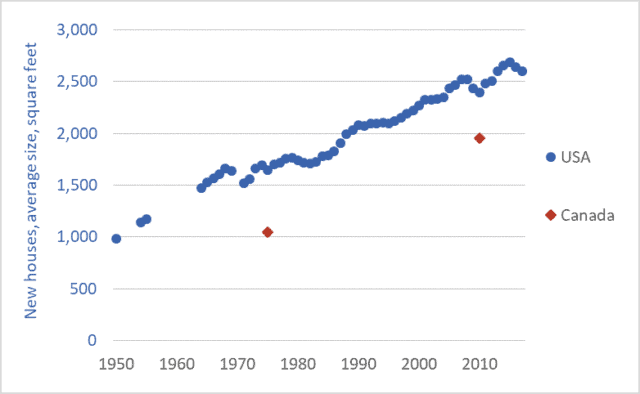
     In addition to the house occupying more of the lot, there is incentive for the builder to increase the size of the actual house. Houses are listed, and compared, by $xxxx/square foot (in other areas Money/square meter). The price to build is NOT the same for all sections of a house. Kitchens and restrooms are more expensive. By adding more square footage to the "living" areas, builders can squeeze out more profit without increasing the price per square unit of area.
A chart of this increase in house size can be seen from Darrin Qualman's post.


     Perhaps this is not particularly egalitarian -- people who have more income (or more inherited wealth) can buy larger houses in more desirable locations with better views, schools, climates, landscaping, local attractions and such than those who are poorer. But such has been the case since land and property started "belonging" to people and is likely to continue.
     The greater problem is having the AVERAGE housing price go up faster than the AVERAGE wage. As time goes on, a smaller and smaller percentage of the population can afford to buy housing. This also reflects upon the situation for renting since renting is the process of fostering out to others property that has been purchased by someone. In other words, rents are loosely based on the amounts of mortgages for the property.
     Before I started researching to double-check facts for this blog, I thought that real estate prices were rising much faster than inflation. It does not appear to be the case. Even wages are reasonably stagnant (decreasing only a small amount, on average, against inflation) from amhill.net's post (you may find other sections of the post of interest, also).


     But, since house prices are per square foot and the average size of a newly built house has increased by 250%, many fewer people can afford a house. What they can afford is an apartment (or maybe a townhouse) which shifts the size back to that of a house built in the 1950s. That may not be that unreasonable -- the increased size is a factor of literal "inflation" but it does mean that the "American dream" of a stand-alone house with its own yard is more and more out of reach for many people.
     One new trend against this flow is for that of the "tiny house" movement. Note that, although the square footage is quite a bit smaller than the typical newly built house of current days, the price per square unit of area actually goes up (once again, the cost of kitchen/bathroom is more expensive and there is less "living area" to offset that cost). Of course, people can still buy their own lots and have their own "moderate house" built. It just doesn't seem to be currently popular -- which means that it may prove hard to sell in the future.
     In summary, part of the lack of ability for people to afford housing is an illusion. Since the size of houses has increased (and the prices accordingly) and wages have remained stagnant then fewer people can buy the houses currently being built. However, if the size of the living area is kept constant -- and the form of the living space is allowed to change from that of a "dream house and yard" -- then people's ability to afford housing has not changed. Unfortunately, the numbers of housing units built of an affordable size is not keeping pace with the percentages who can afford them -- causing housing and rental shortages.

Choices: Often, we are not able to change a situation, but we can almost always make a choice about our response

     I have a long list of possible newsletter ideas which keeps getting longer. Sometimes, I go back to a topic I put on the list ten years...