Showing posts with label income inequality. Show all posts

Wednesday, June 24, 2026

Never Known Hunger: The benefits of having been poor (and are no longer)

     Do you have children who are picky with foods? They don’t eat one of the food groups or the portion isn’t big enough or they would have preferred to have had two desserts and no vegetables? It is beyond their ken to truly visualize not having food and being very glad to have any.

     Although this newsletter is titled to be about food, it is really about the realities of knowing what it is like to be without via experience and the blessings that exist when you can experience having it. It can apply to food, shelter, transportation, good water (I have this tendency to often say, after a long drink of water, “I love water”), clean air, safety, love, or whatever quality you can think of that is not inherent (though perhaps it should be).

     Ideas & Interpretations is a reader-supported publication. To receive new posts and support my work, consider becoming a free or paid subscriber. All posts are free but paid subscribers help the posts to be regular. Thank you.

Growing up without

     Once upon a time (in a galaxy very close but seeming far away), my birth family went through many periods of financial struggle. I have never starved, wondering whether I would last to the next day, because my parents always somehow made it not be the case. Nor have I had to sleep in a car or a back alley. But I sometimes slept on the floor and then, when a paycheck came in, on a mattress on the floor.

     I most remember the periods of stretching food as far as we could (maybe that is why having good food is so precious to me nowadays). A few times we were on food stamps and I remember the three pound blocks of Velveeta (or some other processed cheese) and the two pound tubs of margarine. One of my uncles was stationed in Alaska and, for a couple of years, we received a case of canned salmon for Christmas. There were salmon burgers twice a week for the next two months.

     One of the dishes that lingered the most for me was “ham and beans”. This meant soup made with a ham hock and lima (or butter) beans. We had that five dinners a week for what seemed like months (though I am certain it wasn’t for that long). Although I can eat butter beans now (60 years later), it is always with memories rising to the surface.

     When buying clothes, they were purchased from the bargain racks of a local thrift store. I remember the delight I felt when I got a pair of bell bottom jeans three or four years after they were fashionable. They didn’t last long as the fabric was pretty thin but the rhinestone designs on them made me smile. Thank goodness, no one ever razzed me about them though, as I said, they were badly out of fashion and I never encountered anyone else with a pair while walking through the school aisles.

     I had relatives who had even less than I did so I sometimes felt “rich”. Feelings of richness or poorness is always a matter of comparison. I had a few friends whose families were “professional” (a banker’s son and a dentist’s son) and I slept over in the dentist’s son’s home a time or two. It was the first time I had ever even heard of an electric toothbrush.

Refugees and Immigrants

     In the case of a refugee, the movement from their country is not voluntary. They either no longer have a home or their home area is not safe for them (politically or physically). Immigrants have more control over their movement. They want to move and they have a chance to prepare for the move.

     In both cases, they have inherent motivation to do better in the new country than they were doing in their previous country. For a refugee, it may just be the chance to continue living. If jobs are available, they are usually willing to do any job that will allow them to survive. Often, these jobs are not in accordance with their prior positions or training. It is only when jobs are NOT available, that problems surface. Immigrants who have options have a lower crime rate than that those that already have citizenship including born citizens.

     I had a grandfather to my two older children who immigrated to the US. In his original country, he was an engineer. When he arrived, he no longer qualified to pursue his engineering career. He did a number of things including working with a fast food franchise and owning a health food store. He could not be an engineer but he could, and did, do what he could. This happens with many refugees, or involuntary immigrants. They drop from “professional” careers to labor careers.

     Although fictionalized, “Moscow on the Hudson” with Robin Williams is a good illustration of an immigrant/refugee’s process. Robin’s character took many different jobs to continue to survive. He was also fortunate to make some good, supportive, friends early in the process. Some immigrant/refugees have members of family to help. Some have support from others of their cultural, or ethnic, group. (Some are taken advantage of by others of their cultural, or ethic, group because they are ill-advisedly trusted.)

     In all cases, they have inherent motivation to do their very best.

No one wants to stay poor

     My parents were not always at the upper line of the lower income group. Sometimes they were at lower line of the middle income group. No vacations but they did have the ability to buy a home (in the 1960s, a steady income at minimum wage made such things possible) and they could send us to school and we had the privilege of being able to stay in school and study. No significant savings. I was supported in being the first of my family to graduate from college via social support arising from the death of my father (a Korean “Conflict” veteran) when I was 14.

     During those periods when my parents (and the children) lived on unemployment and food assistance, my brother and I could always hear them talking about possible jobs and methods of stretching what savings they had. As part of their midwestern job ethics, they wanted to leave unemployment and assistance as soon as possible.

     My father did various jobs and tried a few businesses. Alas, he had neither the background nor the preparation to make a business succeed. He only knew how to work hard and that, unless one is very lucky, is not enough.

What can be done?

     I truly think that all in the upper income brackets should be required to spend two years in the Peace Corps or equivalent self-supported situation. They should be required to learn what is needed to live when they don’t have access to hoards of resources most of which they cannot claim to have directly earned.

      Just having passed another Father’s Day, I find myself recollecting and recognizing some of what I did wrong while my children were growing up. (I am sure they have a longer list and, perhaps, leaving out some of things that I think of.) Although I don’t think that any sane parent would force deprivation upon their children when it is not required, I should have been much more ready to say “no” than to say “yes”. In particular, not having any choices for a number of years of their earlier years would probably have led to better hygiene and room cleanliness. Sets of chores would have been useful to them as well as the family. Helping me to repair things would have taught them more basic skills.

     What are my excuses? Well, number one was probably not wanting to be the “bad guy”. It is harder to justify a decision that requires constraint when living in a situation where there is no need for tight budgets. Another one, with which others (including professionals) agreed with, was to be “fair” and “consistent” with older half-siblings who basically did whatever they wanted to. I should have ignored their advice and my uncertainty.

Count your blessings

     There are songs about counting blessings. I truly do that. I don’t end up with a sum where I say “oh, I have 347 blessings today”. I just try to be aware of those blessings that I have. It is particularly useful when faced with a situation of anger or frustration. A driver does something rather dumb and I say to myself (sometimes out loud) “well, Charles, when you are a perfect driver, you can yell at others”. Sometimes my wife will complain that I am always trying to envision solutions to problems before they ever occur (and are often unlikely to occur) but the other side of that is that, by being aware of how things COULD go wrong, I am also very aware of my blessing of them not having gone wrong.

Ideas & Interpretations is a reader-supported publication. To receive new posts and support my work, consider becoming a free or paid subscriber.

Thursday, June 4, 2026

The economy: A set of interconnections

     The economy, whether for a household, a country, or the world, is a game with money as the tokens. Granted, it is a very serious game where the losers may lose their lives, in addition to anything else they possess, without “extra lives” or the ability to reset the game. Some people treat it ONLY as a game and forget that most of the players are everyday people. As a game, it becomes extremely important, and dangerous, when the great majority of the tokens are available only to a few people. Those people have learned to manipulate the rules of the game to take advantage of them for personal triumph but their goal is incorrect and deadly. The proper goal for an economy is to maximize the ability of ALL the people to participate.

An overview of an economy

     As I wrote about in 2014, money is an abstraction of resources and energy. At the very foundation, the basis is about the things that you directly interact with — eat, drink, feel comfort, enjoy, and so forth. The larger the community, the more specialization that occurs and the more abstract money becomes.

     There is a “spider web” that casts out from the specific item to foundational societal, and personal, uses. For example, getting a screwdriver involves a store, sales people, sales environment, stockers, distributors, manufacturers, parts manufacture and assembly, and raw material sourcing. Once upon a time, during a Google interview, I proposed that a tool that worked with the interactions of all such ladders could be of great use for planners and the economy. It could help to answer such questions as “how does moving the economy from private automobiles to public transportation affect jobs?” “How does moving from fossil fuels to renewable energy affect jobs?” Nowadays, the question might be “How will GenAI affect jobs?” but we may not know enough to be able to be sufficiently specific in our questions. GenAI, itself, might be able to do the interconnections but, first, it requires the data.

     A part of the economy that hits most of us week on week is income. One of my sons has gotten a job which does NOT use his bachelor’s degree in Computer Science. It is in a deli for a local grocery store. It is a good company, good people, and the work is work that he does well and for which he is appreciated. But, he is already in the work by the week, counting until the weekend (for him, that is Wednesday and Thursday). In spite of his B.S. and six years as a coordinator at a grocery store in Maryland, he is making minimum wage which is not quite enough to meet his desires to leave home and be on his own. (However, it is better in the state of Washington than many others.) He is definitely not alone. Other forms of income are interest and dividends but those are usually something that exists for older workers or those that come from wealthy families.

     His outgo is like most of ours. Living within the family household, he doesn’t face the corset of a true budget yet but he does know he must live within his means and he has tasted the stock market and wishes to dive back in. For others, not in his situation, they have a “most important first” budget which often does not quite include things most feel are normal. For the rich, and mega-rich, outgo is not really of any importance. All required things are just bloops upon the income/outgo stream. For most of us, the outgo must be monitored closely to not exceed the income. Sometimes we don’t succeed.

     The tokens of the game circulate. The true foundation lies with the material world. That includes food, raw materials, and infrastructure. Without them, the economy would collapse quickly. Other things that we now consider “necessary” for everyday life truly are not although our reliance on the digital economy could indeed crash everything with a few dozen strategically located electromagnetic pulses (EMPs).

The parts of the economy associated with taxes

     “The only things certain are death and taxes”. Just what are taxes and why are they so ubiquitous? Taxes are an allocation of resources for local or national group usage. There are many services that are common worldwide for people to pool resources (often via taxes) to serve the general populace. Such areas include infrastructure (roads, electrical networks, dams and reservoirs, water treatment plants, sewage treatment). Sometimes these are subscription services where individuals, who are willing to do so, pay for service. But, since they are for the common good, they are more often public services paid for by taxes. Can you imagine the situation if only 60% of the community decided to subscribe to waste services? It would leave 40% of the waste lying around causing health problems for everyone — possibly even another Black Death or other epidemic.

     Other services, often paid for by taxes, include improvement of life areas. These may include police service, fire fighting service, libraries. These have a more haphazard payment situation however if (for example) fire fighting was a subscription service then a fire occurring to your next-door neighbor’s house would endanger your own house (and others) if you had private insurance and they had none. It is safer for the community if fire fighting is available for all people and all property. Perhaps you might say “I never use the library, why should my taxes be used to pay for it?” Perhaps you don’t, personally, make use of it but the fact that it is available to your neighbors helps to reduce juvenile delinquency, general unemployment, community estrangement, and social malaise. In other words, your community is healthier.

     National taxes are traditionally used for national services. These include infrastructure that helps transportation from community to community (airports, roads, etc.). It also includes “defense” spending which should be used almost totally for protection of the general citizenry. There is a category of social spending that involves bringing in taxes and then redistributing them according to needs. Retirement and associated disabled benefits is another community support that is spread back among communities. Finally, an increasing expense is interest which is paid on debt owed by the national government to pay out on the budget.

     The national budget, very simply, is a matter of money in and money out. It has been very popular over the past 40 years to pursue the fantasy of “trickle down”. This has led to a general lowering, and flattening, of income into the treasury without corresponding reduction of outgo to non-social services (such as defense). Note that social services such as “food stamps” are such a small portion of the budget that, even if politically appealing, they don’t really make much of an impact to the budget.

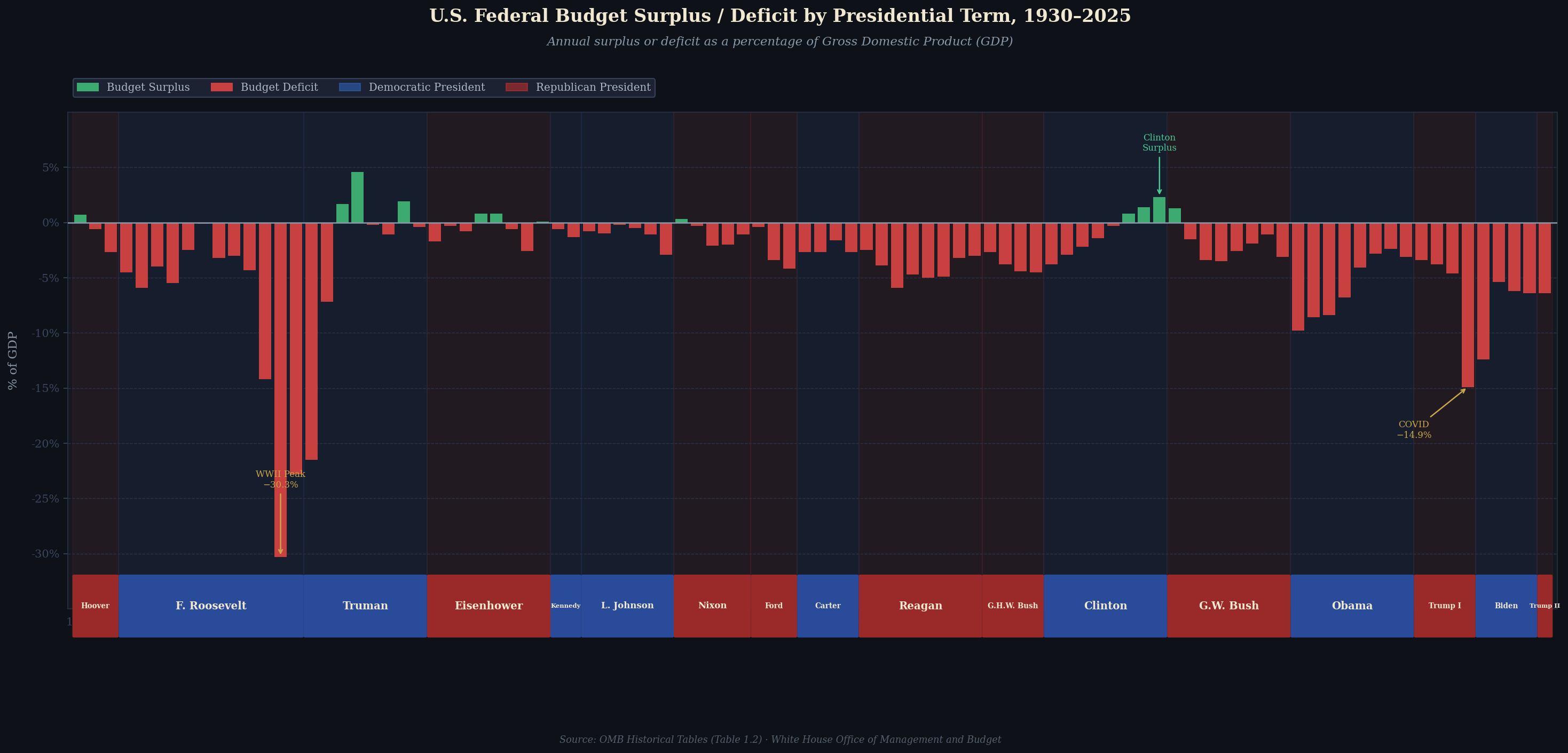
     One can look at the budget deficits over the years and recognize that those yearly deficits continue to accumulate into our national debt.

The three biggest deficits shown (in order) occurred for WWII, the COVID pandemic, and the “Great Recession”.

Money, as a resource, must keep in motion to be useful.

     Money has many attributes similar to that of physical resources such as water or air. As a representation of resource, it must be distributed and redistributed to keep the economy healthy.

     “Trickle-down” creates dams and spill over which don’t serve the purpose of circulating money through the economy. Having lots of people able to afford other people’s services and products is what keeps money circulating. That cannot happen if it is jammed up into the pockets of a few.

     Repeating some of the information from the old blog/newsletter. Money started when society outgrew barter. During barter, some type of conversion rate was agreed upon. One dozen eggs equals one fish. A cord of firewood equals one yard of woven fabric. Once the group of people grew larger, it had to be abstracted as someone who could provide a wall hanging might not need, or want, two cords of firewood. The conversion/barter rate needed to be converted into tokens which eventually became coins and money. It was the ability to easily transfer the coins that established the basic mechanisms of money and an economy.

     Without movement of the money, the economy gets stuck and no longer is healthy and able to fulfill its purpose.

Ideas & Interpretations is a reader-supported publication. To receive new posts and support my work, consider becoming a free or paid subscriber. Posts are free and will continue to be free but paid subscriptions will help to maintain my momentum.

Wednesday, May 6, 2026

A Leadership Position: Not always a replaceable cog in the machine

      Please feel free to repost, or restack, as I think it is past time for this to be discussed around the dining table, boardroom, or virtual water cooler.

     When, in 1983, Steve Jobs hired John Sculley to run Apple, the decision was made because it was felt that a person who had successfully run a campaign to improve Pepsi-Cola’s position versus Coca-Cola could also market Apple products amidst increasing competition. This was reasonable, and rational, on paper. But Apple, and its products, are not fashioned around something that anyone can do or produce. While “the power to be your best” wasn’t a bad campaign idea it could have been used by other competitors without much of a change.

1984

     There was a successful collaboration between Steve Jobs and John Sculley for a while with the peak being the iconic “1984” Apple commercial. But the approaches were just too different between the non-tech Sculley and the tech visionary Jobs and Sculley forced Jobs away from Apple in 1985. Jobs headed off to found NeXT where he wanted to re-create a new Apple from scratch using his experience at Apple. Technically, he was very successful with the NeXT cube used as the software and hardware base for Tim Berners-Lee initial work on the World Wide Web. Commercially, it was not as successful as the journey towards perfection tends to be a costly process. NeXT eventually folded and its modified UNIX® (the ancestor of Linux®) became the basis of Apple’s OS X operating system.

Beyond Apple

     So, is this a newsletter/blog about Apple? No, though the Apple/Sculley/Jobs situation is a great example. The board of Apple wanted Jobs to bring in an experienced executive to run the company. That might have worked for another company but not for Apple.

     This same attitude persists, through today. Boards of directors will compete against each other for the best-known, or highest “ranked”, executive. They treat them as cogs for a machine. If they can run a company making widgets at that place then they can do the same here. Maybe. If they are paid $200 million at Company A then they are surely worth it and they might come over here if we offer them $300 million and an espresso machine. It sounds silly and it is silly and it is a large part of the reason why the ratio of pay between CEOs and line workers is totally out-of-control nowadays within the USA.

Roles of a CEO

     A CEO basically has three roles. One of these is to be the figurehead, or icon, for the company. While the need for a figurehead is true for all companies, it is particularly true for companies that are trying to improve market perception of the product or brand. In this situation, perhaps pay can be justified as though they were a celebrity (sports, music, acting, …). Of course, I’m not at all certain that celebrities should be paid so much but the case can be made that, in some cases, the CEO is to be treated as a celebrity. Steve Jobs, Lee Iacocca, Mark Zuckerberg, Warren Buffett, and more can be considered in this category. One of the first within US history was probably Henry Ford.

     While it is true that a small percentage of CEOs can be seen, and “justifiably” paid, like a celebrity or icon, the great majority do not qualify for such and should be paid much less. All of them, however, do function as the “head” of the company. Sometimes they are actively visible and sometimes they work behind the scenes.

     The second role is as an internal leader for the company. This is important (as Apple discovered within their fiasco). Even if the employees are not treated great, the employees need to feel like their efforts matter to the company. Decisions must be made and communicated in a constructive fashion. The CEO has the “last buck” stopping at their desk and it is vital they are aware, communicate, and take responsibility.

     Any leader can make bad decisions but good leaders recognize, acknowledge, and take responsibility for those bad decisions and redirect before harm occurs. Great leaders work with others whose skills, and expertise, compliment their own skills such that they make very good decisions most of the time. Bad leaders either fail to make timely decisions or make decisions without paying any attention to feedback or outside information. Terrible leaders not only mostly make poor decisions but surround themselves with sycophants (or “yes people”) who will reinforce the tendency to make poor decisions.

     The third role is in the area of networking. This is important for understanding what is happening in the market within which the company’s products are competing. It is also important for making others in the industry aware of what the CEO’s company is doing. New product ideas (and features) occur as a result of networking as well as internal feedback. Public collaboration (cabals and price fixing need not apply) may be of mutual advantage. To know, and be known, within the industry — THAT is the question.

Can a great soft drink CEO be a great tech CEO?

     In the case of Apple/Sculley, the answer was no. Is such a situation always a bad decision? I don’t have enough knowledge and experience to give a definitive answer but my basic feelings are that it CAN work for certain market segments. It is very difficult in the tech industry. In the processed food industry, it is likely very easy.

     If a company has an icon in the driver’s seat then that icon needs to know the product(s) of the company forward, backward, historically, and sideways. Or they have to present themselves as knowing such. If the company does not have an icon in charge, then that CEO can perform, or delegate, the other roles, as long as they have good supporting team members.

What about company employees other than the CEO?

     People filling certain roles can be critical within a company’s long-term plans and ability to support existing products. They can be considered to be mini-CEOs and, within their subdomain within the company, can be treated, and analyzed, in the same ways as the CEO. The head of a product division, for example, may be known within the industry for that product as well as having in-depth knowledge of the product, and people working on that product. This is certainly a definite advantage for the company.

Analysis of needs

     When a CEO is placed, or replaced, within a company there is a need to analyze just what roles is the person to fulfill. Although not titled a CEO, when Ronald Reagan was chosen by his party to be the Presidential candidate, it was to fill the first role of a CEO. He was to represent and be the figurehead of the company (USA). The second and third roles of leadership and networking were left to others behind the scenes and not in the spotlight.

     If the board believes that an icon is needed for the company then, by all means, compete with other companies for that iconic/celebrity position. But, make sure that either the person is capable of filling the other roles or make it clear to them that they will not be controlling such duties. It may be necessary to fill an additional position at the same time to formally (or informally behind the scenes) handle the other duties.

     What if an icon is not truly needed? It isn’t needed for most CEO-level positions. The board (or other group of searchers) must find someone who can be adequate at the figurehead position but who excels in the roles of leadership and networking. Pay them well, in accordance with company performance, but don’t treat them as a celebrity. They are a working stiff who is expected to do their job well and produce results.

Conclusion

     There are broadly known icons within business. They are stars and celebrities. But most are not such icons and should not be paid as celebrities. They are working stiffs expected to do their duties well and who should be well, but not extravagantly well, paid and treated. By paying attention to needs and matching such to a candidate’s abilities, good long-term choices can be made.

Ideas & Interpretations is a reader-supported publication. To receive new posts and support my work, consider becoming a free or paid subscriber.

Thursday, April 23, 2026

Trickle down, Spill over, and Bubble Up: Terrible ideas can be camouflaged by cute names.

     I remember riding on the bus to work back in late 1980. The bus driver was enthusiastic about the election of Ronald Reagan. “The Gipper”, as appropriate for an actor out of Hollywood, had great charisma and could sell a box of gravel to people and convince them it was a box of diamonds. He wasn’t a con person like recent folks but he would have made a great used car salesperson.

Ronald Reagan was the consummate charismatic presenter

     Sometimes Ronald Reagan was called “the first Teflon President” because nothing ever seemed to stick to him. His terms had a bit higher than average numbers of scandals and problems — but nothing close to current times. He just smiled and waved his hand and everyone just said “gee, what a great guy”. You couldn’t always remember just what he said but, golddarn it, he said it so WELL.

     Gary Trudeau would write Doonesbury comics referring to Reagan by “rose-colored glasses”. The world looked so simple and nice through his vision and words.

     It’s impossible for me to know, and possibly difficult for anyone to be certain about, just how much Ronald Reagan was involved in the creation of various policies and ideas — but he was the spokesperson and he made people (in general) happy about them.

Reversal of the New Deal on the road back to a “Gilded Age”

     This was the start of the reversal of the “New Deal” which was instigated to protect the general populace against the greed and carelessness of the rich and large corporations. It’s been a long process but it has continued along for the past 40 years to where we are. Huge income inequality, virtually non-existent taxes for many large corporations, purchased legislators, and ratios of income between CEOs and workers that are dealing with close to astronomical numbers. This situation is quite similar to what existed before the Great Depression happened. Hopefully, we will not need to enter into another Great Depression before restoring sanity to the economy. The ramifications of the AI shift and automation within the labor pool will require something more than the policy changes of the New Deal.

Ideas & Interpretations is my established substack offshoot for Technoglot and a reader-supported publication. To receive new posts and support my work, consider becoming a free or paid subscriber.

Trickle down and Splash over

     The primary economic policy injected into the US economy during the Reagan administrations was called “trickle down”. The idea, sold by President Reagan, was that if taxes were decreased for large businesses and the rich then the additional money they retained would then “trickle down” and increase the general wealth of the rest of the population. It was balderdash then and it has been close to universally agreed to by economists that it is still balderdash.

     The “trickle down” never manifested. With those increased pools of money that were retained by the rich and large corporations, they invested in various things that would bring them even more money. They DID pass along money to others but it was in a way that I call “splash over” — because that money was distributed to the lowest income earners that provided services for them. The pools filled up and the water splashed over to reach the ground. Some bounced back up to minor business owners but most was reserved for services and labor.

Bubble Up is not just a carbonated drink

     If trickle down and splash over don’t provide an equitable, vibrant, economy then what would one call the economy that resulted from the New Deal? I call it “bubble up” in contrast with the misnomer of “trickle down”. Within bubble up, we have a large, thriving, middle class that can save, educate and take care of their families, and look forward to a decent retirement after having worked hard for a number of years.

     We also have a group of lower income folks that work hard for a living wage. They don’t have a lot extra but, without potential health care disasters looming over their heads like a guillotine, they are able to live life without being in a state of panic when an accident, or injury, occurs.

     Unlike the folks being resurrected by the original New Deal, currently our dysfunctional Congress has no plans for what to do with the remainder of the populace who are willing, and able, to work but for whom there is no job. I will expand upon the topic in a newsletter to come but, with AI and automation displacing workers, we will soon (if not already there) end up with more people able and willing to work but with no open positions existing.

Bubbling

     Besides the contrast to the theory of trickle up, why do I call it bubble up? All of these middle and lower income people are working, producing, and earning. They have the resources to spend and, while spending, they generate profits for other businesses. These profits indeed bubble up to owners and stockholders. Rather than some erroneous idea that the wealthy will actively take care of everyone else, it relies on the structure of capitalism to produce wealth that is distributed according to effort and ability with profits accumulated by the owners of capital. Trickle down squeezes the middle and lower class like sponges to drain them. Bubble up encourages them to thrive and keep resources, and money, flowing through a healthy ecosystem.

     So, if it is so beneficial to the economy and society, why isn’t the concept embraced by everyone? Unlike other economic “isms”, capitalism doesn’t require perfect people to make it work but, by itself, it still allows greed, selfishness, and obscene accumulation to occur. And once an oligarchy is allowed to settle in it requires a consensus in others to stop it. Or a Great Depression.

I prefer the peaceful consensus and resurrection of the Renewed Deal. How about you?

Ideas & Interpretations is a reader-supported publication. To receive new posts and support my work, consider becoming a free or paid subscriber.

Wednesday, March 4, 2026

TAXES: Progressive versus Regressive versus Flat; among other matters

     “The only things certain are death and taxes”. Just what are taxes and why are they present everywhere? As I wrote about in 2014, money is an abstraction of resources and energy. At the very foundation, the basis is about the things that you directly interact with — eat, drink, feel comfort, enjoy, and so forth. The larger the community, the more specialization that occurs and the more abstract money becomes.

     So, what does all of this have to do with taxes? Taxes are allocations of resources/money for communal use. The rest of the resources/money is for personal use. ALL of it comes from the same pool of resources/money.

What is the Government Sector and How do Taxes Relate to it?

     Taxes are collected by, or for, sections of the community that are collectively called “government”. We often think of government as those people “in charge” — whether they were put there by democratic vote or as an act of a group of oligarchs or as part of a drafted group of people or a group that overwhelmed and took over from the previous government. But government is divided up more for purpose than of particular titles or functions. Government is composed of decision makers but it is also composed of the manifold people who carry out those decisions and make the system work (sometimes called the “bureaucracy”). A data entry person in a municipal water works is part of government. If it is a separate, for-profit, business then it is not government. The delineation is that the government portion is paid for by the community as a whole and gives service to the community as a whole.

Benefits for Citizens from Taxes

     This is often an area of irritation for taxpayers. “Why should I have to pay school taxes when I don’t have a child in school?” “Why should I pay taxes to the federal government when they are spending money on this, or that, “frivolous” item?” “I don’t have a car, why do I have to pay for taxes that take care of the roads?” “I don’t go out of my house, why should I pay for National Parks?” “I am proud of being illiterate and ignorant, why should I pay for libraries or schools?”

     The answer to such questions is a matter of direct and indirect use. You may not drive on the roads but every person who delivers something to you DOES use them. You may not go to the National Parks but you DO benefit from protections of the environment with better breathing and a general ecosystem. You may not have a child in school but I am certain that you make use of services from people (likely including yourself) who DID move through the educational system. Indirect benefits of taxes are easily forgotten when one is trying to balance the budget for the month. Every rich person is totally dependent on hundreds or thousands of other people who are making use of services that are taxpayer-funded — and so are the rich people.

     When a person is choosing (if they have that opportunity) where to live, cost-of-living is an important factor. This includes taxes. You will probably save money in moving to a low tax area. But lower taxes are also likely to lead to poorer infrastructure and services. Poorer roads, poorer school systems, poorer fire and police departments, and so forth. Although poorer does mean less well-funded, many of these departments may still do very well because of the dedication of the people who work there — funding is not everything — but funding does matter.

How are Taxes Allocated?

     There are many ways that taxes may be levied. In the United States, ONLY Congress can create taxes. Neither the Executive nor the Judiciary branches can create taxes although the Judiciary can determine whether the Constitution allows a particular type of tax to be levied upon the citizenry. Prior to the Sixteenth Amendment in 1913, all taxes levied by the federal government had to be allocated based upon a state’s population. This made any type of income tax upon an individual very complicated as it would mean a double index of tax responsibility — first allocating based upon the state population, then some individual allocation based on another formula. After the Sixteenth Amendment, the federal government was freed from the need to tax only upon basis of a state’s population — though the ability to tax continued to reside with Congress.

     In the US, income taxes are based on income divisions, with higher income brackets having to pay a higher percentage of income in taxes. Alas, this is made very complex with loopholes, deductions, special credits and other methods of reducing or eliminating taxes. Since tax structures, and laws, are primarily created by the wealthy for the wealthy most of those loopholes and such primarily benefit the wealthy.

     There are many other types of taxes. Tariffs, which can be created and managed ONLY by Congress are a type of sales tax paid by the consumer directly or indirectly via the price charged by the manufacturer/distributor. Sales taxes are based on the value of an article purchased. Property taxes are according to the current value of a piece of property. Payroll taxes are charged against specific types of benefits associated with employees. Capital gains taxes, broken into short-term and long-term investment, are levied against any profits (or losses) associated with buying and selling stocks or other intangible value. The last major category is associated with “wealth transfer” — moving items of value from one person to another such as a parent transferring wealth to a child upon their death.

The Uses of Taxes

     A tax is money accumulated from the community as a whole which benefits the community as a whole. It should be that, the more taxes that are given to the government, the more the government does for the taxed citizenry. It is often true — but not always because it is always possible that the money will go to only certain segments of the population. In a representative democracy, it is up to us to make sure that our candidates really represent our wishes — that they truly represent us.

Types of Taxes

     Tax structures can be progressive, regressive, or flat. They can also be uneven based upon special exceptions so that, even if a tax starts off as a certain category, for certain companies or individuals it can effectively be something different.

     A progressive tax has the underlying motivation of having those who are more able to pay taxes — do such. As mentioned before in previous newsletters, there is no direct relationship between income and the earning of income. Much depends on the tax laws and other work laws. We may SAY that a great teacher is the most important job in society — but that is NOT reflected in wages, requirements, or expressed appreciation. On the other hand, a CEO may be a great figurehead of a company and may (or may not) be involved in corporate leadership, product direction, and other things that lend support to the earnings, and value, of a company — but they do not produce that value themselves.

     A progressive tax tries to encourage a desire to do one’s “best” within a capitalist society while spreading the recompense among all the workers who generate the corporate value and wealth. The head of a company making $400 million dollars might be taxed $200 million (leaving “only” $200 million) and a worker producing value make $40,000 dollars and be taxed $200. This is determined by a combination of tax laws, wage laws, and unions (which are designed to represent the people creating the value).

     A regressive tax works in the opposite direction. That $400 million dollar position might pay an effective tax (because of loopholes, deductions, and credits) of only $500 while the $40,000 dollar/year worker pays $10,000. Normally, such regressive taxes are not done via income taxes (much too obvious) but via loopholes, credits, and special deviations from common tax law.

     Another method of imposing regressive taxes is by taxing things that poorer people use more of, as a percentage of expenditures, than richer people. For example, tariffs are often a regressive tax because a $100 tariff on a television set is so much larger of an amount for a poorer person than it would be for a richer person.

     Flat taxes always come up in conversations about tax system improvements. It has the huge advantage of being simple. But it only works without loopholes or other special aspects of the law. The rich pay more because they have more — they don’t like the removal of the loopholes. However, a person earning just enough to live on will be hurt considerably by a fixed tax whereas a rich person getting excessive income may not even notice it.

Tax Fairness

     Different formulas can work and they can approach fairness but loopholes, credits, and special situations can, and will, sink any reform. When we are paying taxes and are not receiving the services and value that we expect, it is time to find new representatives.

     We pay taxes as a whole to receive benefits as a whole. When we pay higher taxes, we deserve higher benefits. But if we prefer lower taxes, we should expect lower (perhaps much lower) benefits.

Thanks for reading Ideas & Interpretations! This post is public so feel free to share it.

Ideas & Interpretations is a reader-supported publication. To receive new posts and support my work, consider becoming a free or paid subscriber.

Tuesday, February 3, 2026

So You Want to Buy a House: The dream has receded for many but hope does not have to be gone forever

      My 26-year-old son occasionally moans to me that “my generation will never be able to buy a house” — to which I raise my eyebrows and say “you might”. A further response is “things just aren’t the same as they were in your generation”. At which point, I stop trying to change his mind. He is right. Things are not the same as they were in my generation.

     Yet, it wasn’t that way in the past and it doesn’t have to be that way in the near future. It isn’t unusual to look around and see a situation and not be able to imagine anything different. I have done blogs/newsletters on many closely related topics — income inequality, hope, apathy, entropy — but sometimes it is necessary to bring related topics together to address something specific.

     Buying a house is a specific, and physical, issue that is closely related to income inequality, hope, and apathy.

Why do people say “I’ll never be able to buy a house”?

     Most people rent. It used to be that most people owned (or held the lease and the bank held the property title) their house. In the US, in 2025, the average mortgage cost $2329/month. The average rent in the US, in 2025, was $1987/month. This is a $342 difference — not much. Admittedly, even not much may be too much for many.

     With only a $300ish difference between renting and owning, why are so many renting? Some want to rent. Assuming you stay in the house for a number of years, a house is a great investment but it ties up a lot of money which could be used in other ways. It is also very “non-liquid”. Getting your money out of the house (equity) may be easy in a “sellers market” or difficult in a “buyers market” or if features in your house are no longer fashionable. I am sure there other reasons for people to prefer renting.

Requirements to buy a house beyond what is needed to rent

     For those who would like to, but feel they cannot do such, there are two major hurdles. First is a down payment — usually 10% but sometimes 20% and, at times, down to 5%. The second, which is closely related to down payment requirements, is your “credit score”. A credit score is a fictitious number devised by credit companies. Companies that determine credit risk have their own arcane formulas. The minimum down payment required depends a lot on the economy and upon your credit score. This credit score also affects requirements for deposits on rentals and services (such as utilities). A third is being able to qualify for the loan — a mixture of income, credit score, savings, and other assets.

     While the down payment is partially dependent on credit score, it still exists. For 2025, Bing says an average house in the USA is $522,200. With a good credit score, a 10% downpayment would be $52,220. There are also various one-time costs associated with buying a house, so let us say $60,000 is needed to buy an “average” house. If you started savings towards this total five years before, that would mean $12,000/year in savings. Or six months rent in savings instead of in a landlord’s pocket.

     So, beyond requirements for renting, buying a house requires a good credit score, a down payment, and qualifying for the loan.

What has changed? Why have hopes to buy a house dwindled over the years?

     There is a simple, quick answer — it is much more difficult to build up the savings needed. And, with the added difficulty, it is much easier to get discouraged and say “what the heck, I didn’t really want one that badly anyway”. The longer answer of WHY is sad but reversible with a LOT of work by MANY people.

     Note that the credit score is tightly connected to savings and to a secure, reliable history of always paying bills on time. There are lots of details, of which some are secret and some are not very rational, but those are the primary needs.

     Over the past 40 years (starting around the time of Ronald Reagan’s term of office in the US), real income (inflation adjusted dollars) has gone down for most workers. A result of the good old ridiculous “trickle-down” economic fantasy. Many people have written about minimum wage amounts, including myself here, but it is also true for those who make more than minimum wage. More people are earning less money and this makes it difficult to save. If you are living paycheck-to-paycheck it is virtually impossible to save.

There is a reason why so many people put that extra change into lottery tickets.

     After World War II, there was a great push to build small, livable houses for the people coming home from the war and their families. These were called “starter homes” as it was recognized that most people would eventually want to move into larger houses. Nowadays, the idea has been revived in the concept of “tiny houses” — but many communities are very resistant to allowing these because they bring the average house price down (deflate the market). I will repeat — communities are resistant to building houses that more people can afford.

     House sizes and house prices (per square foot) have gone up faster than general income. There are many fewer people who can buy a 3500 square foot house with a $80,000/year income nowadays than could buy a 1200 square foot house with a $15,000/year income in 1975. The house size (and price) has ballooned and the wages have stagnated.

     In the US, Congress passed tax laws that allowed deductions for mortgage interest. This was very beneficial to those who lived at that time but having this advantage for house owners meant that houses were/are a good, usually stable, investment — which has led to home price inflation going up faster than cost-of-living and wages. In the past ten to fifteen years, with this being “such a good investment” — and lack of modification of tax laws to keep larger businesses, which have a lot of capital, out of the market — business funds have purchased more and more homes making ownership harder, affordable houses scarcer, and rental prices less flexible and higher.

So, a longer answer is —

  • real wages have decreased for most people in the US.

  • House sizes have greatly increased with few smaller houses available.

  • Corporations and larger financial institutions have taken advantage of tax benefits and loopholes to move house ownership away from individuals and families.

How can such a situation be reversed?

     Once again, there is a short answer. Reverse income inequality and get tax and wage laws back to the era of pro middle-income/upper lower-income. The long answer is much harder as those that have benefited with changes over the past 50 years have a lot of power, are extremely greedy, and continuously want more. There are, of course, exceptions who give back to the community on a voluntary basis.

Income Inequality, wealth, wages, and savings

     Here in the United States, we are enamored of our wealthy people. It’s been that way for a long time — perhaps since the beginning of the country. We don’t have lords and ladies, dukes and duchesses, kings and queens (though some would like to be). But we do have ultra wealthy people who have much, much more than they need or can use.

     Many people admire those rich people. They sit on the sidelines and watch them, envy them, and cheer them on. It’s kind of like being at a racecourse and watching those speeding horses go by while cheering them on. “Rich people” include groups of highly overpaid CEOs and other C-class executives, inherited wealth, the rapidly dwindling “rags to riches” fantasy fulfillments, the financial market manipulators, and celebrities. I may never understand why celebrities are so highly paid — perhaps they are just exceptionally beautiful race horses such that people want to put wads of money into their harnesses.

     The one category that should be expanded upon is “rags to riches”. It did use to be true that people could come up with an idea, dig in, save, and work their way to the top of the financial structure. They didn’t always do it fairly or legally — that is where the term “robber baron” came from. But it is mostly just a fantasy nowadays though it is firmly lodged into the national psyche.

     Bill Gates came from an upper-middle (possibly lower-upper) income family, Mark Zuckerberg was at Harvard when he (with others) started the basis of Facebook — and he wasn’t a scholarship person, Elon Musk was part of a wealthy South African family. I won’t deny talent also but they started off WAY above the “rags” stage. Warren Buffett seems to have started his journey at a lower level than other rich “superstars” but he still didn’t start at the “rags” level.

     So, who cares? However they did it, don’t they deserve it? Aren’t they a reasonable target for our own fantasies of achievement? Maybe — but their huge coffers are filled with what could be our savings and down payments. Tax and wage laws transfer what could, and should in my opinion, belong to the others.

     There is NO “entitlement” to riches. NO ONE got rich by themselves. They may have started on their own (or with a few partners) but, after a certain point, they have to start leveraging the work and talents of others to keep climbing the wealth pyramid. An awful lot of the rich have forgotten, or firmly deny, this reality.

Here is an insanely simple example. A person with a company that has $10,000,000 of sales per year has 200 people working for them each making, on average, $25,000 per year. This leaves the person “owning” the company with $5,000,000 to put into their offshore accounts every year. If the wages were raised to an average of $40,000 per year, those 200 people would each have an additional $15,000/year for savings, education, a down payment, a vacation, or whatever and the “owner” of the company would still have $2,000,000 to put into their offshore account. That “offshore account” is also a major factor in that they quite likely are using various legal loopholes and methods to prevent proper taxes being taken from that $2,000,000.

     The idea of “ownership” is a basic tenet of capitalism — but it isn’t written on the tablets with the Ten Commandments. The ability of the “owner” to pay their employees $25,000 per year rather than $40,000 per year is a matter of wage laws, inherent morality, and unions. Note that unions have suffered greatly over the past 50 years. There is no magic wand that says Bertha doing X work “deserves” $Y,000 a year in salary and benefits. It is ALL up to the society and the laws that are enacted.

So, how can the migration of wealth from the 98% to the 2% be reversed?

     Once again, a simple answer first. Tax and wage laws need to be shifted back to favor the 98%. And unions need to be appreciated and supported with laws and by the community. There is not much to be done about people’s inherent morality or lack thereof.

Changing the laws

     The wage and tax laws favor the rich because our legislators favor the rich when creating the laws. Some do this because they are among the rich — they have a lot of money and see nothing wrong with creating laws that will keep them accumulating excess money.

     I “joke” about the rich owning our legislators. It seems that way but it is not quite that simple. Being elected to national office is a very expensive business (see why in my old blog here). It is easier for a candidate to have the money needed to be elected if they have rich sponsors. Those rich sponsors may, or may not, tell them how to vote and what laws to create or remove — but the elected officials are very careful not to antagonize their rich contributors because “how can they do good for people if they aren’t in office — and that means getting re-elected time and time again”? This is an excellent reason for term limitations. People who have held elected positions for a long time are very likely to do more and more to retain their position but do less and less of the things they originally wanted to do. Once again, exceptions do exist.

     The rich have always had greater leverage but it accelerated horribly when the Supreme Court, very dubiously, ruled in favor of the rich in the Citizens United case in 2010. Although not explicit, this case allowed the rich to give (without disclosure) as much money as they wanted to candidates. It allowed the purchase of legislators. There really isn’t any other way to describe it.

     So, the rich have a highly weighted influence on the US legislators and courts. There are also many other legal and economic benefits for the rich that are not available to the poor. Lastly, legislators who have been elected for multiple terms are more likely to value being re-elected than to be actively fulfilling their original desires for the citizens.

Primaries are key

     Peacefully, the main method that US citizens have of truly changing our legislative base, and judicial appointments, is via the system of primaries. It IS possible to start new political parties but that is a much more difficult process than changing existing political parties from within.

     The ruling structure within a political party have enormous advantages for electing the candidates that THEY choose. But, with a lot of hard work, it is possible to change the candidates running for office. It is possible to choose candidates that favor the general populace rather than the rich.

     This is not easy but it IS possible. Without it, nothing more can be done. Tax, wage, and election laws will not change. You have to have legislators willing to work for the general populace and who are not scared of disrupting the status quo.

Once the legislative base has changed, what then?

We’ve really talked about all the parts but we’ll summarize here (not in any particular order):

  • Legislate enforceable ethics requirements for all branches of government.

  • Legislate term limitations.

  • Legislate enforceable limitations on campaign donations and require (down to the individual) visibility of all people donating.

  • Change the tax structure such that the 98% have a better chance to accumulate and save. The word “billionaire” should be so rare that people need to check their (online or print) dictionaries to know what it means. This includes changing tax rates and closing loopholes.

  • Change tax laws so that corporate ownership of property no longer has any advantage over investment of any other type of property.

  • Add citizen protection agencies that have the power, and political independence, to protect individual rights including unionization.

In some cases, creating effective legislation means approving Constitutional Amendments.

     So, there we have it. Yes, it is much harder to buy a house now for most of us. But it didn’t use to be that way and it doesn’t have to continue to be that way. Primaries are key.

Thanks for reading Ideas & Interpretations! This post is public so feel free to share it.

Ideas & Interpretations is a reader-supported publication. To receive new posts and support my work, consider becoming a free or paid subscriber.

Tuesday, August 26, 2025

Recidivism: When the past just will not let go

     This newsletter/blog is unusual for me. I am extremely grateful that I have no direct experience about the subject matter — recidivism. To come back to jail means that you have been in jail. And I haven’t — though every time I stand up at a nonviolent protest to protest injustice there is a part of me that wonders whether I will end up in jail.

     Being arrested does not necessarily mean that you have done anything wrong. In fact, especially in current days, it may mean that you are doing something very right. Not that current protests (yet) approach the dangers of protests in the 1960s. Or the labor protests in the U.S. in the early 1900s. Being convicted does not mean that you are guilty. When discussing a person’s record, it is more accurate (and fair) to say they have been convicted of a crime.

     As part of a book club in which I participate with my wonderful wife, we often read books that I would not choose. Although I would have to admit, if asked, that I sometimes verge on the edge of doomscrolling (currently very difficult to avoid without ignoring the entire outside world), in my books/movies I veer towards the opportunity to move away from conflicts, difficulties, and tragedies. But book clubs often choose such — perhaps because such topics give more to discuss. One such book is “The Many Lives of Mama Love” by Lara Love Hardin. I won’t reveal many details of the book because I hate to give out spoilers but let’s say that it is a book of “move smoothly, stop at roadblock, work around roadblock, move smoothly again, …”. And there are a LOT of such roadblocks in the book.

     There are other books, and movies, about the effects of having a jail record. In the movie “Ant Man”, Scott Lang (who is this universe’s Ant Man) faces the problem of not being able to get a job because of his jail record. It doesn’t even matter if his area of conviction has no relevance to the job position. Large corporations do this for liability reasons and they are not noted for compassion. Smaller companies have more options but they, also, have the tendency to use the old adage of “better safe than sorry”. (This is, of course, from the company’s point-of-view.) This is played, in the movie, as comedy but the realities are quite tragic.

     Please note that this essay only applies to middle income people and the poor. In the U.S., the rich have a different justice system (not in theory but very much in fact). Their penalties (if any) are not even close to proportionate to the penalties given to the less wealthy. Corporate penalties are often completely laughable — so much so that the companies have very little incentive to not commit crimes. A million dollar fine sounds like a lot to a poor person but it sounds like nothing when it is less than a day’s profits. A crooked con person steals millions of dollars from poorer people, destroying their lives or retirement, and goes to minimum security jail for three years. Someone poor steals a car for resale in order to have food to feed their family and goes to jail for ten years in maximum security. “Les Miserables” is not just a historic book and film. It continues to reflect the truth of society.

     Assume that you were convicted based upon a law that you broke rather than for something that you had nothing to do with. Further assume that it was a law that makes sense — that the crime affected other people and, thus, would be a bad thing for you to do again. Once you have completed the required penance, there truly is a large percentage (it depends on the state, but as high as 61%) of people who commit similar crimes once again and go back to jail (recidivism). There are no statistics as to how many actually wanted to commit the crime again.

     What? Why would a former convict commit a crime if they didn’t want to? Sometimes it is because it is the only thing they know how to do. A con person is best at being a con person. An embezzler can most easily embezzle. A drug addict may find themselves unable to resist the attractions of the drug. More often, however, it is because almost all legal options of earning money are denied them. What are the difficulties that they can (and probably will) face?

  • Forever. Google (or any other search engine) means never able to say you are sorry. Unless you have a brand new legally searchable identity, anyone will be able to track down your past. And you can only get a new legally searchable identity through a “Witness Protection: situation or via someone who is able to illegally change, and enter, records into appropriate government databases. And the “Internet is forever”. This will likely affect the ability to work, relationships, general reputation and the ability to move on from the past. And it doesn’t matter if you were innocent or guilty, whether it was a crime against injustice or a crime against people.

  • The “Big Net”. If the bureaucracy can use you, they will. Let’s say that you committed Identity Fraud by stealing (or buying from the Dark Web) credit information that allowed you to illegally access fund or create new fraudulent credit liens. Once arrested, there may be other unsolved identity fraud cases. The authorities need to only prove specific crimes but they can add on whatever similar crimes they wish. After all, if they can prove that you did SOME crimes, can you PROVE that you didn’t do the other similar crimes? They get to take it off their books as now having been solved and you get to pay for someone else’s misdeeds.

  • Finances. Who do think does the work in a prison? Yes, there are wardens, and guards, and repair people, and such. But who cleans the cells, prepares the food, does the laundry and so forth? If you guessed inmates, you win a prize. In our peculiar mechanisms of capitalism, if everyone released from prison never came back, the prison system would collapse. Taxes would have to go up to have paid labor do these jobs. Whenever, in capitalism, more money is made/saved by doing something stupid rather than doing something well — guess what usually wins out?

    Also, the cost to the government (state or federal, which means taxpayers) is between $25,000 and $300,000 per inmate. How much does added educational and social support cost, and child care, and so forth to support people as they make their way in society? Yes, a lot less. Prison makes no sense within a capitalist economy and education and social support make a lot of sense. I have no solutions to propose — that is just a side-effect of U.S. capitalism and social policies.

  • Income. As discussed briefly in a previous blog/newsletter, prisons/jails are allowed to lease out inmates. They perform jobs at prices that go into the prison’s budget (or to stockholders for private prisons). Keeping a good supply of prisoners is healthy for the bottom line.

  • Employment. As already mentioned, it is hard for a person with a criminal record to get a job. It’s a circular societal problem. In theory, they want you to begin a great life free of crime. On the other hand — “not in my neighborhood” — few people are willing to take ANY risk to hire someone with a criminal record. (The rich don’t need to worry about being hired, of course.)

  • Bureaucracy. The system has a lot of very loving, caring individuals that want the convicted person to be released and succeed. However, the system as a whole makes it very difficult. Had trouble getting, and paying for, childcare before you were convicted? Wait until you try now. You have to attend two different meetings with two different departments 50 miles apart from each other? You have no car and they want you to meet at both places at the same time or you violate probation? Some individuals may care but the system doesn’t and they don’t want to hear excuses.

  • Society. Your friends all wanted you to do drugs, commit small crimes, and so forth? Stay away from them. What, they are the only people you know and if you try to make other friends, you are in a catch-22. If you tell them about your record, there is a good chance they will avoid you. If you do NOT tell them and they find out later they are likely to be mad, ostracize you, and malign you to everyone they know. So much for support groups. Family is a likely potential source of support — except, if they didn’t support you before are they really likely to support you afterwards?

     Exceptions happen. People do succeed after being released. They are the exception and are a variant of the vanishing urban legend of the “rags to riches” story.

     If a person really does do the penance for a crime (defined as having broken a law — or convicted of such whether you actually did it or not) then why do we keep a manacle on them for the rest of their lives?

Ideas & Interpretations is a reader-supported publication. To receive new posts and support my work, consider becoming a free or paid subscriber.

Friday, January 31, 2025

Income Inequality: The Nitty Gritty, bad for the economy, bad for society

     At this point, almost everyone has heard about income inequality. It seems that income inequality defines itself in the very name. A few have a lot and a lot have very little.

     In the United States, income inequality increased through the “roaring 20s” and culminated in the Great Depression — which affected people throughout the world. In the US, the “Dustbowl” was a secondary factor which made the effects of the Great Depression even worse. One targeted the overlying economic system and the second targeted the underlying ability to produce food and other necessities.

     Once the Great Depression hit, it was a matter of figuring out how to allow the greatest number of people to survive. Horrible as it was, it did force the population and the government to stand back and look at what had been happening to have the country come to this position and to put so many people into such desperate situations. “Sacred cows” — things that “had always been such” came under questioning. Perhaps “just because they had “always” been done that way” was no longer a sufficient reason to do that.

Root Causes of the Great Depression

     Folks who know a lot more about history, and economics, than I do have split the root causes of the Great Depression into five areas.

  1. Vulnerabilities due to Massive Events. For the 1920s, this was the effects of World War I; it involved changing global trade agreements, war debt, and job displacement due to casualties in the war. In the present period, the global pandemic initiated situations very similar to that of the WW I.

  2. Financial Speculation by those that had large “footprints” in the global stock markets. There were very few regulations on the banks or investors and the actions of a very few people caused a ripple effect, and panic, through the economy. After reversing many of the safeguards instigated in the recovery from the Great Depression, we are once again vulnerable to financial speculation. In addition, the US government concept of “too big to fail” (TBTF) encourages large businesses to do unsafe, even foolish, things.

  3. Shortly before the Great Depression, the “Fed” decreased the money supply and greatly increased interest rates. This occurred because of panic moves by the controllers of the Fed. Hopefully, this is one factor that will not come into play at this time — but with oligarchic influence it cannot be certain.

  4. The Wall Street collapse influenced people to purchase gold with their currency. The Fed then increased interest rates to “protect” the value of US currency which led to a further economic slowdown.

  5. The Smoot-Hawley Act. This Act, initiated before the crash, but signed after the crash, increased US tariffs an average of 16 percent. This was responded to by other countries increasing tariffs and inflation roared, the value of the dollar decreased, and global market chaos ensued.

     In summary, the Fed has a good deal of influence. As long as they maintain independence from large businesses and wealthy people (and have competent people in charge) then that should act as a safety cushion. But the increasing oligarchy puts this into jeopardy. Also, the concentration of wealth into the hands of the few, with fewer and fewer restrictions on businesses and wealthy individuals, easily transform small errors into large problems. Once again, the increasing income inequality brings this into question. Finally, it is normal that there is a reaction to every action (Newton’s laws apply to many areas) — and tariffs for control are likely to result with tariffs in reciprocal.

Putting All the Eggs into One Basket

     There are still some safeguards in place from the post Wall Street collapse/Great Depression days. Hopefully, they are still sufficient to avoid the “domino effect” that was a strong factor in the Wall Street crash of 1929. People who watch the stock market have probably noticed that the stock market has been “frozen” a few times over the past few years once certain criteria have been met — those instances are the safeguards at work. But, with the current oligarchic Executive Branch (including Cabinet) there is no guarantee that features protecting the general populace will stay in place.

     Still, even if safeguards prevent the domino effect, income inequality is still like putting all of your eggs in one basket. Let’s say that the eggs in your local coop number 100 per day. If the number goes to 75, or below, then it causes problems in being able to meet commitments to people buying your eggs. If one person owns 25 eggs, three own 10 each, five own 2 each, twenty-five own 1 each, and sixty-six own the remaining 20 then you have to keep your fingers crossed that the mega egg-carrier doesn’t trip and fall.

     Perhaps that may be a silly example — but our economy is such that large shifts can have extra large effects and if only a few people are needed to make those large shifts all by themselves, then we have a dangerous situation.

A Dam in the Flow of Money

     A very small minority of economists still think that “trickle-down” economics has positive value; this is an argument for keeping, or increasing, income inequality. But the great majority acknowledges that this does not work. Perhaps “splash-over” will occur as the ultra wealthy hire masses of people at minimum wage to build their personal equivalent of a pyramid. But that helps very few — and mostly gets distributed to those at the lowest economic ladder.

     IF that huge pool of money retained by the ultra-rich gets dispersed throughout the economy then the economy still flows — though there is still no “trickle-down” effect. But that isn’t what happens. It is retained and, based on current rules (or lack of rules) on capitalism is able to “earn” more money by being available to other businesses and earning interest and capital gain. But it is not available for general people to exchange for goods and services. One person making larger purchases that do not always flow back into the general economy or ninety-nine people making purchases that do flow back into the general economy. Which is better?

Regulated Capitalism Works for All

     The economic system of capitalism works because it works with people as they are — not with how we wish they were. Many people are greedy. Most people want a direct correlation between their work and what they get back from the work. The book “Animal Farm” by George Orwell does a great job, in my opinion, of describing the problems that exist when an economic, and societal, utopia is attempted with people as they are. While most people would wish that people would be “better”, wishing doesn’t help a lot.

     I look at it as over a long period. Are people, in general, better off now than they were 500 years ago? Certainly they live longer, are healthier, and have access to facilities that would not have been dreamed of 500 years ago. There are some negative effects also; the direct connection to the land for most people has been lost and that may be lamented. All in all, in general (and that is always needed to be kept in mind as there are almost always exceptions) we treat each other better and live better now than back then.

     But, people are people. Capitalism may work because it works with people as they are — but that doesn’t mean that letting them move along freely works the best. Greed can be good as it motivates — unrestrained greed creates social problems, breaks “free market” restraints on how competition works, and creates income inequality. Unrestrained business practices can abuse the general workers, destroy the environment, and warp priorities around the specific businesses.

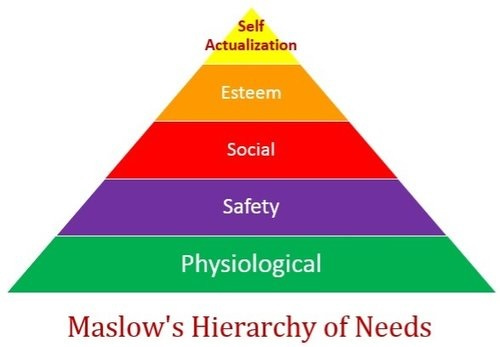
     People need money (or the equivalent of money) for basic needs. Maslow’s “hierarchy of needs” lists the layers of physiological (food and clothing), safety (job security), love and belonging needs (friendship), esteem, and self-actualization. These are listed in the order of first needed. Everyone needs food and clothing (and shelter and other physical requirements). Those are necessary before the next step — security in being able to keep those items. And that is necessary before beneficial social interaction.

     But, a strange thing exists — well, not really strange but rarely pointed out. Money is needed for physical needs. Stability of income to provide for those physical needs comes next but as we ascend the “pyramid” of Maslow’s needs, there is less and less need for money. Assuming that Maslow’s pyramid of needs is correct and reflects reality, then money is superfluous beyond a certain point — it may even be counter-productive. So, restraint on greed within capitalism both allows a larger number of people to meet their needs (and preserve a healthier society) and may be of general benefit to the people whose greed is restrained. A progressive income tax, in conjunction with strong unions (which strive to balance the needs of those within companies), works to achieve that result.

Ideas & Interpretations is a reader-supported publication. To receive new posts and support my work, consider becoming a free or paid subscriber.

Look and subscribe here.

Tuesday, December 31, 2024

What's Happened to Education?: Effects of Income Inequality

     By almost all measures, as an overall average, our children in the US are not emerging from the education system (public or private — but more so with public) as well prepared for the world as they were 40 years ago. This is true in most measurable areas — but especially true for the non-measurable areas. Education (public, private, home schooled, or self-schooled) should end up with people able to use knowledge, able to research knowledge, able to evaluate knowledge, and with a desire to continue to grow in knowledge and the ability to use it. For most, that’s not the case.

     Overall, people have not changed that much in their potentials. This is true for all humans no matter the gender, ethnic background, nationality, or other qualities. There is, of course, a range of abilities from not so capable to enormously capable. We have now also recognized that there are different types of intelligence and each type is most useful in particular situations. Often we emphasize intellectual (or academic) intelligence but other types of intelligence are often more important in the pursuit of happiness and “success”.

     Assuming (though not likely to be something upon which all agree) that this is true, what has happened? What has happened over the past 40 years to lend support to such a trend? There are many things that are possible causes — environmental contamination and change, educational methodologies, social support, and societal expectations, and on.

     I propose that one of the primary reasons for our faltering educational system is that of greatly increased income inequality.

From the Pew Research Center:


     Okay. These are the numbers, but what does it mean for the general populace in the US? It means that a much larger percentage of people in the US find it difficult to support themselves within our economic system. Note especially the widening gap between middle-income and upper income. Some specific outcomes, for lower and middle income people, are:

  • People are spending a higher percentage of their income on rent or mortgages.
  • People are having to tightly prioritize expenses.
  • There is less of a cushion available in case of emergencies or fast changes in income (such as layoffs). 
  • Parents are working more hours — sometimes more jobs — and spending less time with families.
  • Due to lack of time and energy, parents are also interacting less, with teachers and schools, in a direct manner.
  • In regards to education, one direct result of income inequality affects tax support of schools. Funding for schools is different for each state in the US but they all involve some combination of property tax, local taxes, state taxes, school levies, and federal support. Increases in taxes must be approved, directly or indirectly (through representatives). As budgets tighten, there is a desire to reduce taxes and expand classes.

     An example of the direct effects of the expansion of class sizes could be an example from my wife’s situation as a teacher within a much-too-numerous student class-size. During the last year that my wife taught 5th grade, she had 39 students in the class. Assuming six hours in the classroom (it varies from state to state and district to district), that allowed less than ten minutes to be spent with each individual child. Of course, that is not how classroom time is structured. Most of the time is allocated to the class as a whole and the amount of time, to be allocated among those 39 individual children, might not even be an hour (or less than two minutes apiece) and the majority of that time will be spent with children who have attention-seeking behaviors (usually via misbehaving).

    With less time available to get to know the teachers and the schools, parents are left with what is said by their children, and by other teachers and groups, to determine what is going on in the classroom. Not a surprise to the children but, somehow, a great surprise to the parents is that the children do not always tell the truth or take responsibility for their own behavior and actions. And other parents and groups are not always a good source of information as they may be responding to things said to them — with similar lack of direct interaction with the teachers and the schools.

     This lack of adequate awareness of what is really going on within the classroom can lead to an antagonistic relationship between parents and teachers/schools. After spending a 60-hour workweek (40ish at school and another 20ish at home grading papers and preparing lesson plans), it is difficult for teachers to find time or energy to disentangle parents’ misbeliefs.

     Expanding upon the last three bullet items stated above, income inequality can directly lead to fewer resources to the schools, unworkable increases to class sizes (and a decrease in the amount of time available for the teacher to work with individual students), and lack of positive communication between the teachers and schools with the parents. Another large factor in educational performance is a shift in emphasis from qualitative experiences to a hyper-focus on quantitative experiences. I will expand on that in the next newsletter. Ideas & Interpretations is a reader-supported publication.

To receive new posts and support my work, consider becoming a free or paid subscriber.

Tuesday, May 9, 2023

Happiness and Income Inequality: closely connected


     The image shown on this posting is from a study by Harvard Business Review researchers. It graphs the "overall well-being" of people in a country versus the income inequality of a country. Another way to compare is to use the "happiness index" of countries versus a listing of "income inequality" (this listing is actually for income equality -- to save me the need to reverse the list) for the countries. There is one outlier (Israel) but, otherwise, the top 15 countries on the happiness index (except for Iceland which was not listed in the happiness index that I found) were the same as the most income equal countries. I am not a statistician but I'm pretty sure that is very significant; minimum of 13 at the best of both lists.

     So, why should this be? The HBR researchers had their own ideas as shown in their paper. I prefer to take the approach of going into greater detail of what the lists mean. The income inequality list uses an index called the Gini index. The higher the number, the greater the inequality. However, a simpler way (which is part of the Gini index) is to check the concentration of wealth in a country.

     To make it easier, let us say that the country of TGT (target) has 100 people. That will mean that each 1% represents one person. If 1% (one person) of the population controls 20% of the wealth, that is very out-of-balance. This would mean that the remaining 99 people have 80% of the wealth -- or an average of .81% for each of the remaining 99 people. The person at the top would control 24.7 (20 / 0.81) times as much as each of the bottom 99 people.

     But, it is actually worse because the distribution of wealth is in an exponential distribution. If the top one person controls 20% of the wealth then it is likely that the next four people control another 20% of the wealth. Thus, the top five people control 40% of the wealth and each of the remaining 95 people controls 0.63% of the wealth -- or the top person controls 31.7 times as much as each of the bottom 95 people. Ah, But it doesn't stop there with an exponential spread. It would be likely that the next 10 people would control another 20% of the wealth. We now have 15 people controlling 60% and the remaining 85 people controlling 40% of the wealth. This equates to each of those 85 people controlling 0.24% or the top person now controls 83 times as much wealth as each of the bottom 85 people.

     So, who cares? How does this affect the happiness index? If that 0.24% is enough to meet all of the needs of those 85 people then it probably doesn't (but remember that the exponential spread has not stopped -- the bottom 20 people probably have VERY little money). But how realistic is that? It may be true that money doesn't buy happiness but having enough food, clothing, shelter, and hope is a very important ingredient towards being able to be happy.

     And that is the basic idea. The more that the wealth is squeezed into the "hands" of fewer people, the more people who are left with too little. The happiness index is based on the happiness of all 100 of the people of TGT. The greater the squeeze (concentration of wealth at the top) the greater number of people who don't see a way to easily live, let alone be happy with their lot.

     Ok, so who cares if people are happy? Ah, that is a philosophical and morality question and that does not have a single answer for everyone. Personally, I would greatly prefer (and am willing to have much less excess beyond what I need) to have more people happier. But, that is not a universal outlook.

     Beyond the philosophical and morality aspects, there are practical aspects. Lots of unhappy, desperate, people may eventually reach the point where they don't feel they have anything to lose trying to redistribute (possibly violently) the wealth so they can live. Also, that concentration of control does not inherently mean that that top 1% are all going to wisely make use of their economic control. Right before the Great Depression, income inequality was at its highest level within the past 100 years. Coincidence? Maybe -- I can't juggle the multiverses to find out but it is certainly suggestive and, looking at the Gini chart (yellow dots) shows that income inequality has already bounced back up to the level of about 1940 -- considered to still be part of the period of the Great Depression.

     Maybe not everyone cares about happiness for all but most would prefer to avoid another economic collapse. And when control of so much is in the hands of so few, it only takes a couple of mistakes for an avalanche of despair to happen.


Smoke Gets in Your Lungs (updated)

     This is an article that I published in here on February 22, 2013. I try to make my articles “timeless” as I try to work with “foundatio...