Showing posts with label happiness. Show all posts

Tuesday, June 9, 2026

The Price of Happiness: Nope -- it has almost nothing to do with the amount of money

     Once upon a time (over 20 years ago), my wife and I went to Peru to see Machu Picchu and other sites within Peru. It is a beautiful country, full of many wonderful and friendly people. As part of our tour, we did quite a lot of walking and were often walking at greater than a mile altitude. One trip was to an elementary school high in the mountains. My wife, a schoolteacher, had brought our weight limit’s worth of supplies. Notebooks, crayons, and so forth. The school was basically just rooms with desks and decorated walls. I suspect that it was quite cold in the winter. But the teacher and children were glad to see us and our supplies. We did not intrude long upon their class time.
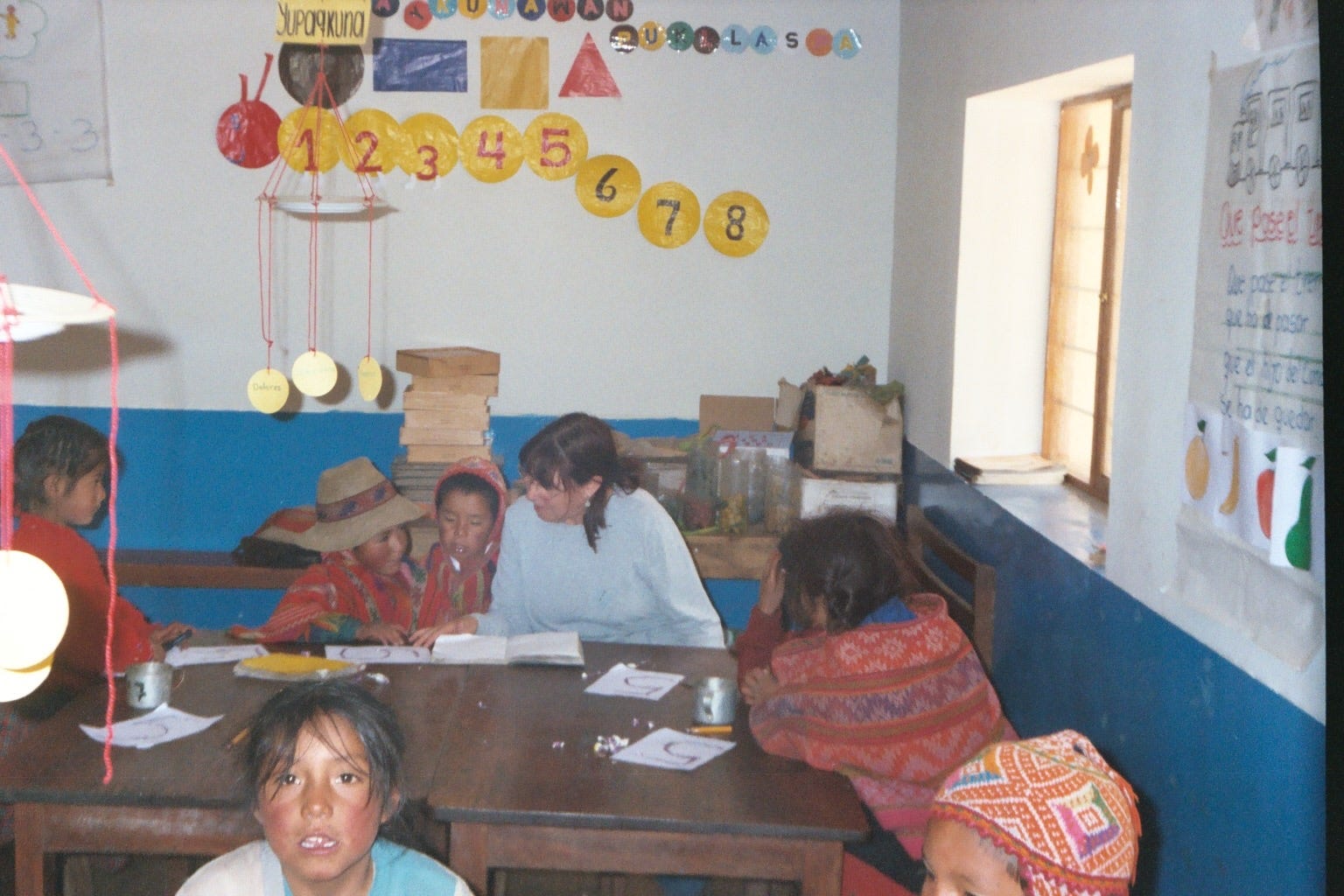
     In order to get to the school, we had to walk along trails leading from mountain peak to mountain peak. Not difficult walks but certainly longer than most US suburban dwellers are used to. We had one 82-year-old woman from Maryland with us. We could barely keep up with her. At any rate, during our treks, we would occasionally walk by a private house, One such had a number of articles in the yard that we were mistaken in thinking that they were trash. A plastic milk jug, some sheets of plastic, some broken dolls. No, these were treasured play things. They were very happy to have them and likely had as much enjoyment from them as my children had from video games in their youth. (I am certain there are children in Peru, in the cities, who are glued to videogames just as my children are.)
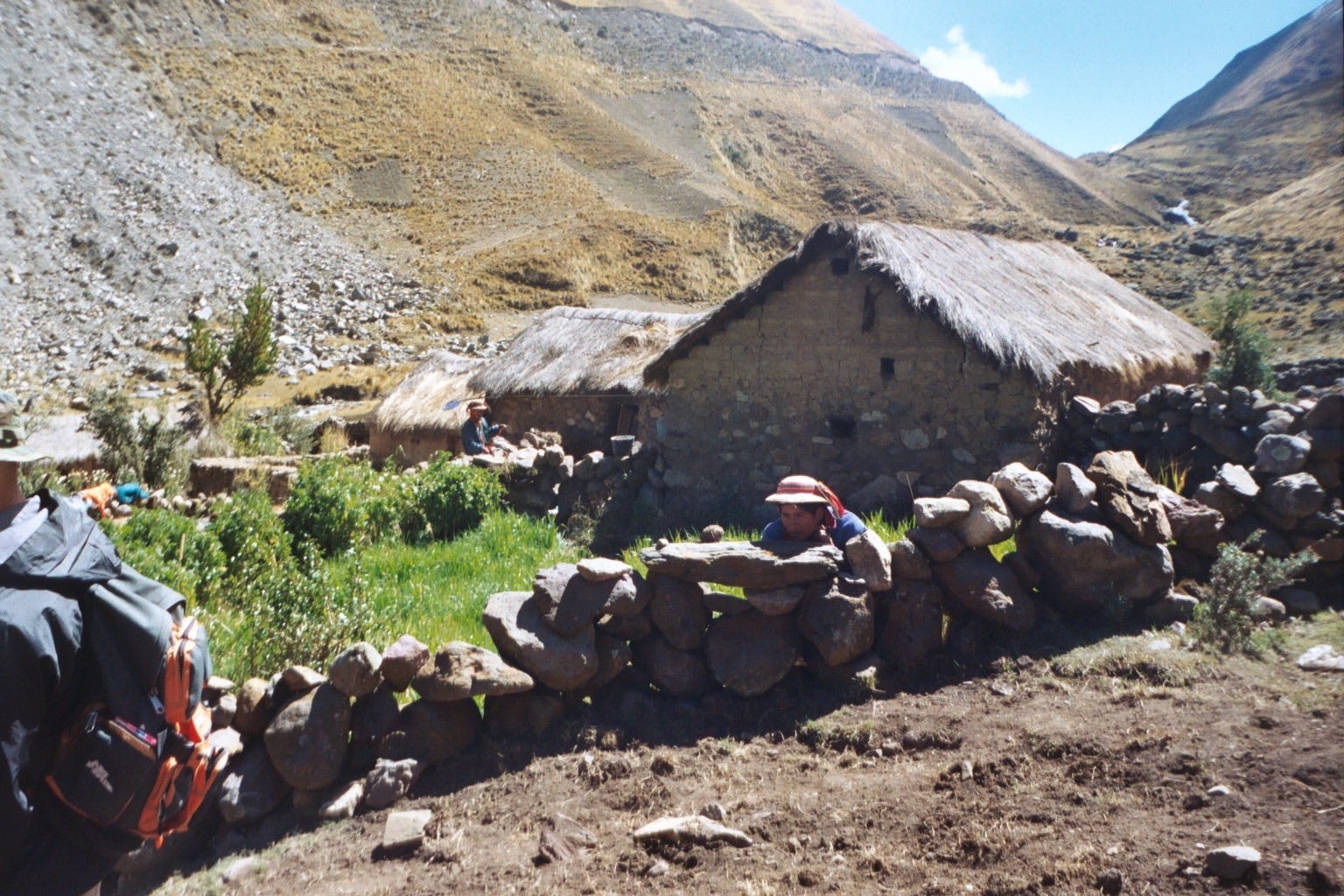
     It was a wonderful trip in many ways but what I most brought back was a love and respect for the wonderful people. From what we were used to, they had so little but from a more important basis, they had health, they had each other, and they had happiness in what they had.

     One note in somewhat of an explanatory disclaimer. The people in this small house in the mountains, as well as the children in the school, did have access to community supplied healthcare as did others. This was certainly a factor in the reduction of their stress in “having enough”.

     There exists a list (we seem to love lists, don’t we?) called “The World Happiness Report”. This report ranks the average happiness of citizens of different countries in the world (the Scandinavian countries seem to always do well). It says that the main three of its six criteria are income, social support, and freedom. Well, I certainly won’t try to disagree with them but we should recognize that they are trying to come up with a quantitative number. In order to do such, they have to have criteria that they can evaluate into a ranking number. In my opinion (and other opinions can have equal validity) the basis of happiness can be reduced to security and community. Another way of naming them would be the physical and spiritual sides of happiness.

Security as a basis of happiness

     I use the two words, security and community, to simplify the definition of a basis for happiness. Note that there may be (completely reasonable and valid) reasons why a person might have these in their life and still not be happy.

     What do you think of when you think of security? I think of lack of fear. To be not afraid of not having food to eat. To be not afraid that someone will snatch me, or a member of my family, off the street or break down my door in the middle of the night. To be not afraid that, if I get really sick, I will lose all my savings and become homeless.

     Currently, in the US, any one of these may happen to someone and, for some people, perhaps more than one.

Community as a basis of happiness

     What is community? For me, community requires at least two humans interacting with one another. A certain degree of community can come out of taking care of, and being taken care of by, a pet. That may be sufficient for some people but most need the ability to share with, and be reflected by, at least one other person.

     Of course, communities may be positive, constructive, beneficial groups of people or those communities may be negative, destructive, and malicious. Some groups may be supportive within the group but highly negative with those outside of their group. I don’t think I am qualified to say whether happiness can occur within such a group. Happiness at the expense of the happiness of others? The thought makes me sad.

Does money come into the formula for happiness?

     It all depends on the societal makeup. For most, satisfying the physical security requires some money. The money is a method of arranging for the true needs. In my opinion, the “safety net” of Scandinavian countries allows much physical security without explicit exchanges of money. Naturally, money as a resource is still needed but actual transfer has less importance.

     But a strange thing has happened within much of the “modern” society and that is the concept of “needing” more than is necessary for physical security. Perhaps this occurs, in part, due to the generally stressful situation of a society in constant change. It can lead to a malaise, or even disease, where this desire for more, more, more prevents any capability of obtaining the spiritual/community portion of happiness. Too much creates fear of having less. Too much can start to denigrate the physical and community needs of others. Too much actually DECREASES happiness.

All in all, happiness requires balance

     Physical security and spiritual community work together to give a balanced life and sense of happiness, not matter what words are used to describe it. As usual, this newsletter is not meant to give any “final answers” but a basis for discussion and investigation.

     Ideas & Interpretations is a reader-supported publication. To receive new posts and support my work, consider becoming a free or paid subscriber.

Tuesday, May 9, 2023

Happiness and Income Inequality: closely connected


     The image shown on this posting is from a study by Harvard Business Review researchers. It graphs the "overall well-being" of people in a country versus the income inequality of a country. Another way to compare is to use the "happiness index" of countries versus a listing of "income inequality" (this listing is actually for income equality -- to save me the need to reverse the list) for the countries. There is one outlier (Israel) but, otherwise, the top 15 countries on the happiness index (except for Iceland which was not listed in the happiness index that I found) were the same as the most income equal countries. I am not a statistician but I'm pretty sure that is very significant; minimum of 13 at the best of both lists.

     So, why should this be? The HBR researchers had their own ideas as shown in their paper. I prefer to take the approach of going into greater detail of what the lists mean. The income inequality list uses an index called the Gini index. The higher the number, the greater the inequality. However, a simpler way (which is part of the Gini index) is to check the concentration of wealth in a country.

     To make it easier, let us say that the country of TGT (target) has 100 people. That will mean that each 1% represents one person. If 1% (one person) of the population controls 20% of the wealth, that is very out-of-balance. This would mean that the remaining 99 people have 80% of the wealth -- or an average of .81% for each of the remaining 99 people. The person at the top would control 24.7 (20 / 0.81) times as much as each of the bottom 99 people.

     But, it is actually worse because the distribution of wealth is in an exponential distribution. If the top one person controls 20% of the wealth then it is likely that the next four people control another 20% of the wealth. Thus, the top five people control 40% of the wealth and each of the remaining 95 people controls 0.63% of the wealth -- or the top person controls 31.7 times as much as each of the bottom 95 people. Ah, But it doesn't stop there with an exponential spread. It would be likely that the next 10 people would control another 20% of the wealth. We now have 15 people controlling 60% and the remaining 85 people controlling 40% of the wealth. This equates to each of those 85 people controlling 0.24% or the top person now controls 83 times as much wealth as each of the bottom 85 people.

     So, who cares? How does this affect the happiness index? If that 0.24% is enough to meet all of the needs of those 85 people then it probably doesn't (but remember that the exponential spread has not stopped -- the bottom 20 people probably have VERY little money). But how realistic is that? It may be true that money doesn't buy happiness but having enough food, clothing, shelter, and hope is a very important ingredient towards being able to be happy.

     And that is the basic idea. The more that the wealth is squeezed into the "hands" of fewer people, the more people who are left with too little. The happiness index is based on the happiness of all 100 of the people of TGT. The greater the squeeze (concentration of wealth at the top) the greater number of people who don't see a way to easily live, let alone be happy with their lot.

     Ok, so who cares if people are happy? Ah, that is a philosophical and morality question and that does not have a single answer for everyone. Personally, I would greatly prefer (and am willing to have much less excess beyond what I need) to have more people happier. But, that is not a universal outlook.

     Beyond the philosophical and morality aspects, there are practical aspects. Lots of unhappy, desperate, people may eventually reach the point where they don't feel they have anything to lose trying to redistribute (possibly violently) the wealth so they can live. Also, that concentration of control does not inherently mean that that top 1% are all going to wisely make use of their economic control. Right before the Great Depression, income inequality was at its highest level within the past 100 years. Coincidence? Maybe -- I can't juggle the multiverses to find out but it is certainly suggestive and, looking at the Gini chart (yellow dots) shows that income inequality has already bounced back up to the level of about 1940 -- considered to still be part of the period of the Great Depression.

     Maybe not everyone cares about happiness for all but most would prefer to avoid another economic collapse. And when control of so much is in the hands of so few, it only takes a couple of mistakes for an avalanche of despair to happen.


Sunday, January 6, 2019

Economic reevaluation: From GDP to the donut


     The Gross Domestic Product (GDP) has been maintained as the holy grail of the world of economic evaluation for around 75 years, since it was given a modern definition by Simon Kuznets in 1934 and then adopted as the primary method for measuring a country's economy at the Bretton Woods conference in 1944. Even as Kuznets was making use of the term, he warned against overusing it and making it more important than it really was.
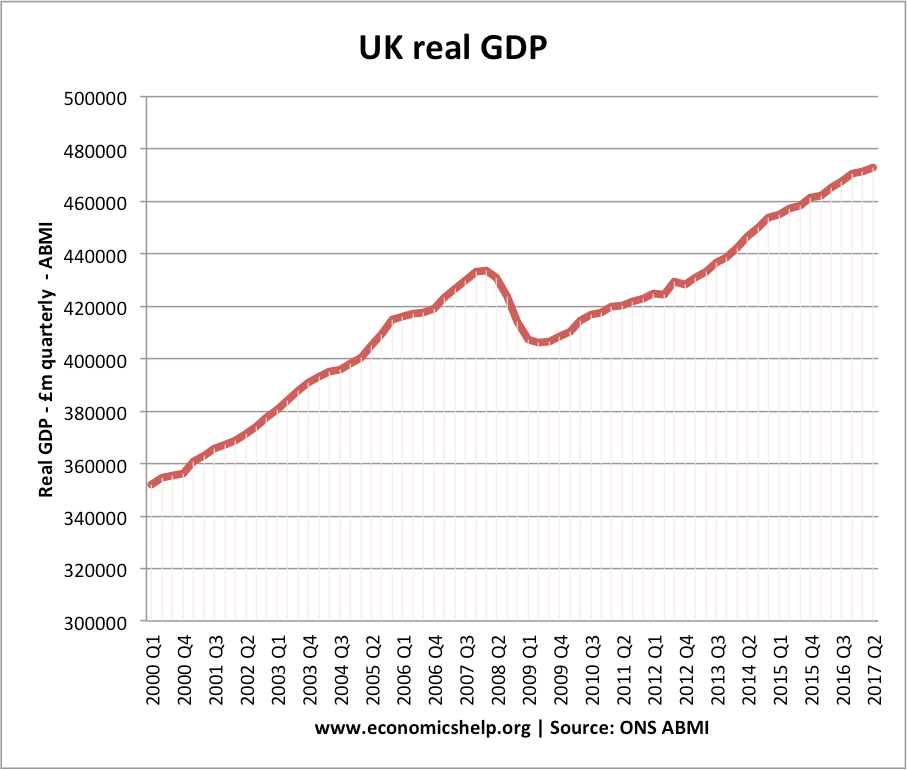
     Alas, humans often prefer to take the easy route rather than more troublesome, but more accurate, methods. Thus, the GDP -- which was relatively straight-forward (although requiring huge masses of data) to calculate became the primary indication of a country's economic health. An increasing GDP was "good", rapidly increasing GDP was "better" and a stagnant, or decreasing, GDP was "bad". An example of such a graph follows ("real" GDP compensates for inflation and graphs according to a certain monetary index at a fixed period of time):


     Many criticisms have been made about the GDP but it was simple, came with an apparently exact number, and there was no alternate proposal to take its place. Complaining about something that is bad is useless unless you have something better that people can agree upon to take its place.

Some of the primary criticisms of the GDP as a primary economic index are:
  1. It leaves out a lot of the economic activity of a country -- probably the majority of activity. It only counts activity where "money" (or economic credit) is transferred from one entity (person, corporation, country, ...) to another. This leaves out all of the work done by "non-paid" workers -- including parenting, "housewives" and "househusbands", inter-generational childcare and other family work (such as within a business or on a farm), and so forth. Think that shouldn't count? Think about how many minutes a country would survive without it.
  2. The model relies on continued growth. Growth of population, growth of numbers of consumers, growth of production, growth of monetary supplies according to GDP status (a bit circular there), and on and on. This emphasis on growth also pushes the economy towards consumerism and nonrenewable wastage of resources. In a finite world, with finite resources, and the need to protect the environment and economy for future generations, the idea is counter-productive and destructive.
  3. GDP aggregates the economic transfers within a country. Thus, if one company (or individual) controlled all official economic activity, the GDP could be the same as for a country where economic transfers were spread out equally among all the people within a country. Accurate numbers but largely meaningless in terms of economic health.
  4. Economic credit transfers is a poor indicator of a country's health by itself. There are many other "soft" factors -- "happiness", income distribution, access to food and water and clean air, and so forth. Thus, you can easily have a strongly positive GDP growth rate in a country in which no one wants to live.
     As mentioned above, one objection to discarding the GDP as a primary economic indicator has been the lack of anything "better" to take its place. In this case, "better" means something that, at the least, takes into account the above criticisms of the GDP model.
     Kate Raworth came up with a model that has limits -- the limits are indicated by an "outer" limit where human activity uses up resources faster than can be renewed and an "inner" limit beyond which human activity cannot achieve the minimum needed to live. These upper and lower limits are expressed as two concentric circles or -- in the shape of a donut (doughnut for some).


     So, what does it mean to have a new model? Will this new model solve all of the world's problems? No. However, in order to THINK about a situation, or an idea, it is very useful to have a visualization of the concept. A person must have words, or some other representation (such as images), to properly manipulate an idea.
     One real-life example that has come out of this model is that of reorienting sales from products to services (which is compatible with many business strategies). There is an airport (I believe in Germany) that now pays a company for light -- a certain amount of lumens distributed across certain living areas in the airport. This is instead of paying for light fixtures, light bulbs, and electricity. Thus, since the provider wants to maximize their profits -- it is to their advantage to have the most long-lasting, energy-efficient light production as possible AND to recycle older materials as they are replaced (rather than throw them out). Profits on services makes the provider want to make them as efficient as possible -- and that tends to fit into the donut model better than the continuous growth/consumption GDP model.

Smoke Gets in Your Lungs (updated)

     This is an article that I published in here on February 22, 2013. I try to make my articles “timeless” as I try to work with “foundatio...