Showing posts with label recycling. Show all posts

Sunday, January 6, 2019

Economic reevaluation: From GDP to the donut


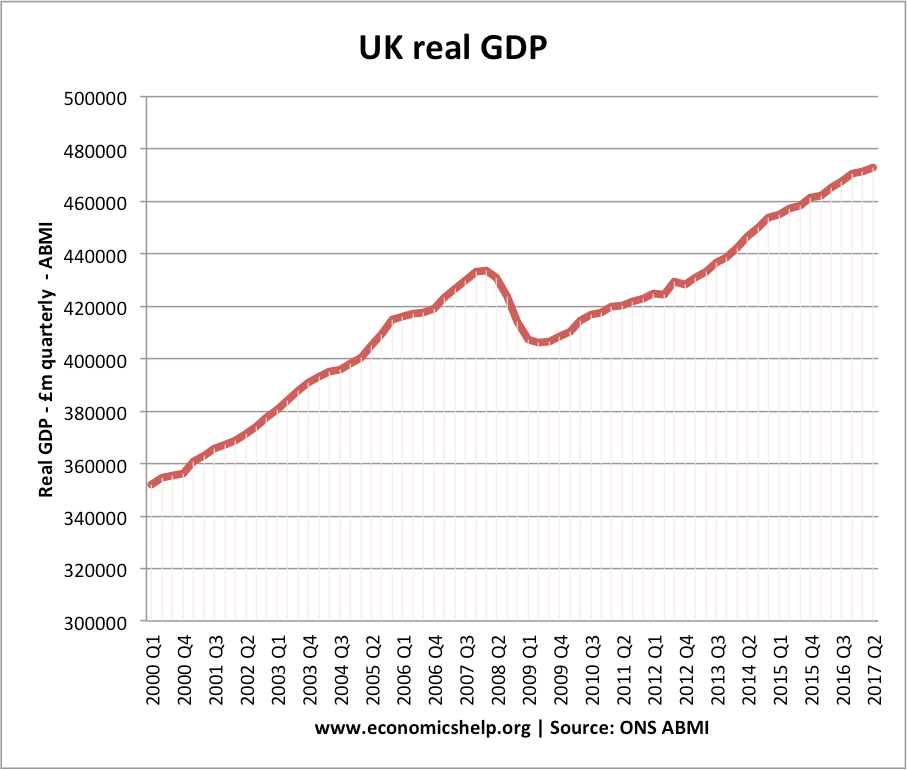
     The Gross Domestic Product (GDP) has been maintained as the holy grail of the world of economic evaluation for around 75 years, since it was given a modern definition by Simon Kuznets in 1934 and then adopted as the primary method for measuring a country's economy at the Bretton Woods conference in 1944. Even as Kuznets was making use of the term, he warned against overusing it and making it more important than it really was.
     Alas, humans often prefer to take the easy route rather than more troublesome, but more accurate, methods. Thus, the GDP -- which was relatively straight-forward (although requiring huge masses of data) to calculate became the primary indication of a country's economic health. An increasing GDP was "good", rapidly increasing GDP was "better" and a stagnant, or decreasing, GDP was "bad". An example of such a graph follows ("real" GDP compensates for inflation and graphs according to a certain monetary index at a fixed period of time):


     Many criticisms have been made about the GDP but it was simple, came with an apparently exact number, and there was no alternate proposal to take its place. Complaining about something that is bad is useless unless you have something better that people can agree upon to take its place.

Some of the primary criticisms of the GDP as a primary economic index are:
  1. It leaves out a lot of the economic activity of a country -- probably the majority of activity. It only counts activity where "money" (or economic credit) is transferred from one entity (person, corporation, country, ...) to another. This leaves out all of the work done by "non-paid" workers -- including parenting, "housewives" and "househusbands", inter-generational childcare and other family work (such as within a business or on a farm), and so forth. Think that shouldn't count? Think about how many minutes a country would survive without it.
  2. The model relies on continued growth. Growth of population, growth of numbers of consumers, growth of production, growth of monetary supplies according to GDP status (a bit circular there), and on and on. This emphasis on growth also pushes the economy towards consumerism and nonrenewable wastage of resources. In a finite world, with finite resources, and the need to protect the environment and economy for future generations, the idea is counter-productive and destructive.
  3. GDP aggregates the economic transfers within a country. Thus, if one company (or individual) controlled all official economic activity, the GDP could be the same as for a country where economic transfers were spread out equally among all the people within a country. Accurate numbers but largely meaningless in terms of economic health.
  4. Economic credit transfers is a poor indicator of a country's health by itself. There are many other "soft" factors -- "happiness", income distribution, access to food and water and clean air, and so forth. Thus, you can easily have a strongly positive GDP growth rate in a country in which no one wants to live.
     As mentioned above, one objection to discarding the GDP as a primary economic indicator has been the lack of anything "better" to take its place. In this case, "better" means something that, at the least, takes into account the above criticisms of the GDP model.
     Kate Raworth came up with a model that has limits -- the limits are indicated by an "outer" limit where human activity uses up resources faster than can be renewed and an "inner" limit beyond which human activity cannot achieve the minimum needed to live. These upper and lower limits are expressed as two concentric circles or -- in the shape of a donut (doughnut for some).


     So, what does it mean to have a new model? Will this new model solve all of the world's problems? No. However, in order to THINK about a situation, or an idea, it is very useful to have a visualization of the concept. A person must have words, or some other representation (such as images), to properly manipulate an idea.
     One real-life example that has come out of this model is that of reorienting sales from products to services (which is compatible with many business strategies). There is an airport (I believe in Germany) that now pays a company for light -- a certain amount of lumens distributed across certain living areas in the airport. This is instead of paying for light fixtures, light bulbs, and electricity. Thus, since the provider wants to maximize their profits -- it is to their advantage to have the most long-lasting, energy-efficient light production as possible AND to recycle older materials as they are replaced (rather than throw them out). Profits on services makes the provider want to make them as efficient as possible -- and that tends to fit into the donut model better than the continuous growth/consumption GDP model.

Thursday, December 31, 2015

The Houseboat philosophy : The Four "R"s


   Once upon a time, I lived in Seattle -- loved it there because it was an environment in which I could walk, or take public transportation, to 80% of the places that I wanted to go (exceptions being grocery shopping -- mainly out of laziness). A pedestrian-friendly city gives a natural interest in adjusting one's life, in general, to the environment and trying to live within the environment rather than take it over.

   My wife-to-be was taking courses at the local University of Washington (Udub) and one of her teachers invited us to a lunch on her houseboat that was docked on Lake Union. While there, and conversing on various topics, she introduced the "houseboat philosophy". A houseboat has a certain capacity -- it weighs a certain amount and it can support a certain amount without sinking. So, unless you want to start swimming for shore during the next rainstorm (when the lake becomes definitely non-calm) you recognize that clutter is not something that you can tolerate.

   When something comes onto the houseboat, something has to go off. In a way, this is parallel to time organization of "most important now". What do I most want to have around me? If I bring something aboard, what do I want to take off and what will I do with it? Of course, there are a certain number of things that are in constant transit -- like food. Most things, however, including a stockpiling of the pantry must be considered to be an added weight.

   What to do with what one takes off leads directly to the three "R"s of Recycling. Reduce. Reuse. Recycle. Reducing is associated with packaging material and extra things that are not directly part of the item which you acquire. Reuse can be a matter of giving used items to charity to be re-sold or to become part of the lives of other people who need them. It can also be used to indicate a refilling of containers and such. Finally, recycling allows the materials to be incorporated in new products.

   The Houseboat philosophy adds one additional "R" -- Rethink. This is a preparatory thought before acquiring something. Is this something that will add to the quality of my life? Is this something that is more important than something else that I presently have around me? This isn't something that happens a lot in the current consumer-directed economy and society in which we live. (It DOES start moving that direction when one starts going towards the final direction of life -- a desire to eliminate the unneeded before someone else has to take care of it.)

   All together, the four "R"s are really the Houseboat Philosophy. While, for most of us, our houses are not likely to sink if we get one too many things into the house, clutter still affects our lives. How many times do you have to look for something you have mislaid? Is it easier to find one item out of a thousand that you have around -- or is it easier to find one item out of a hundred? How about cleaning? Is it easier to clean around 20 pieces of furniture or is it easier to clean around six?

   We are presently reducing in our household. We have a lot of books. Each book includes memories -- where did we get it, what thoughts arose when we read it, what other people were around when we read it, what was our mood before and after reading it. It is hard to remember that, even if the book is no longer around, the memories can still be present. If you have a box of things that hasn't been opened in ten years then how important are the things in that box?

   What are the important items to keep on your houseboat?

Smoke Gets in Your Lungs (updated)

     This is an article that I published in here on February 22, 2013. I try to make my articles “timeless” as I try to work with “foundatio...