Showing posts with label change. Show all posts

Thursday, November 6, 2025

Branding: It stands for something -- but that something can change. Always examine beyond the brand name.

     Brands are a word that get tossed around a lot currently. What is a brand? At the foundation, a brand is something that gets associated with something else. A brand on a cow identifies which ranch the cow belongs to.

     Nowadays, we refer to brands with less physical types of associations. When we are in the presence of others at business situations, we are supposed to have our “elevator pitch” prepared such that we can concisely wrap up the primary characteristics that we want to have the listener associate with our name. A LinkedIn profile will do similar things and, although not usually called a brand, a CV or resumé is basically an extended brand.

     Manufacturers, or distributors, of products want to associate a brand name with a set of qualities. Although some physical qualities are part of the package, it is usually more a matter of feelings to be associated with the brand name. Brand WHOZIT is associated with excitement, reliability, quality, etc. Naturally, such companies want only positive attributes associated with the brand. There have been instances over time when negative attributes have become connected to a brand name and the company has been unable to disconnect those attributes from the brand. At that point, the brand is “retired” and no longer used. The word “Edsel” has become a generic name for a product (possibly even a good product) which has gathered negative feelings associated with the brand. You don’t want to produce an Edsel.

     Brands can also be associated with people. That is the point behind various “branding” exercises. Beyond the elevator pitch, people may want to become the person you “go to for xxxx”. Certainly, on business social media such as LinkedIn, that is a very important part of interactions.

     It was something that I lacked during the short period when I was an independent contractor. It is very difficult to create a brand when one is interested in, and produces, more-or-less anything unless the name, in itself, creates the brand. A brand focuses attributes and it is preferred that those attributes are seen as distinct from other brands. Sometimes a “brand” is a person’s name. Bill Gates is a brand — based on his life, and corporate, history. Steve Jobs is a brand as is Beyoncé. If someone talks about a “Steve Jobs” type of person, you immediately have an idea (correct or not) as to their attributes.

     Positive attributes and associations are best. Negative associations are bad but politicians recognize that people do not remember details very well or very long. Thus, “there is no such thing as bad publicity”. Name recognition is very important when you approach the ballot or are examining products on the shelf.

     One important aspect of brands is that they are sometimes given more importance than the “interior”. My Aunt and Uncle were very loyal to a US electronics brand. They would buy Brand YYYY without even looking at comparable products. They were the type of consumer that manufacturers LOVE. Later (in the 1960s) the brand name, and product line, was sold to another company which wasn’t even in the US. Quality and design went down (a sold brand doesn’t necessarily become worse upon being sold — but this one did). Product reviews were bad and my Aunt and Uncle ended up returning a few products. But still, they continued to buy Brand YYYY. They still didn’t consider competing products.

     A product brand may also be registered with a trademark to prevent others from using the same name for that same product category. This is not a clear safeguard as it is possible to have the brand be so popular that the brand becomes almost synonymous with the product description — called genericization. For example, Bayer lost the use of Aspirin as a trademarked brand because Aspirin became a common replacement name for acetylsalicylic acid. (It later did trademark the double word “Bayer Aspirin”).

     A brand, with positive recognized attributes, is very useful for a company or an individual. Is it useful for the individual making their decision according to the brand?

     Perhaps. It can reduce the effort needed to find a qualified person or product. BUT, it does NOT eliminate “checking under the hood”. Assume that you always buy trucks manufactured by DDDDD. There is a parking lot of trucks to choose from. You choose the DDDDD truck without examining it or comparing to the others. You get into the truck to start the engine and it doesn’t start. It doesn’t even make a noise. You get out and look under the hood. No engine. Whose fault is that? Whose responsibility is that?

     You can certainly validly complain about misdirection in advertising. But truly, do you expect a company to say “We proudly sell DDDDD trucks but we no longer include an engine with the purchase”? Either they bought the brand name and product line because they recognized how much the name could reduce their PR expenses or they had had the brand name for a long time and relied on its historical value. Most will try to maintain the value associated with the brand. Perhaps they will not go so far as to stop including an engine. But it may no longer be their focus as a company. Quality can decline.

     You, as a consumer, are responsible for evaluating a product, person, or political candidate. A brand name may be of use as a starting point but it is always appropriate to redefine the quality, and value, of that brand name as you examine products.

Thanks for reading Ideas & Interpretations! This post is public so feel free to share it.

Ideas & Interpretations is a reader-supported publication. To receive new posts and support my work, consider becoming a free or paid subscriber.

Saturday, March 22, 2025

This Too Shall Pass: Helplessness and Hope

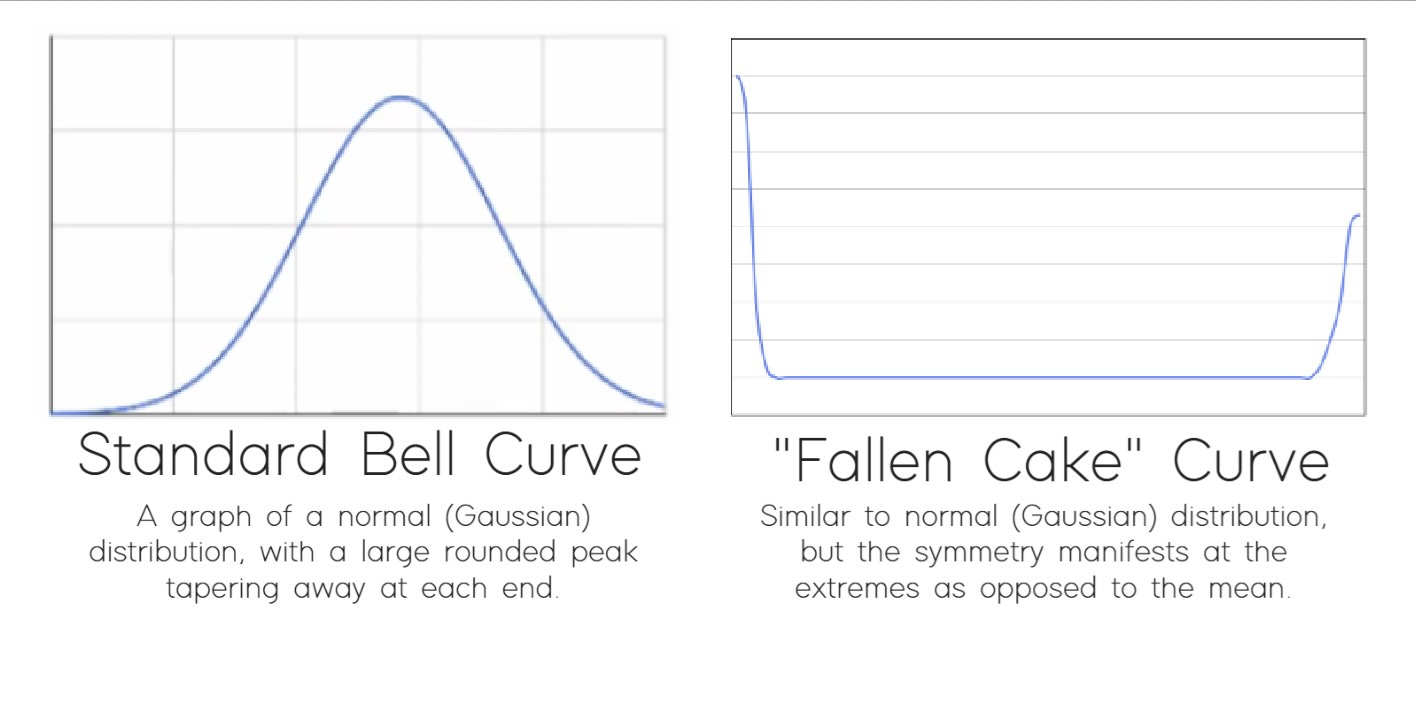
      Everyone is familiar with the old “bell curve”. It is used as an indication of distribution for many different things from school grades, to “IQ”, to the ability to afford housing, and so forth. But, there is another graph that applies to attitudes. I am sure that it has a real name but I will just call it a “fallen cake” model. Although it does not happen often nowadays (does anyone know why?), cake batter within a mold will raise uniformly across the pan and then, because of a strong vibration or other event, the middle can just fall — leaving the edges relatively high with a wide plateau in-between that looks more like a crater. Unlike the bell curve which has its peak in the “center”, a fallen cake model will have two highs — one at each end of the graph.

     The fallen cake provides the shape but not the interpretation. For attitudes on most issues (pick your favorite, or least favorite, one) — there will be a group of people actively supporting the issue and another group actively fighting against the issue. These are the two “humps” at the ends of the horizontal axis. The height of the humps is a reflection of the activity of the group.

     That big flat area in-between are people who are passive. The flat area is almost always a wide area. If the humps are about the same height then they are fairly well matched though the width does come into play as it indicates the number of people in that active group. The shape changes as various factors are involved. Those passive people still make a difference as they still control votes or taxes or other means of input. Both humps will try to make the passive folk amenable to their position. The various “controversies” about issues are indicators of the flux within attitudes.

     Homosexuality, as well as all other folk within the LGBTQIA+ area, is not new. Various accounts have been recorded as far back as there have been written records. The First Nations were well aware of the diversity within humans and celebrated them. In various studies, there have been indications that external factors can affect the numbers in diversity but they are involved with gestation factors and occur before birth. Numbers of such are not zero and never have been and have never been a choice. The width and height of the humps, indicating acceptance or xenophobia, have vacillated throughout history.

    The medical, and recreational, use of marijuana has been reflected in attitudes throughout the past 60 or 70 years. My father talked about usage of marijuana as an ordinary, non-controversial, type of recreational drug within the Navy during deployment in the Korean War. At that point, it was a “who cares” issue. But with political and idealogical involvement, the fallen cake model started mobilizing against usage and, of late (with profit models being developed), for generalized usage once again. On one side are people who don’t think it is an issue with which the government should be involved and on the other side are people who think that all vices should be rigidly controlled. People who profit from the “drug wars” are particularly opposed to legalization.

     The United States is the only “developed” country which does not provide a baseline set of health care services for all citizens. Most countries do have the opportunity to pay for private insurance but such plans are in addition to that provided within their individual universal health care plans. This is very similar to those in the US able to be covered by Medicare, with private insurer “Part B” and “Part D” able to boost your benefits above basic Medicare. Yet, after indication of the majority of the US population indicating a desire to implement Universal Health Care, it continues to face uphill struggles. I talked about this in another blog recently. It fits the fallen cake pattern. There are people actively trying to get the US to provide for Universal Health Care and others who are actively trying to maintain the existing unique for-profit healthcare business model.

     There are many attitudinal issues for which the fallen cake model can be applied — climate change, AI development and ethical issues, the death penalty, mandatory vaccinations, public education, disarmament versus weaponization, participatory democracy versus authoritarianism, and so forth. There are also issues which appear to be “settled” that are actually still part of a fallen cake model and attitudes are still in flux. Many of the social support and movement aspects are in this category. I often place a pin on a history graph, at the point where feudalism started to become less acceptable, as a starting place for improvement on general social issues. As brought out in “The Handmaid’s Tale” attitudes can backslide.

When a person is actively involved with one of these issues, it can feel like

  • There is no chance of change in attitudes (completely stable and accepted)

  • People will never agree on a new attitude (discouragement)

  • Change is “just around the corner” (enthusiasm and exultation)

     The reality is that attitudes change. Attitudes about measurable facts can change. Attitudes about emotional issues can change. What is an accepted situation can become a forbidden situation (and vice versa). Hope for change is always reasonable and apathy about the inability (though not necessarily the difficulty) to change is to be overcome.

     Hope and helplessness can, and do, co-exist.

Ideas & Interpretations is a reader-supported publication. To receive new posts and support my work, consider becoming a free or paid subscriber.

Thursday, August 3, 2023

Being Yourself: Sometimes the hardest thing


     According to my mother, when my father was dating my mother, they did a lot together. They went to dances. They went to the movies. They went on picnics. After marriage, my father soon settled back into a routine -- go to work (When he had work. Although a very hard worker, since he had only a ninth grade education, he was usually on the queue to be first let go), come home, eat dinner, and settle down in front of the television. And so the days went. Our family went on a vacation once in my childhood -- a camping trip with my aunt and uncle and cousins. We did not stay the full planned length of time -- some type of argument. This was not the life that my mother had expected within the marriage.

     When most of us approach a job interview, we are asking ourselves "what do they want to see in a candidate for the position?". Yes, the interview should be mutual but it often isn't seen that way by one party or the other or both. There is nothing wrong with trying to present one's best behavior and attitude in an interview (or a date, or ...) as long as it is still within the range of behaviors that you would normally do. But trying to present an image of someone you are not is a mistake. Strive towards that mutual interview where you are discovering what the company is and they are discovering who you are.

     Unless you are applying for a role in a movie or play production, it is not a good idea to pretend to be someone that you are not. Look at the situation from a long-term basis. Can you, and do you WANT to, present that person for the next 20 years? It is a tried-and-true technique, for personal behavior modification, to "fake it until you make it" but that doesn't work if you do NOT want to shift behavior in that direction. You are more likely to be tired, irritable, and angry.

     If you bring a smile to your face each morning, it is difficult to not have that influence your mood. If you glower at your workmates each morning as you arrive, don't be surprised if they start becoming hard to find in the morning.

     Dating advice often says to do things you like to do in order to meet other people who also like to do those things. But often we will find our eye drawn to those who do those things that we idealize as things we would like to do, think we should do, and admire others who do them. As an example, you admire someone who exercises on a regular basis and has a good awareness of their body to properly eat. If you are not of the same mindset then you should NOT try to be involved with that person as it is a conflict that is not likely to change. (Note that it can work if priorities are not the same for both; if one person has a high priority of financial security and the other has a high priority of aesthetic achievement then incompatibility can still achieve personal goals.)

     In general, be the person you are most comfortable being. Don't expect to be able to change others (you can't) and if others want you to change then determine what you, yourself, want to do. They can't change you but you can (if sufficiently motivated) change yourself.

     Accept that being the best you, that is natural for you to be, is good enough.

Wednesday, May 3, 2023

Evolution: Change, Mutations, and Leaps


     Organisms change. They may be living or a business but they do change. The word "evolution" has a rocky history and is certainly not approved by all people. But I don't know of a better word which encapsulates the process of continuous change to fit the environment. So, evolution it is.

     Since the period of time that Charles Darwin took his journey in the Beagle and Gregor Mendel worked with his peas (and others unrecognized before, and after, them), people have noticed that things change. Not just geological change with volcanoes, floods, earthquakes, and other changes to the earth -- but changes to life. Moths change color to adapt to pollution in the air. Birds change their migration paths due to changes in the Gulf Stream current or whether El Niño is in effect. Foxes start having white fur when their range is pushed up into colder, snowier, territories.

     Changes in life take place at the genetic level. With the Human Genome Project, CRISPR, and other continued understanding, and manipulation, of the genetic code, exploring the mysteries gives us more answers. (Although, like almost every other area of knowledge, each answer generates multiple new questions.) One thing that has been found is that the genetic code has duplications, or redundancies, that appear to each facilitate the same growth process (often protein creation). Another thing found is that there are dormant sections that don't appear to do anything. How both of those work, and why they exist, are part of the continuing set of new questions.

     We recognize change when it affects behavior, or appearance, or some other quality that we can notice. Before it reaches that stage there are probably changes to the genetic code that are NOT observable. The only thing we can really say about such changes is that they are not immediately fatal. If the changes were fatal, then they would not propagate to the next generations. Once these non-fatal changes accumulate to the point of being noticeable, then the next step of winnowing is how it affects survival in the environment.

     Note that human technology has changed, and continues to change, how this survival mechanism works. We have more people needing glasses, or other physical aids, because we now have the technology that allows people to use their other attributes and still survive with their challenges of birth. Being severely myopic in the 16th century while living in the forest was likely soon fatal. It isn't a big thing in modern society.

     Each change in the genetic code is an aspect of mutation -- having something appear which was not there before. We also have changes in the individual genetic pools due to haploid combinations -- receiving different genetic material from the female and from the male and combining the material.

     When changes accumulated to start showing blue eyes rather than brown, they were noticeable. But sometimes the changes are VERY noticeable and these are leaps -- or quantum jumps in evolution. The changes were proceeding under the surface but now they surface. Although it is rarely (if ever) as dramatic as those presented within the "X-Men", once noticeable it can be considered a small change or a large leap.

     As a parent of two children on the autistic spectrum, I have read a lot of the (often) contradictory information that exists. One thing that appears to be (often) true is a change in the neurological configuration of the brain. Some groups call this, and the behavioral challenges often associated with it, a "disease" but I don't look at it that way at all. It might be an evolutionary jump -- such as suggested in the books "Darwin's Radio" and "Darwin's Children" by Greg Bear. Certainly, advances pushed forward by people of history who are thought (perhaps erroneously) to be on the autistic spectrum lend weight to that theory. These are people such as Albert Einstein, Anthony Hopkins, Isaac Newton, and Nikola Tesla.

     As for business. Changes can be deliberately encouraged or the result of smaller changes under the surface. Just as in genetics, smaller changes (which are non-fatal) can accumulate until something very different shows up.

Saturday, September 23, 2017

Economic Interconnectivity and Big Data


     The world economy is a huge set of interconnections. One type of job depends on other types of jobs; if a job type disappears it is likely to affect many other job positions. Scarcity of resources of one type can affect the prices of many cascading products. If the world does shift from fossil fuels to renewable energy sources, new jobs will appear and old ones will change or go away.
     The interconnectivity also causes great fragility as the world gets larger and there are more dependencies. Imagine, if you can, people waking up tomorrow and deciding that the Internet is no longer of interest (I can easily remember when it didn't exist) -- how many products would no longer have a market, how many people would no longer have a job, how would it affect others (advertising, for example -- and printed newspapers might surge back into dominance)?
     Once upon a time, I was interviewing with Google and, as part of the telephone interview, we discussed potential projects and interests. I put forth the idea that, since Google was well designed to integrate knowledge and had such massive data storage and access, they would be well able to create an economic model of interconnected occupations and salaries. At this point in time, I would like to also add in products and localized market prices.
     Why bother with any type of tool? Why not just make the change and see what happens? The main advantage of such a tool is to have a better ability to forecast the effects of policy changes. What really happens if minimum wage is increased to a living wage? What happens if the illegal immigrants who are largely responsible for hand harvesting of our fruits and vegetables are kept away -- what will be the effects on produce prices, truckers, grocery stores, and so forth? What jobs are affected if private transportation is minimized and public transportation maximized?
      Such a project would be impossible if every individual, unique job, discrete part, and location had to be tracked. Luckily, items can be aggregated -- 500 Blue F-150 trucks should only have a quantity value change over 1 Blue F-150 truck (but, at the same time, there needs to be a way of describing Red F-150 trucks without having a fully different item). There is a lot of work to be done and it would still be a difficult project but certainly within the capabilities of many of the larger data handling companies -- Google, Facebook, Amazon, IBM, Microsoft, ... What would be the Return On Investment (ROI) for such a project? It's really difficult to know but it would be a valuable service/project that should be of use to governments and businesses around the world.
     I would suggest architecting such  a project as an iterative accretion of data. Start with something relatively small -- a loaf of bread. The loaf of bread has a set of occupations associated with it -- baker, packers, delivery people, stockers, advertising, payroll, Human Resources, etc. It also has a set of ingredients -- flour, yeast, filtered water, possibly milk, salt, and so forth. Each ingredient has an amount which acts as a ratio of strength in the links to the bread. Each ingredient has its own delivery and production chain which each have associated costs and value. It would be considerable in itself but the greatest value would be the fact that it is still small enough to be thrown away. New links and new data structure values will be discovered to be needed as the database develops. Now do it over (iterate) with those better values and links. Do it again if needed. Now add butter to the bread and continue on.
     There are also usability concerns. The bread company may start off selling only white bread and then add rye bread -- each with their own percentage of sales. How does one substitute recipe ingredients? How do you change the dependencies and the ingredient ratios? What happens if a problem ruins the rye crop for the year? If modelling an auto, how easy is it to change the model from gasoline to electric? Not only is there a substitution of an "ingredient" but the interconnections to suppliers, dealers, raw materials (batteries, possibly lithium) change. The model must be able to be changed easily because modelling the existing situation may be interesting but comparisons are what gives the most value.
     How would you address such a problem? What do you see as specific practical benefits from such an economic model? Is there some subset of such a model already in existence that could be used as the core of expansion? How are unpaid people incorporated into the model, recognizing that the system falls apart without them -- even if they are not considered to be part of the Gross Domestic Product (GDP) or a paid occupation?
     While I find the project fascinating just from a theoretical basis, I keep finding more and more potential uses as I consider the matter.

Saturday, October 29, 2016

The Luddite effect -- when the new does not transition the old


    In the eighteenth and nineteenth centuries in London, as part of the "Industrial Revolution", a group of workers in the textile industry started gathering together to fight against technical replacements for their labor. Their fear was based in reality. The textile industry in England was a large one within which a considerable portion of the workers earned their living. A mechanized loom might replace the manual efforts of dozens of women and men.
    Similar to the situations that often exist today, these people were hard-working and had developed their skills over their lifetimes and, sometimes literally overnight, there was no longer any market for those skills. The response -- a losing battle -- was to destroy machines, make threats to those who were instigating the changes, and disrupt the ability for the new factories to produce. Some historical accounts indicate that the leaders of the workers recognized that there was no way to defeat the change but wanted better leverage to provide retraining and support of the unemployed.
    Government response was primarily organized around protecting the new factories, their owners, and products. Severe laws were passed and a number of "show trials" were held with death or penal transportation/exile as potential penalties. These laws, in effect, did succeed in breaking the movement.
    Other areas of skilled labor were also displaced within the context of the Industrial Revolution. Although history books usually focus on the improved ability to manufacture goods (and decrease of prices for the average consumer), they do not often indicate the huge labor displacement which was a direct effect of the change.
    The Luddites provide a practical history lesson. Change is difficult for societies to adopt and it is particularly hard on those who have invested much time and effort on the old. If change is to happen (and it is difficult to avoid it) then the process of moving away from the old must be kept in mind.
    There are a number of changes currently going on in current times. One is semi-involuntary, one is semi-voluntary, and another is fully voluntary.
    Climate change is semi-involuntary. This is because it was probably avoidable but made difficult to avoid because of inertia of old methods of business. Although there is still the chance to make the change less severe, it has already made significant changes to the world. The Great Barrier Reef is close-to-death largely because of the increase in global water temperature. The glaciers continue to shrink around the world -- this is especially important in the Asian subcontinent where winter storage of water in snowpacks and glaciers provide water to billions of people. "100-year-floods" and "100-year-storms" are occurring more often as the water temperature rises.
    A semi-voluntary area of change is the shift from non-renewable energy sources. Since the change has to be encouraged, and pushed for, it falls into the voluntary category. It is reaching the tipping point where it is almost easier to use new, renewable, energy sources than to keep using the old ones. However, just as happened in the textile industry, it is very important to recognize, and assist, the people and families dedicated to the old energy systems. Solar panel factories located at old coal mines to allow easier transitions?
    A full voluntary area of change is the strong push towards greater and greater independent automation. Phones get smaller and more powerful. Robots can take over more manual labor in a programmable fashion (as opposed to dedicated design such as in the textile mills). Innovation and extensive education becomes more and more necessary for general job positions.
    Whether voluntary, involuntary, or a mixture of such, change requires preparation and assistance in moving from the old. The is a necessity for the change and, when it is forgotten, much suffering can occur as well as rebellion (isolated or global).
    What happens to the old when the new comes? This is an age old question but, with more rapid change comes the need to actively address the needs for migration, retraining, and restructuring.

Transparency: Feared and Useful

     My mother spent many of her working years as a server in restaurants. Her experience, from the 1950s through the 1960s (she then did ot...