Saturday, May 12, 2018

Failure is not an option -- why not?


     "Failure is not an option" is a famous, and memorable, line from the movie "Apollo 13". I have a favorite shirt, slowly fading, with the line written upon it. Although the line exists within the movie, no one actually said it during the time of the Apollo 13 equipment failure. It is a summary/scriptline composed from a bunch of thoughts and explanations (post-event) from the NASA ground crew.
     Failure may not be an option -- but it does occur. In fact, it would be a rare occurrence, within a business environment, for failure analysis to not occur after an instance of a project or business failure. I am positive that, if I were to startup another business, I would make an entirely new set of mistakes.
     It is not currently popular, but failure analysis also is very useful within the non-business world. It is called "learning from history". It requires recording history as accurately as possible, studying that history, and analyzing what went well and what did not. (It is preferable if people choose to NOT repeat what did not go well.) All three of those steps are difficult but worthwhile.
     So, failure is certainly possible -- yet it still should not be considered an option. Within the world of computer programming, it might be considered to be the default condition. You keep planning for, and defining, all of the situations that you can think of -- and if none of those occur then it falls into the "default" case. It is the bottom basket into which all of the "not-planned-for" events fall.
     Failure occurs but it isn't planned for yet it can be (and, in business, often is) analyzed afterward. But is failure to be allowed? This often ends up being a Return On Investment (ROI) question. In the case of the human astronauts' lives in Apollo 13 there were severe limitations on materials and what could be done but, within those limitations, no effort was too much. In the case of human lives suddenly at risk because of accident or natural disaster, the cost is often analyzed only after the events have passed.
     In the case of the potential failure NOT involving human life, it is much easier to quantify the costs. These include the costs to avoid failure and the costs of having reached the point where one would call it failure (Edison once said "I have not failed. I've just found 10,000 ways that won't work.").
     It is most useful to determine first the value of success, then the odds of success, and then the amount of resources (time, money, energy) to be invested before purposefully stopping the effort. It could be argued that that would not be a failure because there is no way to know the final result if the effort continued. Yet it also would be difficult to call it a success. As the costs go up and the estimated value of success remains constant, it is a situation of "diminishing returns".
     In summary, failure is the final result when all of the plans for success have refused to come true. Failure, in itself, is not planned; it is not an option. The process of planning for failure makes it just one more planned result and if a planned result occurs then can it be failure?
I have not failed. I've just found 10,000 ways that won't work. Thomas A. Edison
Read more at: https://www.brainyquote.com/quotes/thomas_a_edison_132683
I have not failed. I've just found 10,000 ways that won't work.
Read more at: https://www.brainyquote.com/quotes/thomas_a_edison_132683
I have not failed. I've just found 10,000 ways that won't work.
Read more at: https://www.brainyquote.com/quotes/thomas_a_edison_13268

Saturday, May 5, 2018

Mortality: How can awareness change your life?


     No specific focus for this blog -- just lots on wandering (and wondering) thoughts. I have gone past the anniversary of 60 years of the earth moving around the sun. I occasionally talk to my children about preparing for my not being around anymore. They don't like this at all -- but it isn't something that will become easier with time and they need to deeply understand that they cannot stay reliant on their mother and myself -- that there is pressing need to be able to fly out of the nest.
     Not that I plan to die tomorrow. Who does? (Well, some souls do have a more precise knowledge to encourage preparation.) The general societal culture in the United States is one of avoidance of death -- the attempt to live forever (preferably looking like one did at age 21) seems to be in many of the increasing number of sales brochures that arrive in my mailbox (electronic or physical).
     Various strategies for immortality have been attempted over the centuries. Presently, cryogenic preservation and digital simulation/storage are among the more active avenues being attempted (none have been proven to work so far).
     There is no reason that a person should NOT attempt to be the healthiest (mentally and physically) possible while they are loping around this world -- as long as they aren't spending most of their time and thoughts on doing that instead of actually living their lives. Or, as I like to put it, "worrying about things is often worse for your health than the things you worry about".
     Robert A. Heinlein's story "Lifeline" dealt with the idea that a machine could be developed that can tell you when the lifeline is to be cut -- the day that you would die. Of course, this was not good for the insurance companies. It did not end well, of course, but the sealed envelope the inventor left ... well just read the story.
     I don't think I would like to know just what day my story ends. But I like to think that I do use my awareness of my mortality to live my life as best as I can. I have lost my fear of saying "I love you" to people as I am much more afraid that I might leave without letting them know. I try to keep my "things in order" so that my wife will know where all the accounts are if I'm not around and can pay the bills and make use of the money we have saved.
     However, I do NOT have my study or house in as tidy of shape as I used to have it. As Bill Murray says in "Meatballs" -- It Just Doesn't Matter. Oh, I'll fight the fight against entropy when I can -- or when it becomes important to my wife -- but I no longer consider it to be a major sin.
     I have a general (and, possibly, more conscious than many) daily awareness of my life's eventual end but I don't update my obituary each day. I know that STATISTICALLY I have quite a few more years in me as my ancestors who died "natural" deaths tended to live quite a while. So, it only affects me in a mild (and, hopefully, positive) way.
     One way that my own attitude affects me, however, is that of being more aware of OTHER people's mortality and a wondering of how their circumstances change their lives. If a person lives in a country at war, or with a large degree of terrorism and destruction on a daily basis, how does this change how they deal with life on a daily basis? If, because of skin color, ethnicity, or religion, they know that others may irrationally murder them as they walk down the street how does that change their attitude toward life each day? Do they embrace life and speak loudly and laugh as much as they can and generally live each day to the full? Or do they move from one shadow to the next hoping to increase their chances of making it to the next day? Or perhaps it is a mixture of all -- changing from day to day and person to person.
     There is, of course, the other end of the spectrum -- being so scared of one's eventual mortality that paranoia, selfishness, and self-isolation become daily crutches. As Frank Herbert says in Dune -- "fear is the mind killer" and death certainly qualifies for fear for many. For some, it reaches a degree of fear that they forget to actually enjoy what they can while they are still alive. I don't know but I would suspect that people who live in a higher-than-average dangerous situation learn to suppress reasonable fear because, realistically, there is little they can do.
     How does the reality of death affect you? Is it a subject to avoid? A matter-of-fact reality? Can a person really prepare for the unknown? Is awareness a potential blessing or a curse?

Saturday, March 17, 2018

Drug addictions: Not so much a matter of what but why


     Due to the "opioid epidemic" in the U.S., there has been an increase in studies and general research about addiction. I have a fairly high level of scepticism about individual studies (as per another blog) but that doesn't mean they have no uses and cannot be treated as a group for some type of insight.
     One anomaly that has been known for a long time is that people in severe pain only rarely get addicted to painkillers -- even the "heavy" painkillers such as heroin or other "opioids". The few that have gotten addicted seem to have had caregivers who did not decrease the medication when the pain decreased (and, even then, most did not remain dependent once their pain was overcome). It is the same medicine as that which might be used by a street "junky" -- but one is addicted and the other is not.
     The reality is that there are different types of addictions. There is the physical addiction which directly affects the mind and body and which carries with it the potentially lethal side-effects from overdose and withdrawal. This is often the primary aspect that is discussed -- and is how various addictive substances are listed in severity. With some drugs, it is possible to become physically addicted with the very first usage of the drug -- others take longer and have a constant increasing dosage requirement. No matter how quickly physical addiction takes place or how difficult (and, possibly, dangerous) withdrawal is -- there are beginnings and endings to physical addiction.
     So, there is no physical addiction before the drug is tried and physical addiction is fairly short-lived (assuming the person does live through the withdrawal). Why do they start? Why do they resume? The Alcoholics Anonymous groups talk about one day at a time -- recognizing that each day they do not resume is another day without alcohol. Other physically addictive drugs also tend to be resumed. Why, if the physical addiction can be removed?
     One study among a number of recent studies got a mouse (or rat, I cannot remember) addicted to some substance. They then (without having it go through a withdrawal process) placed it in an environment where it could go and have more of the drug OR go to a different room where it could have access to play activities with a number of other mice. The mouse chose the community playground.
     There are, thus, three phases of addiction -- becoming addicted, physically addicted, and potential relapse to addiction. The middle phase is the most physically dangerous but it is bounded. Pre-addiction is almost completely a social or emotional attitude -- the answer to "why?". The last phase, potential relapse, can be framed more from the question "why not?.
     Three of the potential components of why a person starts with an addictive substance includes behavior of their social group (family and peers), feelings of loneliness and/or hopelessness and/or some other situation earnestly desired to be escaped, and plain old curiosity (although their choice of substance is often socially constrained).
     Social (and, related, income) group is highly related to the type of substance used. In other words, what is popular and what is easily available? The drug of choice, and form, also depends on income levels. Low-cost alcohol for low-income and imported beer, wine, and liquor for higher-income. Tobacco use has decreased from about half of the U.S. population to less than 20% but the distribution is not even -- it is more likely of a choice for those who make less money and have lower amounts of education. In the case of the "opioids", it can depend on the vector of access. If it is prescribed, then certain drugs will be used. If purchased on the street, other drugs are more likely. In some cases, such as with refined sugar or some common household spices, it will meet the dictionary definition of a drug, but it is not considered as such by the general population.
     In all cases, continued use is dependent on finding a degree of pleasure from the experience. Generally, this is involved with dopamine in the brain. Different drugs work differently. Some increase dopamine, some prolong the interaction, and other interactions exist. Heroin is considered to be a highly addictive substance because the effect is so quick.
     At some point, a crossover takes place where the avoidance of withdrawal takes precedence over the attraction of the experience. This is the point that is more often called addiction. It continues, and may intensify, until there is an internal, or external, decision to stop or the person dies. This is not meant to imply that all addictive drugs are fatal though most are harmful to the body with extended use. A person can smoke for a normal lifespan -- it being very dependent on the individual's genetic history. On the other hand, a heroin addiction is not likely to be survived for a long time.
      It is a peculiar side-effect of messing with dopamine actions in the brain that it can also cause memory responses. You can reach the point of hating what you are doing while addicted and yet, after not that long, the memory of hatred fades and the dependency comes to the forefront once again.
     If quitting the addiction was done for an internal reason then the person has taken a strong step towards staying non-addicted. If the decision was imposed externally, then a number of factors are likely to be involved that will make it even more difficult to stay non-addicted. The internal decision has already wrestled with various pro- and con- factors. An external decision avoided such.
     We are now at the "why not" stage. As mentioned before, memories of the negative parts of the addiction are not likely to be very strong. Therefore decisions have to be made based on other factors. If the original attraction was to avoid feelings of hopelessness, is there now more reason to hope? If the original attraction was to avoid feelings of loss, do you now have other, healthier, ways of coping with those feelings? Even with the faded memories, hopefully curiosity is no longer a factor but you may still be surrounded by others who are still involved with the drug. In the case of legal drugs, they may even still be in the process of being advertised. (Note that, often, the primary difference between a drug being legal or illegal is political.) Basically, if the purpose of taking the drug was to avoid something and that something still exists, a return to the road of apparent (not actual) escape can be very, very tempting -- perhaps overwhelming.
     You have out a weighing scale and one side says "become readdicted" and the other side says "stay non-addicted". An outside observer may say "no problem -- it is obvious". It is not always so easy to the person who has passed through the gauntlet.

Sunday, March 11, 2018

Victim Mentality: How NOT to improve your situation


     First, let's state up front that there IS such a thing as being a victim. This occurs when there is an imbalance of power, real or perceived, between two people or groups. There may not be an identifiable quality that differentiates between the people or groups. Or it may be "justified" because of difference in body shape, amount of money, skin pigmentation, gender or gender identification, sexual orientation, religion, genealogy, political branding, attitudes towards social or political situations, and so forth. It can be primarily between two individuals (bullying or a crime done to you) or two or more groups (-isms).
     I do not have the chutzpah to try to define all victims or to identify causes or cures for various victimizing situations. But I was a co-editor of a minority newsletter at work for about three years and I left after I started detecting a persistent and demoralizing pattern. About 80% of the articles were about what "they" do and the effects of what "they" did. The articles generated some anger but, often, more of a sense of hopelessness. Anger can be used as a source of energy to create positive, proactive, change. Hopelessness does just the opposite.
     Victim mentality basically says "I have no power" and "the person, or people, abusing me is the only one that can change the situation" and "all of the power rests in others". While there is a sense of familiarity in giving up -- a comfort in the situation that says you can expect ongoing victimization to which you already used to -- it also means that nothing will improve. Even external attempts to improve the situation will be defeated because, in reality, you have the primary power and if you believe nothing will improve -- it won't.
     During my cross-checking research for this blog, I ran across a number of articles concerning how to get out of victim mentality -- but not very much on just why victim mentality is so counter-productive. These are a few of the components from the articles that I once read that ended so mired in victim mentality.

  • One person does not define everyone. A person has done something to you. Possibly even a set of people has done something to you. This still leaves 8.6 billion, minus the people who did something to you, as NOT having done anything to you. You against the world may be the feeling that you have -- don't make it the reality. Make allies instead of enemies.
  • Don't exclusively focus on what you do not have. A number of the articles seemed to have the general theme of "count your curses" rather than "count your blessings". As a legitimate victim, you have things that have happened that are bad. But isn't there anything good?
  • In many of the articles, there was an emphasis on people, who were chosen by the victim, doing bad things to them. That's indeed terrible. But why were they chosen? Do you often make such choices? Can you start making better choices?
  • Often there is a direction of "all or nothing". Sounds great -- except for the "nothing" part. Break up the goal into a bunch of parts (the smaller they are, the more easily attainable some of them will be) that add up to your "all" and then start woking on the various "parts". You may never reach the "all". Maybe your great-grandchildren will. Who knows? in the meantime, things are improving and you have stopped concentrating on what you don't have.
  • Search for alliances, support, and helpers rather than sympathy. Many articles seemed to cry out "poor me". OK, I am sorry for what happened. Now how can I help you help yourself? What is needed by you, or within your environment, to help prevent what has happened from happening again?

     I would love to never read another article that appears to be based out of a victim mentality. Until that day comes, I will do my best to help in the ways that I can.

Saturday, March 3, 2018

Personal inventories and assessments: Does your box matter?


     Have you ever taken a personality inventory test? For work? For a career exploration workshop? For fun? As a Myers-Briggs Personality Inventory (MBPI) INT/FJ (usually just put down as INFJ), Enneagram Type Nine, TeamSpace Teacher/Pioneer I have to say that I have done many (but only when they're free).
     On a more serious grouping, there are tests which lead to diagnoses from the Diagnostic and Statistical Manual of Mental Disorders (DSM). This manual of diagnoses is now up to the fifth version and is called DSM-5. Two of my sons have been classified as being on the ASD (Autistic Spectrum Disorder -- I prefer the phrase Autistic Spectrum Difference) scale. In DSM-4, one was classified as having Asperger Syndrome and the other was classified as PDD-NOS (Pervasive Developmental Disorder -- Not Otherwise Specified). The PDD-NOS diagnosis basically meant that not enough sub-boxes were checked off in diagnosis to give a different, more specific, label.
     In the DSM-5, both Asperger Syndrome and PDD-NOS are no longer separate diagnoses -- they blend into the more general ASD category. They have not changed substantially but their boxes have "moved". In a parallel way, this type of thing happens in other categories (I had relatives change the town in which they lived without moving by having the town boundaries changed). Still, if the boxes, or labels, can be changed at any time -- what are the uses, if any, of the boxes?
     The labeling can be broken into two general groups -- legal/medical and interrelational. Laws are written around the DSM. Medical benefits (or lack thereof) are based on the diagnosis (or box -- or label). Thus, when the DSM-5 eliminated the separate classification for Asperger or PDD-NOS it also changed the relationship to medical insurance and general law. It is possible the guidelines will be modified to adapt to the new boxes of the DSM -- but probably only after time and pain.
     I do not know the exact differences between the DSM-4 and the DSM-5 but I do know that, when such documents are directly tied to laws and policy, changes will be a problem. Sometimes, it may work to people's benefit such that they NOW qualify for benefits when they did not used to do so. But it will change.
     Within the other group, that is usually for "fun". That means that there are usually no repercussions based on the box in which you end up. There are no laws that mean that an Extroverted Sensing Thinking Perception (ESTP) people will be treated differently than those who come out Introverted iNtuitive Feeling Judgmental (I prefer the term Judicious). An Enneagram Type Five is not covered under different sections of the law than an Enneagram Type Eight (though, perhaps, they should be ).
     This interrelational category is best used for self-analysis. Use the box to see if things "ring true". See what it says about your strengths and weaknesses. Find out if its insights about approaches to problems or relationships holds true for you. Above all, do NOT assume that the box defines you. The box is useful only as a tool to help you to understand yourself by correlating (within the initial test or assessment) answers with behaviors and tendencies. Just as there are 7.6 billion unique people for external characteristics, there are only 16 boxes into which the Myers-Briggs Personality Inventory can put those 7.6 billion people. They will not fully fit into any of the boxes.
     When I first took the MBPI I was told that I might get a different result depending on whether I took the assessment at work or at home. This is because the "what would I do" or "what would I prefer" types of questions depend on context. You might very well have a different response within the work environment than the home environment (and perhaps you should respond differently). However, this does mean that the box is not fixed -- it depends on your emotional and social context within your environment.
     Sometimes, the tests come out with a specific answer (TeamSpace Teacher/Pioneer). Other times they come out with a range. That is why my official Myers-Briggs is INF/TJ -- because my Feeling scores and my Thinking scores balanced out and I am on the "0" spot on the scale. On the other hand, my Judicious score was pretty far towards the J. I retook the test with a Career Counselor after having taken it at work and it was more strongly on the Feeling side of the scale -- which is why I usually call it INFJ. The Enneagram expands from 9 to 27 "boxes" by adding something called "wings".
     For most evaluation assessments, they emphasize that the results are your preferences. An introvert CAN be among groups of people. A "thinking" person CAN do things based on a "hunch" or via intuition. In the specific case of the MBPI, there is a sliding scale so your actual label would include both the letter and a numerical value. For example, I might actually be I15N7F0J25. Some assessments work within the Jungian models that allow for "shadow" types. A shadow type is your non-strength but which you can exercise in order to strengthen. Strengthening your shadow side allows you more flexibility in how you react to circumstances.
     There are lots of tests which work in either category. The Body Mass Index (BMI) is a physical assessment often used within a medical/insurance setting. The designers of the BMI stated that it was appropriate for about 85% of the population. Another way of looking at it is that it is NOT appropriate for about 15% of the population. (I, of course, am in that 15%.) The 15% include athletes and other people with higher than average muscle mass and also very slender people. There are better methods of determining body fat, and mass, composition -- but they are more expensive and more complicated. Your doctor may talk with you and understand if you are not in the 85% -- your medical insurance will probably not care whether or not the BMI is relevant -- they will just use the BMI number as it fits easily into their actuarial tables.
     With 7.6 billion people in the world, there should be 7.6 billion "boxes" in the world. Assessments, and characteristics, exist that attempt to group people. The groupings are valid within the context of the test but their appropriate use and interpretation still need to be done according to your own specific history and situation. A football player or body-builder may have a high BMI but that does not make him (or her) fat. You may be considered to be Introverted -- but that doesn't mean you cannot make a speech in front of thousands of people and do a great job. Use the boxes and labels -- don't let them use you. 

Saturday, February 17, 2018

Walking a mile in another's shoes: blisters or insight?


     I am, perhaps, cursed in my use of language. I am unable to not hear language BOTH literally and figuratively. While this helps in inflicting punishing humor, sometimes it also forces my mind to look at issues from multiple points of view. This is almost always helpful as it is difficult to find many issues that have a single "correct" point of view.
     Of late, there have been various articles chastising people about attempting to write fiction, or non-fiction, from others' points of view. In some ways, this is certainly valid. I, as a pale-skinned male, will never have the insight, history, and experience of someone who has grown up with non-pale skin. I will never have the insight, history, and experience of someone who grew up as a woman. And -- they will never have the insight, history, and experience of growing up as a pale-skinned male. It works in all directions.
     It goes much further, however. I am a short, pale-skinned, early balding, white-haired, bearded, 60-something male, multilingual, U.S.-born but of mostly direct European with a trace of Melanesian ancestry, .............
     In other words, I -- as is true of every person of the approximately 7.6 billion people on the planet -- am unique. No one else has the complete combination of my genetic history, environmental history, and life experiences. I have considerable doubts that it would be possible to raise two clones such that they end up exactly the same at any point in time (the older the more divergent).
     Was Jane Austen able to truly write about Willoughby? Was Isaac Asimov truly able to write about the Mule? Did Ursula K. Le Guin have a similar history to that of Argaven Harge to be able to write about the character? Could Harriet Beecher Stowe directly relate to either Uncle Tom or Simon Legree?
     Back to the title of this blog. The saying goes that one cannot understand another until you have "walked a mile in their shoes". When I hear someone say this, I cannot do anything other than wince. After shoes are worn by someone for a while, they change shape -- they "mold" themselves to the wearer's feet. Some shoes, such as hiking boots, are specifically designed to do this. So, by wearing someone else's shoes, you not only are "stepping into their paces" but are trying to get your feet to react the same as the other person's feet. Bumps, muscles, and bones fail to match up. It is painful, as well as educational, to "walk in someone else's shoes".
     What should it be? Since every one of us is unique, should we be limited to only writing about ourselves? Or is the painful experience of trying to put ourselves into another's shoes a worthwhile stretch of imagination and understanding? Perhaps what is needed is the caution and respect to not try to pretend we know more about the other than we possibly can?
     Although we are all unique, I probably have sufficient commonality with another computer programmer to be able to write somewhat about what that experience is like within another character. I am not a life-long farmer, but I have driven tractors and pulled spring-tooth and fed cattle in the winter. Can I use those experiences within another character? My father was a machinist and a mechanic -- can I use those experiences even though they weren't mine? Can I possibly write about a non-pale skinned programmer even though I only have overlap in experience in the computer science and programming aspects?
     Personally, I hope so. I would hate to lose all of the literature of the world and to have only facts listed, without people, in non-fiction books. The lead character of my first middle-school book is a young woman. Is that bad? I don't think so.

Saturday, January 27, 2018

What is Net Neutrality? Why should anyone care?


     First thing to mention -- net neutrality does NOT guarantee that you have equal ease of access to all websites nor that you can transmit to, or download from, a particular site just as fast as all other sites. The speed of a connection, and the ability to access a site, depends on many different factors (including, but not limited to, net neutrality).
     The current primary differences occur at the physical site of a website. What kinds of hardware do they have? What types of software (and how up-to-date) are they running on their servers (the computers that host the website)? What is the bandwidth of the website's connection to the rest of the Internet? Consider the bandwidth to be equivalent to the diameter of a water pipe -- it limits how much data can be transmitted. The transmission medium will determine the speed.
     We are now at the border of the "cloud" of the Internet. Once upon a time, there was still a lot of unpredictability once data had reached what we now call the Internet (or, at that time, the various Internet Engineering Task Force (IETF) protocols such as TCP/IP, supporting the DARPAnet) because the connectivity was neither available all of the time nor did each connection (or "hop") have the same speed and bandwidth. If your data went via one path it was pretty quick. If it went by another path it might take hours.
     By the time of the transition to what we think of as the Internet had taken place (marked by use of the first freely available browser, "Mosaic", more than anything else), there were still differences in the speed of different data paths through the network. However, we are talking about an overall speed that would now be considered unusable. Within this very slow network, the differences between different data paths were not as noticeable.
     Fast forward to the Internet of today and the data access from home or business into the Internet and out to the website's server is largely taken care of by a homogeneous set of connections provided by your Internet Service Provider (ISP). There are common, "backbone", data paths that may be used by multiple ISPs -- but you largely get the bandwidth (total amount of data) and speed that you pay for from your ISP.
     And that is at the heart of the issue of Net Neutrality. Right now, you pay for a certain amount of data and a certain access speed (possibly different for each direction). But, the ISP is neutral to the contents of the data and the destinations of each transfer of data (with the exception of potentially examining the data streams for viruses and other hazardous information). Whether you are streaming a movie from Netflix™ or accessing the on-line catalog of the Library of Congress, you will get the same service (up to the access point of the website).
     Elimination of net neutrality means that it CAN matter just what data you want to access and from where you want to access it. There are two categories of how this can affect the general consumer. The first is primarily a business purpose from the ISP -- to increase profits from their services. If you just use the Internet to access mail, then there may be one service level. If you use social media, that may be another service level (for more money). If you stream movies on a regular basis then that could be yet another service level. In addition, if the ISP had a working partnership with a streaming company (or was owned by, or owned, it), then access to streaming service A might have a higher fee than for access to streaming service B (from which they already directly leverage profits).
      In this first category, the general intent of removal of net neutrality is to increase profits. Some people might pay less for low-end access and service. Others will pay more. The net effect is expected to be an increase in profits -- the concept of removal of net neutrality is NOT "revenue neutral". If it were, the ISPs would not care -- net neutrality is actually easier for them.
     The second category is one that is often considered to be "something that cannot happen here" (but it certainly happens in countries that do not have a policy of net neutrality). If you are treating different data and different destinations differently, this is just another way to define censorship. While it may not occur, it is very hard to prove just what is happening once net neutrality is removed. Did a website "fall between the cracks" or was it deliberately made slow, and difficult (or impossible), to access? Is it coincidental that the political leanings of the website are counter to the desires of the owner(s) of the ISP? How is a small website going to enforce First Amendment (in the U.S.) rights? Can they? Can the Net still be regulated?

Sunday, January 21, 2018

Income Inequality: How does it create a tightening spiral?


     With the new tax "reform" in the United States in the news, the topic of income inequality resurfaces as something of interest. As will have been noticed, the way that the economy actually works is something that I find continuously fascinating. As for income inequality, just what is it? How does it begin? How does it accelerate or become less?

[Please note that the numbers used within this blog are snapshots and may be different in a different year's snapshot.]

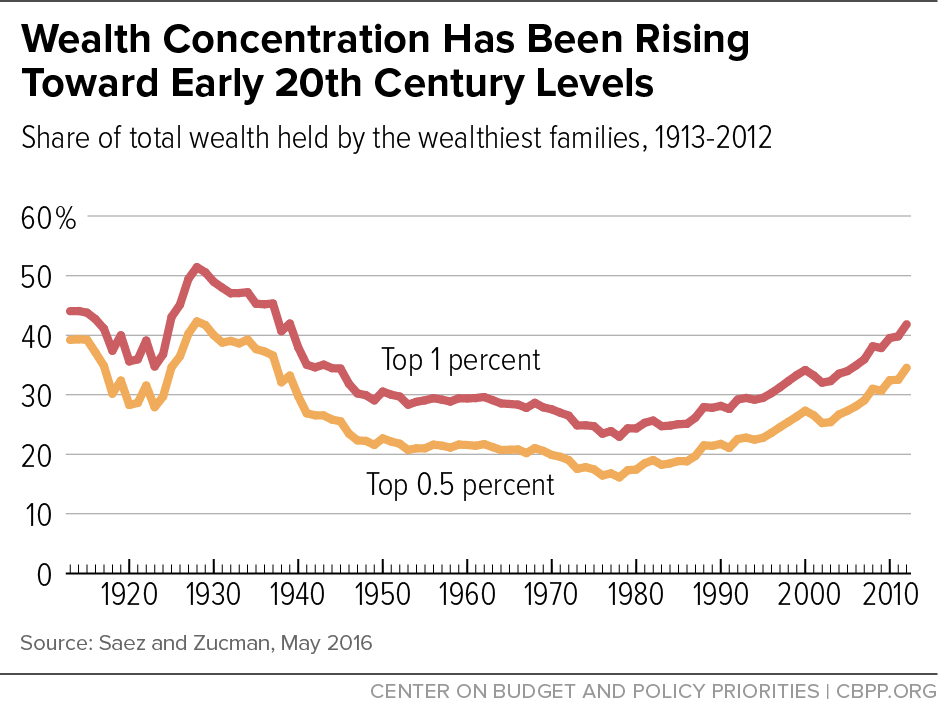
     In the first place, there are two different inequalities within a capitalistic economy -- income inequality and wealth inequality. These are often discussed as if they were the same thing. While it is true that there is often a correlation they are not the same. Income inequality is the difference in the amount of usable income in a given period (usually a year) between different income divisions (see my blog about income groups if you are interested). Wealth inequality is the total control of capital associated with a particular division. Generally, wealth inequality is even worse than income inequality because wealth both accumulates and compounds (wealth generates more wealth).
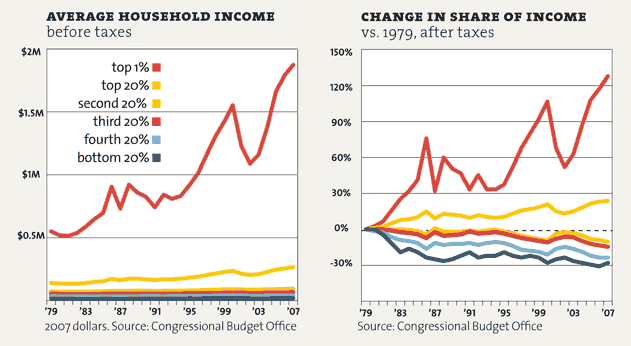
     If we look at the following graph of income inequality in the United States:

First note that these graphs only continue up until 2007. The general trends have continued through the present year. Next, note that the increase is much higher with the top 1% than the next 19%. The bottom 80% actually indicate a DECREASE in income.
     Income inequality arises out of the difference between income and required outgo. For the lowest income groups, the amount of income is less than the required spending. This deficit is dealt with by supplements from the general tax pool and by dropping budget items that are not immediate for the family -- dental care, general medical care, and so forth. Eventually income rises to the point where the income matches what is required for spending for essentials.
     We have now reached the bottom of "middle income". This continues until there is extra income beyond essentials. This is the point at which there is actually a voluntary potential of the family being able to accumulate additional wealth. In other words, there is an amount of money that has discretionary spending possible. It could be put into savings, or invested in stocks and bonds -- or it can be spent on more expensive cars, long vacations, fancy clothes, and so forth. In the first situation, the family has the potential of raising their overall wealth (and income). This is the historic "rags to riches" story -- but it requires having enough income to have excess and the number of people in this category continues to shrink and, for better or worse, an expensive car often wins out over extra savings.
     Finally, we hit that upper income category. This is where both survival and initial spendable extra income have been exceeded. It has to be either hoarded or invested. This is complete "gravy" and has nothing to be done with except to expand it. This is where the tax laws can be written to help the vast majority who generate the income or to help those who already have more than they need.
     There is no "trickle down" -- no lower levels that make 1/4 or 1/3 of what the higher level employer makes (and then continuing on down with the next level making, perhaps, 1/8 or 1/6 of the highest level). Only a "splash over" occurs -- lots of service people employed to do things that those with excess income do not want to do themselves. (Of course, the service people are still grateful to have income.)
     So there is the summary. Those who don't have enough to survive and must be helped, those who do have enough to survive but are faced with choices on spending and often spend the additional income beyond survival, and the third category with excess that has no choice but to keep growing unless compensated for with tax laws that re-distribute the money back to the people who generate it.
     Beyond fairness, however, there are reasons why it is very dangerous to allow working capital to be concentrated in the hands of a small percentage. First, the rich are not particularly different from the poor (except where nutritional situations have caused permanent damage) -- they have a "normal" distribution of intelligence from not very to average to very smart. If the top 0.1% of the population (about 160,000 families in 2015) families in the United States have control of 22% of the nation's wealth (2015 statistics) -- that means that 80,000 families of below average intelligence are controlling 11% of the nation's wealth. Even more, the top 10% (16 million families) control 78% of the nation's wealth -- giving us 8 million families of below average intelligence controlling 39% of the nation's wealth. In other words, there is a lot of economic power concentrated in the hands of people who have no particular special quality about knowing how to make use of it.
     The second part of the danger is that, with 16 million families (out of approx. 160 million) controlling 78% of the nation's wealth, we have a situation of a capital circulation problem. If 160 million have the capacity to equally spend on goods and services, the capital flows freely. If it is concentrated in the hands of a few, it is more parallel to a tourniquet being applied to part of the body.
     We have a continued concentration of wealth in the hands of a few and the recent tax "reform" act will accelerate this concentration. We have two major demonstrations of this situation (I do not claim ONLY two demonstrations) -- the Great Depression and the French Revolution. Both were situations where income got overly concentrated in the hands of the wealthy.
We have now surpassed the point in history of the end of the 1920s and are rapidly heading to the point in 1929 where someone, who had a lot of capital and power in his (or her) hands made a mistake and started the dominos falling.
     Will this happen again? I don't know but we have few documented cases where income concentration exceeded these levels and a stable society continued. These cases were demonstrated primarily in pre-colonial Europe and an outlet existed  (unfortunately for the existing native populations of Australia and the Americas) for the poor and desperate. Where is that outlet -- that safety valve -- now?

Monday, January 15, 2018

Controlled falling: how to teach a robot to walk


     Every part of growing up is a miracle in its own way. However, if you happen to be an engineer or a computer scientist, you may find yourself looking at your child in a somewhat different way than most parents. Every act is a matter of "how did they do that?" Or, a matter of "I didn't know they couldn't do that originally".
     Learning to walk is a gradual process. The first part is a matter of figuring out just how to control those wonderful muscles on purpose. For fortunate babies, they have a working nervous system and all of the appropriate muscles are there but that doesn't mean that they pop out into the world ready to do a 100-yard dash. Think of a control room with hundreds, or thousands, of unlabelled switches -- each of which cause a muscle to respond in some way. How do we use an electrical switch box which has lots of unlabelled switches? Try them out and see what they do. (And then, perhaps, label them after we notice their effects.) For a robot, this is a bit simpler as there is a specific control register (or bit within a register) that causes a specific servo-motor to work.
     Now that the child knows what muscle connects to each impulse (and I am not going to try to pretend that I know just how this really takes effect), she (or he) has to practice. This may entail kicking dad in the face a few times and laughing or hitting brother in the nose. Strength is developed as the muscles are exercised. And a special sense (not always fully present in autistic children and others) called "proprioception" starts to be better known. Proprioception is also sometimes known as "body sense" or "kinesthetic awareness". No matter what you want to call it -- it allows us to know just where our body parts are. Is my finger extended? Is my leg bent? This is important if we want to apply the right muscle at the right time.
     For a robot, this has to be done in different ways (although, once again, I do not claim to know just how body sense works within a human). One dominant method is to keep track of relative position. This works like the cursor on a screen -- when the system is powered on, a specific point is considered "home" position and the cursor is moved relative to that position. The same can be done with any servo-mechanism between the limits of its movement. However, it must start at a known location and there cannot be any exterior limit on the movement (which would cause a need for recalibration). Other methods are possible but require more active sensors (and, thus, are more expensive).
     Two more requirements exist for easy movement. These are the ability to know how hard a muscle is pushing against something (the floor, for example) and how fast it is moving. The human nervous system makes use of tactile feedback to determine how hard the muscle is straining and the body sense to know how fast it is going. With a robot, a feedback loop using torque measurement may allow the robotic arm to hold an egg -- or to crush it. Speed is determined by the rate of change of movement -- how fast position changes versus and internal clock.
     With these four aspects -- ability to move, knowing where the parts are, knowledge of amount of force, and knowledge of speed -- coordinated movement is possible. Early programming of robots tried to imitate the specific movements of human muscles within their ranges of motion. It is possible to do it this way provided that there is complete control of the environment. Nothing in the wrong place, no unexpected alterations in the footing or the locations of other relevant objects. Consider a factory line with fully repetitious movement and behaviors (until a part sticks or parts run out or a dog runs into the factory ... or) and one can relatively easily see a robot taking over the factory job. In fact, many of the jobs taken over so far have been of this nature. 100% replacement is not possible because of the many exceptions that can take place and which requires more flexibility to handle -- but a considerable reduction in human staff is possible.
     But we were talking about walking weren't we? Could we use the same methodical programming to teach a robot to walk? Barely possible but, once again, only within a highly controlled environment.
     Imagine that child learning to walk. They stretch. They pull. They start becoming caterpillars on the carpet while they both strengthen and practice their muscles. Finally, they pull themselves up. And fall down. And go up. And fall down. Then they are able to stay standing up -- but hanging on. Then they let go. And fall down. And so on.
     This is a type of programming -- but not "linear" programming. This is not "do A, followed by B and then C". It isn't even exception-handling programming "do A, followed by B, then D if condition C else do E". This is neural programming. Sequences are attempted and then, based on results, discarded or modified or increased. A goal has been set and if enough sequences are tried then, at some point, success will be reached.
     Note that a new item has now been added -- a goal. In order to have a goal there must be a way to determine if you have reached that goal. For a child that is emulating other people who are walking. For a robot, it is necessary to have goals that can be specifically quantified -- expressed as numbers -- against precise targets. For walking that might be obtaining a certain height, directional velocity, and stability. Note that balance, for a human, is obtained by the feedback from the inner ear. Tools, such as gyroscopes, are available to both help maintain, and recognize loss of, stability. Laser positioning devices can be used to indicate height. Global Positioning System (GPS) information can be used for large-scale movement for direction and a combination of position and speed tracking can be used for shorter distance velocity calculations. I am sure that other tools also exist.
     For a child, they see others walk -- and those others encourage them (and protect and guide) -- and they go through a seemingly never-ended process of trial and error. They train parts of their brain and nervous system such that the thought "walk" indicates a complex series of changes, movements, and activities. I shudder to think of trying to program that linearly.
     A robot can learn in the same manner but they have to have ALL of the correct tools -- servo-motors, proper range of motion, torque feedback, auto-recognition, or storage (with its likelihood of losing calibration), of movement, and so forth. As long as they have a goal against they can match their efforts, they can keep trying combinations until they succeed. However, there is a "secondary" aspect of this type of learning -- to keep the "winning" processes and discard the "losing" processes. Humans do this (in some way that I cannot explain) but robots have to do it also. In many ways this is even more difficult because it is unlikely that the next attempt will be EXACTLY like the one in which they previously "won".
     As a note, other types of activities can be approached in the same manner -- trial and error measured against a goal. But the less physical the more difficult the definition of the goal.
     #robotics,#AI,#NeuralProgramming

Saturday, January 6, 2018

Climate change and refrigerators: transfers of energy


     There is presently a mass of very cold air settling down over much of the Eastern coast and Northern (or the eastern 2/3 of the Northern) states of the United States. There have been shifts in the Arctic air mass before and there will be ones in the future. In itself, not that big of a deal although many people need to be extra careful with the unfamiliar conditions -- and, of course, the homeless need extra special care. This gets lots of headlines. What does not get headlines is the extra HOT weather occurring primarily in the Southern and Southwestern states of the United States.
     Ten years ago (or so) -- before the oil companies starting admitting that they had known about climate change for years -- there were lots of elected officials in the U.S. Congress trying to still keep business from having to change their daily protocols concerning energy. One such elected official brought in a snowball as a visual aid -- which got a big laugh -- although it actually had no relevance to the global situation.
     Why didn't it have any relevance? Let's start off with a more localized energy system -- a refrigerator (or air conditioner). A refrigerator cools off what is inside. Perhaps you have even felt tempted (or actually did it) to try to go inside the refrigerator when the room was too warm. But, have you reached around to the back of the refrigerator? It is hot there (be careful). The process of expanding and compressing the refrigerant gases within the tubing inside (nowadays, usually hidden) and the back of the refrigerator is a transfer of energy. Cooler inside, hotter outside. The same situation exists with an air conditioner -- the exit spot at the outside of the cooled location will be quite warm.
     On a global scale, what we have is more heat (primarily solar, some geothermal, and some direct combustion from old stored sources) being trapped than is being released. There is a balance of heat trapped and released. The primary location where the heat is stored is within the oceans.
     When we talk about climate change we are talking about what changes will happen all over the world. When we talk about global warming we are talking about the net balance between heat trapped and heat released. This can be most easily, and directly, measured by the ocean water temperature. This thermal balance is an indicator -- the precise effects are more difficult to determine because there are so many different factors interacting.
     The most immediate direct effects concern the heat sinks -- the oceans. Life in the oceans has adapted to a fairly small range of temperatures and steady, periodic, shifts. The coral ranges are showing huge, immediate, damage. The growth and patterns of plankton and other sea life is shifting. There are possibilities of current shifts -- which would more directly affect coastal land masses.
     But what about that snowball? What about that Arctic mass of air coming down? Note that an increase in the ocean temperature -- the indicator of thermal balance -- is a direct indicator of how much ENERGY is contained within the weather ecosystem. The more energy, the more activity. Stronger and more frequent storms. Stronger winds and different shifts of thermoclines (the water layers). Harder, faster, more energetic -- on balance hotter but with colder aspects at times also.
     One of the great positives of humankind is our adaptability -- and our ability to make use of tools and mechanisms (pyramids of tool usage) to be able to live in places where other species would die off before being able to adapt. However, this current shift is happening so rapidly that relocation and adaptation will push us harder than ever before. (It will also probably cause needs for shifts in disaster management and private versus public insurance situations).

Saturday, December 9, 2017

Fight, Flight, or Pause; Beyond Instincts


     Most people know the cliché/proverb -- prepare for "fight or flight" when they are confronted with an unexpected or fearful situation. A surge of adrenaline prepares the body for a quick, immediate response. If you round a pass in the woods and come face to face with a bear then those choices are probably good ones (pulling out a can of bear spray also hits a high mark). An oncoming avalanche probably gives you only one choice. There are even situations within the urban setting where the instinctual responses still may be good -- an unexpected car running a red light and across the crosswalk or a flower pot coming down from an upstairs window.
     In modern life, the options of fight or flight are often not sufficient for the situations in which we find ourselves. For example, the situation of driving on the highways and within the streets of a city or a town -- this is prone to generating great stress. Someone cuts in front of you and forces you to go into defensive driving mode. Someone is in a car behind you, at an intersection, and starts honking. Does your adrenaline start moving through your body? Probably. Should you fight or prepare for flight? Not really an option.
     Fight and flight don't work well while you are sitting surrounded with 4,000 pounds of metal and plastic -- the use of those options is often called "road rage" -- and that is not constructive. What can work? Nothing. Or, to put it more explicitly -- pause, calm, let it be. Sometimes, I find myself starting to replay scenarios in my mind. "They didn't see me when they moved over". "They can't see what I can see and they think the intersection is clear when it isn't." Perhaps, I may even reach the point of recognizing potential personal responsibility for the situation. "I may have been tailgating the person in front of me and I know the person behind me was tailgaiting and there might not have been enough space for them to safely merge."
     My contemplation of the other person and the situation, of course, might not start off quite as constructive as what I listed above. I might start by thinking what an inept, inconsiderate, socially maladroit, ignorant person they are -- or whatever short version may happen to be your favorite. I have yet to meet a perfect driver -- or be able to be one. No one is always able to ignore distractions or be able to see 360 degrees around them at all times or to anticipate strange, illegal, or other types of unexpected actions from pedestrians and cars around them. This is sometimes hard to remember when the event is occurring.
     What do you do when you are face-to-face with a person that gets your adrenaline surging? There are two variations on the situation. In the first, there is someone available to mediate -- a police officer, a neighbor, a store security officer, a manager. In the other, it is just you and the other person. The two situations are basically the same -- and almost identical if people are not willing to accept, or make use of, the potential mediator. This process is usually called "conflict resolution". The following principles are often considered to be part of conflict resolution (I add number 0 because I think it is often overlooked).
  • 0. Pause. If you are confronting a situation or a scenario where it is not possible, or advisable, to directly work with another person, this may be your only possible initial response. There may be times when it is not necessary to have a reaction. Relax, pause, evaluate, let it be.
  • 1. Listen to the Other Person Actively. Listening is not the same as hearing. (For the deaf, seeing is not the same as paying attention.) If you are preparing a response before hearing what they say, you are not listening. Take notes if you are concerned that you may miss a point you want to address. Be ready to echo things that you think you have heard -- they may not have meant that at all.
  • 2 Think Before Reacting. Once you have listened and taken notes, it is time to think about what was said -- and what you believe you heard. Find out if what you heard is what they meant. Expand on areas in which you need more details.
  • 3. Attack the Problem and Don't Attack the person. An easy trap for some to fall into but name calling doesn't help matters. It really means that you don't have a rational, logical response -- that is, they have won. Best outcome is that you both go forth from the situation as better acquaintances (maybe even friends) with the possibility of mutually solving matters about which you disagree. That cannot happen if you attack them.
  • 4. Accept Responsibility. Blaming doesn't help. In a traffic accident where both vehicles are moving, it is rare for 100% of the responsibility to be with one person -- at the very least being more aware to make better defensive moves or better allowance for hazardous conditions. Assumptions often cause problems because each person looks at things from their own unique viewpoint and history.
  • 5. Use "I" Statements. You don't know what they feel, or think, or meant. They are the only one who knows that -- and all feelings are appropriate for them. "I was angry when your car moved in front of me and I was scared I wouldn't have enough time to stop". "I felt angry and disrespected when you talked about the idea I had just mentioned to you before the meeting and you didn't tell anyone that I had the original idea." You know your own feelings and thoughts -- but you only know what is externally observable about the other person (and, even there, no one is omniscient).
  • 6. Look for What is in Common. Is there something that you can agree on with the other person? Even if it is not all you would like, it may be a beginning from which you can do more later. Concentrating on differences is not likely to help. Everyone is different and unique. A common goal may have more than one way to be approached.
  • 7. Focus on the Future and What Can and Needs to be Done. Where do you go from here? Do you have need for a future discussion -- weekly meetings? Have you achieved a common understanding that is sufficient for the time being? Is there even a need to reach a common understanding -- are you heading off in different directions and there is no real need to settle anything further?
     At one time, the "fight or flight" choices from the experience of an unexpected situation were sufficient. It is no longer sufficient -- and, in many cases, can be quite counter-productive. Decide what you want to achieve but, in the meantime, pause and consider unless in immediate physical danger (then thank goodness for the instinctual response).


Smoke Gets in Your Lungs (updated)

     This is an article that I published in here on February 22, 2013. I try to make my articles “timeless” as I try to work with “foundatio...