Friday, July 13, 2018

Real Estate Inflation -- an income wedge


     Investing in real estate is not always a sure bet -- the "bubble" in the U.S. in 2008 is a recent indication of a "correction" when real estate prices were rising much faster than demand would normally expect -- and when people were going beyond the point where they could truly afford to buy real estate. But, in general, real estate prices continue to rise.
     This is something very pleasant for the real estate owner. Over the long run, the value of the land or property (a "parcel") is expected to rise. In the short run, it may be difficult to sell. It is not "liquid" -- it can only be exchanged for money or other value if someone else happens to want it. But, if it is a good piece of land or property, it will probably find a buyer at a good price.
     What defines a "good price"? What are the components of the rise in value of land or property? Realtors are likely to say the phrase "location, location, location". That is actually only half of the criterion -- the other half is "distinctive". By building high or covering a wide area, the specific location can be widened and a specific property or land area becomes less valuable. However, with increasing density and encroaching natural borders (such as hillsides or rivers) or supportive resources (water, power, sewage, ...), there is a limit to the number of parcels that can be available at the same approximate location. Each, of course, will have their own view and orientation which may make them more, or less, valuable.
     Another component of the price can be quality. A well-built, or designed, home should be of greater price. If the person/company that designed, or built, it is well known (Frank Lloyd Wright?) then that automatically adds to the price. History can add to the price -- if Abraham Lincoln slept there then the price should go up (assuming it can be proven).
     Yet another aspect of pricing is determined by the general income level of the neighborhood. There will be a lower limit of reasonable pricing determined by the cost of materials (not applicable in the case of land) and local labor -- but that lower price limit may be voided in cases of desperation or foreclosure. However, the price will float upwards as the prices of the parcels around are rising (for whatever reason) as competition between realtors, owners, and buyers start to change the lack of sufficient property into higher prices
     All of these parts of determining value are indicative of why housing prices vary -- more expensive in some locations and less expensive in other areas. A 2,000 square foot house in San Jose, California will cost a lot more than a 2,000 square foot house in Mobile, Alabama. (Even though the quality of the house will probably be less in San Jose.) Within Wichita, Kansas, a 2,000 square foot house in a wealthy neighborhood will cost more than that within a lower income neighborhood (although neither will come close to the price of a house in San Jose).
     Once upon a time (when I was growing up -- not quite the dark ages), my architectural drafting instructor told us about an expected ratio of land to square footage of a house. As I recall, the "footprint" (the amount of land the foundation required) of a house was supposed to be no more than 1/9 of the lot size (land). (It was never indicated as to any rule-of-thumb on apartments or townhouses.) With a reduced expectation, and use, of land -- as well as an increased percentage of the total price spent on land -- it is now not unusual to have a house occupy 1/3 of the lot (sometimes even less in urban areas).
     In addition to the house occupying more of the lot, there is incentive for the builder to increase the size of the actual house. Houses are listed, and compared, by $xxxx/square foot (in other areas Money/square meter). The price to build is NOT the same for all sections of a house. Kitchens and restrooms are more expensive. By adding more square footage to the "living" areas, builders can squeeze out more profit without increasing the price per square unit of area.
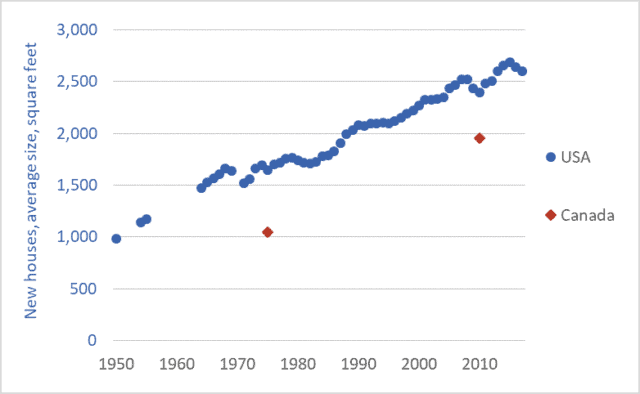
A chart of this increase in house size can be seen from Darrin Qualman's post.

     Perhaps this is not particularly egalitarian -- people who have more income (or more inherited wealth) can buy larger houses in more desirable locations with better views, schools, climates, landscaping, local attractions and such than those who are poorer. But such has been the case since land and property started "belonging" to people and is likely to continue.
     The greater problem is having the AVERAGE housing price go up faster than the AVERAGE wage. As time goes on, a smaller and smaller percentage of the population can afford to buy housing. This also reflects upon the situation for renting since renting is the process of fostering out to others property that has been purchased by someone. In other words, rents are loosely based on the amounts of mortgages for the property.
     Before I started researching to double-check facts for this blog, I thought that real estate prices were rising much faster than inflation. It does not appear to be the case. Even wages are reasonably stagnant (decreasing only a small amount, on average, against inflation) from amhill.net's post (you may find other sections of the post of interest, also).


     But, since house prices are per square foot and the average size of a newly built house has increased by 250%, many fewer people can afford a house. What they can afford is an apartment (or maybe a townhouse) which shifts the size back to that of a house built in the 1950s. That may not be that unreasonable -- the increased size is a factor of literal "inflation" but it does mean that the "American dream" of a stand-alone house with its own yard is more and more out of reach for many people.
     One new trend against this flow is for that of the "tiny house" movement. Note that, although the square footage is quite a bit smaller than the typical newly built house of current days, the price per square unit of area actually goes up (once again, the cost of kitchen/bathroom is more expensive and there is less "living area" to offset that cost). Of course, people can still buy their own lots and have their own "moderate house" built. It just doesn't seem to be currently popular -- which means that it may prove hard to sell in the future.
     In summary, part of the lack of ability for people to afford housing is an illusion. Since the size of houses has increased (and the prices accordingly) and wages have remained stagnant then fewer people can buy the houses currently being built. However, if the size of the living area is kept constant -- and the form of the living space is allowed to change from that of a "dream house and yard" -- then people's ability to afford housing has not changed. Unfortunately, the numbers of housing units built of an affordable size is not keeping pace with the percentages who can afford them -- causing housing and rental shortages.

Tuesday, July 3, 2018

Why Do Prohibitions Fail -- the reduction of undesired behaviors


     In January of 1919, the United States passed the 18th Amendment to the Constitution and, a year later, it went into effect. This Amendment prohibited the "manufacture, sale, and transportation" of drinking alcohol. Note that it did not prohibit the drinking of alcohol but, legally, the only alcohol a person could drink was from the stockpiles that were already in their possession. Although there was initially a drop in alcohol-associated problems such as driving under the influence and arrests for drunkenness, difficulties started to increasingly plague the movement. Enforcement was very difficult -- easier in rural and "pro-temperance" areas and harder in urban settings -- and there were increased costs both in policing as well as prisons. In addition, the now-illegal activities of "manufacture, sale, and transportation" increased both the price of drinking alcohol and the attractiveness of criminal (by definition, those participating in illegal activities are criminal) participation in "bootlegging". Al Capone was a very famous leader of such gang activity.
     By February of 1933, the Amendment was increasingly unpopular. The high price of bootleg liquor and alcohol primarily punished the middle and lower income people (remember that drinking was still legal). The reduction in tax revenue was a problem within the period of the Great Depression. The "temperance" (those who favored alcohol suppression) movement was being taken over by people whose primary motivation was their interpretation of religious documents. Police and government corruption and organized crime and violence was getting worse daily. AND, there was no success in the overall reduction in drinking alcohol by the general populace. Prohibition had failed. Upon the 21st Amendment being introduced in February, it was quickly ratified and became law on December 5, 1933 upon the signature of Franklin Delano Roosevelt.
     In summary, the prohibition of drinking alcohol failed -- and failed badly. It did not achieve its primary purpose (reduction in drinking). In fact, the continued (now illegal) activity caused huge problems in police and government corruption, organized crime and violence,and general disregard of the law.
     Drinking alcohol is not a "victimless" activity. Overuse of alcohol causes problems for the individual as well as their family and other people who care about them. The effects of alcohol cause reduction in judgment and focus which, in combination with certain environments (such as driving), can cause "side-effect" problems such as accidents, fights, and job loss. Yet, it was emphatically proven that prohibition did not, and does not, work to reduce misuse.
     With such a dramatic, and relatively recent, knowledge of the failure of prohibition it would be reasonable to think that we would no longer try prohibition. Yet, that would be clearly incorrect. Among the many activities that have been, or currently are, prohibited include:
  • Drinking alcohol
  • Gambling
  • Drugs currently categorized as illegal
  • Socially disapproved sexual activity (adultery, masturbation, prostitution, pornography, public exhibition, ...)
     According to Lysander Spooner, the difference between vices and crimes is the direction of said action. "Vices are those acts by which a man harms himself or his property." "Crimes are those acts by which one man harms the person or property of another." As mentioned above, however, it is possible for a vice to harm others through side-effect (not the direct action but resulting from the effects of the action upon the person involved).
     Note also that the "harm" may be defined from a religious or societal basis and not from a measurable physical change. Thus, there may not be consensus -- nor may such attitudes be constant -- on what is of "harm" to people or to society. I am certain that there are other items that some people would add to the above list. I am equally certain that some people would remove some items.
    Recognizing that there is not full agreement as to what is of "harm" to an individual -- what can be done to reduce those behaviors? Both the experiment of Prohibition (focused on alcohol) and many other prohibitions (focused on other items, including the items on the above list), have shown -- over and over -- that prohibition of "vices" DOES NOT WORK. In fact, it is counter-productive in that reduction is minimal and the continued illegal activity increases crime and corruption with net loss in available tax money for more productive uses.
     Successful reduction of disapproved activities fall generally into two closely related categories -- education and expansion of alternate choices. Often, a third item is added -- regulation and oversight -- in order to keep track of the activities as well as to provide social recompense (tax revenue, for example) that is not involved in reduction of the activity.
     Education provides a mechanism to inform people of the effects of the activity. This is usually focused on the negative effects (there is little desire to increase the perception of positive effects). There will still be reasons for attraction to the activity for people so the base reason for the education is to have the choice to participate in the activity be an INFORMED choice.
     In order for there to be a choice, there must be more than one option. It is neccesary to provide OTHER, preferred, activities in which they can participate. If no other choice is available then the single, non-approved, choice is still the "best" choice for a person. Provide attractive alternatives!

Saturday, June 23, 2018

Why Write a Blog -- why write anything at all?


     My official view count on blogspot recently exceeded 20,000 views. I am fairly certain that this is a low number. There are places where I post my blog that make their own copy and, thus, the official counter is not incremented. Twenty thousand is not really that amazing. There are people who are better well known, who work much harder at getting their blogs visible, who blog in association with a company or technology, and others in different circumstances who have view counts that make mine insignificant. But, it is significant to me.
     This total of 20,000 views is from a long history. I have been working on this set of blogs for almost 11 years and have written 115 blogs. They total around 100,000 words -- which is about the same as a couple of moderate-sized novels. A guesstimate is that it has taken about 450 hours or 11 full-time workweeks (or an average of one 40-hour week per year).
     Why put in this amount of effort? I have occasionally joked -- sometimes more than half seriously -- that I write because I am a masochist. I have gaps of weeks to a month or so when I just cannot get myself to go back to the keyboard. There are often few, or no, comments -- "what is the sound made by one hand clapping?". In some social media, it is not uncommon for people only to comment, or downvote, if they don't like it -- and generate only silence if they like it or are OK with it.
     I have even had one moderator of a social media site insist that blogs were the same as spam. Upon suggesting that she, or he, read it -- they, in proud fashion, insisted that "they didn't read spam". The reality that their arguments would apply equally to any posted article (Computerworld, Newsweek, Time, Washington Post, ...) made no impact on their worldview.
     The question as to "why bother" applies to most writers. The statistics of  about 10 years ago were that 90% of all writers do not, or cannot, make a living at writing. I suspect that the statistics have not changed much -- possibly it has even gotten worse as there are many more "markets" where a person can publicly write for free. I am sure that there do exist blog writers who make a living -- maybe in the same general percentage as other writers. Personally, I would have loved to have made reasonable money from my blogs -- but I haven't.
     When I wrote, and had published, my three technical books, I earned back my royalty advances which placed me in the top 20% of all non-fiction writers; I didn't earn very much past those advances. I may have earned a dollar an hour for those books (they are all long out of print). My initial fiction book has earned closer to a nickel an hour -- though I always have hopes that the right person will read it and it will take the world by storm (it has been well reviewed). I think that writers, in general, have to have an optimistic core or they just wouldn't write.
     So far, this blog has listed lots of reasons NOT to write. Don't expect (you are allowed to hope) to earn money writing. You are more likely to hear complaints than compliments. You may even have to justify your very existence in your writing.
     So, why write? I have been in the paid workforce for about 47 years -- working in the computer science arena for 40. During that period of time, I have read thousands of books, worked on hundreds of projects, interacted with thousands of people, worked in dozens of different roles and even in a dozen different fields (donut baker, programmer, wheat field tractor driver, company startup co-founder, small item construction field worker, manager, ...)
     In this, I am certainly not unique. There are many of you out there who have had as many experiences and some who have had more experiences or experiences that may be of more popular interest. A lot of you are like me -- wanting to share back with the community from which we learned and have gotten so much.
     But, I like to write and am pretty good with the written word. So, as I fill up with experiences I want to share them -- and I can best share them via the written word. So, I write. And, among other methods of publishing, I blog.

Saturday, June 9, 2018

You Can't Give If No One Will Receive : a closed cycle of sharing


     Most (but not all) of us were taught, as we were growing up, that it is good to give to others. Some societies include sayings such as "it is better to give than receive". The lesson sticks with people better, or worse, with a lot of the adhesive depending on what those who are close to us actually DO ("lip service" doesn't work well as an example).
     Giving has no expectations of return. I give you a gift -- you may, or may not, give me back a gift. And that's OK. I give you a gift and you give it to someone else, exchange it, or I find it in the trash can at some later date; once I have transferred something to you then it is yours. That's OK also.
     It's OK but it's not ideal. Ideally, you give someone something they want and like (perhaps even need) -- such that they will not WANT to discard it but will treasure it (or, in the case of something transient as in food or money, the memory of it) as a type of bond between the two of you. For this to happen, the act of giving can no longer be unilateral. There must be an active receiver in addition to the giver. I give, you receive. In the 1990s, a group called "The Boomers" had a song called "The Art of Living" which talked about this situation.
     Many people are taught that they should give. Not a lot of people are taught that they need to receive -- and, certainly, not how they should receive. In the U.S., we have a lot of good givers (not always from as pure of motive as desired) but not a lot of good receivers.
     OK. We get lessons on how to be a good giver (not that everyone does such). Give without thought of return, including not having conditions attached to the gift. Give according to what is needed, or desired, rather than what one most wants to give. Give as you can -- but not more than what is comfortable such that you will resent it.
      What about that receiver side? There aren't many lessons on it. First thing is to recognize that receivers make givers possible. If you truly believe that giving is a good thing, then you need to learn how to be a good receiver. You don't need anything? Not even a compliment (which, if sincerely given, may be even better to receive than a material fortune)? Congratulations. Maybe you know someone else who does need what is being offered -- pass it along to that person, or group, giving credit to the person or group from whom it was originally given.
     You do need something? OK -- you have joined the ranks of the majority. If something is freely offered to you, the first thing is to NOT feel guilty for accepting it. You are providing an opportunity for them to give. But do be appreciative as they did not have to give. My relatives always told me to write a thank-you note but I still don't see any reason for such if you have already thanked them in person. But do thank them. What if you don't need it, want it, and don't know of anyone else who does need or want it? That is more awkward as they may have indeed felt that it was a generous offer on their part. Express appreciation and then suggest a more appropriate recipient. Let them know they have done something good and you want it to be used to the best extent possible.
     What if someone insists on "giving" you something even though you have insisted that you don't want it? Well, that is not really giving. I am not sure there is a specific word for it in English but it is more related to assault or forcing than giving. I cannot say what the "giver" feels under such circumstances but the one being forced to take something is not going to feel good about it. Of course, "receiving" something without a corresponding giver is just taking (perhaps stealing).
     Let's work towards the ideal of truly giving, with a full and joyous heart, and receiving, with appreciation and acknowledgement of self-worth. In a world where life is not often "fair", we can help to even things out.

Saturday, June 2, 2018

Is "free" ever free? -- a matter of choice and perception


     "Buy One Get One Free!" This is a famous advertising slogan within the U.S. Often it is shortened to just BOGO. Do they really give you one "free"? Of course not -- try asking for just the free one. They will respond with a laugh if they are in a good mood. Financially, it means they are selling the product for half price (50% discount) but -- from a consumer/shelf rotation point of view -- it is not quite that. By requiring you to buy two in order to get the discount, they are also increasing their sales volume. This is the non-food version of supersizing -- the food version of which I expand upon in my blog on "supersizing".
     This advertising method is also used for other percentages and other quantities. Buy Two Get Three Free (60% discount with five products sold). No matter what the actual proportions, it is a method of advertising and tricking the brain into thinking that something is "free". Another variant is to have a "sale" offering 10 of product G at D% off. Or, in a specific example, if the article usually sells at $1 the offer is to sell 10 for $6. Sometimes, the advertising also says "must buy 10" -- sometimes it doesn't -- but, a lot of the time, people will still feel the urge to buy a full 10. (Read the entire sales quote including the smaller print.)
     Of course, this type of "free" doesn't have to be within the same merchandise. "Buy Product X and, for a limited time, we will toss in Item Y (which we haven't been able to sell on its own) FREE." This has the big advantage of reducing inventory on Item Y. This is not saying that Item Y is not a good item -- but it doesn't have the appeal necessary to sell it by itself at a good profit margin. Product X gets a boost in sales attractiveness without directly discounting its price.
     In the above cases, the primary economic advantage is selling more products. In the U.S., and in most of the larger countries, consumerism is a heavy factor in the economies of the country. From this orientation towards consumerism, many factors are emphasized within society. These include expanding feature sets, obsoleted -- and "new" future fashions, minimal useful worklife, and so on. In the past decade, a transition has started being made from physical to electronic products -- higher profit margins and less required capital with an ecological benefit. However, this causes labor redistribution and retraining ("no free lunch" -- see next paragraph).
     "There is no such thing as a free lunch!" Absolutely true -- but it may be absorbed into another existing budget -- this can either be within a corporate advertising budget or within a system of taxation. As mentioned in the previous paragraph, it can also apply to benefits in one area requiring extra effort or pain in another.
     My wife and I often get calls of the nature: "you are the winner of a free vacation to our wonderful resort in Paradise, Country X". We are of a certain age that is expected to be looking towards retirement. We "won" because they have determined (from extensive data mining and other methods) that we can potentially afford something and that we have a reasonable chance of actually buying it. They may have also researched a "soft touch" factor on us (how well do we resist sales techniques). At any rate, we are part of a group of "winners" and, statistically, they are likely to get more profit/sales out of the group than it will cost up-front to get us all to their resort and pay for the advertised benefits.
     This isn't saying anything bad about the resort -- it may be fantastic and it might even be something for which we might be grateful for the opportunity to purchase. But it is an example of how something "free" is incorporated into a larger budgetary item -- in this case, advertising.
     Tax budgets are another situation where "free" items are incorporated into the budget. In this case, since the taxation is mandatory, the items labeled "free" are usually called such by a group of people wanting some OTHER use of the money (they rarely want the money left with the people -- though that may be denied). So, "free" is bad and implies that it is an unearned "gift" from the taxpayers.
     Taxpayer revenue forms a budgetary pool just like the general revenue of a corporation. Within that budget, there are various allocations. Each allocated budget item is "free" from the point of view that it is paid for by the entire pool of taxpayers. On the other hand, NONE of the budget items is "free" because they are ALL paid for by the entire pool of taxpayers. Priorities are determined within the budget for items and there is considerable disagreement between groups of people as to what those priorities should be -- but the use of "free" to describe usage of the budget is a political term and not a financial one.
     So, is free truly never free? No -- not quite. Currently, people can still breathe without cost. Freedom to drink potable water is becoming a greater and greater struggle but it is still free in some places (in others, it requires community subsidization and allocation). There are places in the wild where (often against the rules) you may be able to eat wild vegetation, or hunt/trap animals, just because you are there. I am sure there are other examples that are outside of the general economy. But -- within the societal economy -- "free" means being paid for via some other person, agency or budget. Can you think of exceptions within economic society?

Saturday, May 26, 2018

The Foundations of History Tend to Shake: could the Holocaust fade away?


     The last of the surviving veterans of World War II are making their passage from this world. Also, the last of the survivors of the Holocaust. Together, this means that -- out of the many thousands of direct and indirect witnesses to the atrocities of the Holocaust -- very few remain and soon there will be none still alive.
     So, why does that make a difference? It is recorded in history and references are still taught and read. It happened, has been very well documented and proven, and is a tragedy from which we can learn for many years. Right?
     Alas, such is not necessarily the case. History is always in the process of being rewritten. Sometimes it is a result of more information coming to light -- excavations, first-hand documents, physical proofs and artifacts. Sometimes it is a matter of documents and artifacts being lost or deliberately destroyed or suppressed and then denied.
     At its best, history is a tiny slice of what has happened at a particular time. Choices are made as to what to include and what to omit.  History, or "His story", tends to focus on males throughout history -- such that women's accomplishments are forgotten, overlooked, or attributed to men associated with them. Histories are also "written by the winners" and the losers of wars and other confrontations often have their records destroyed or omitted -- certainly they are de-emphasized. Also, the history writers make choices from the materials available. Who, and what, is "important"? Do they talk about the war leader or do they talk about the woman organizing and leading the cooks to feed the army (or the family)? Is the life of the baker considered to be as important as the Duke? Do the details of the life of a peasant get equal emphasis to that of the local feudal lord? Even during peacetime, the accounts and records will be more in depth for those of the ruling segments.
     At its worst, history can become fantasies to support the current people in power. Perhaps out of shame, genocides, massacres, and evils done by humans to other humans (such as slavery) have a great tendency to be obscured or their realities warped. Some people try to "clean" history -- change the language used within books, change scenarios and such so that it meets present-day standards. That is also a method of falsifying history. A third category is to deliberately create fake documentation to support misinformation that the person, or group, would like to present as the truth.
     A very active and well-known Anti-Semite wrote a "scholarly" book concerning his anti-semitism. At first reading, it looks very well-researched, objective, and persuasive. It is not until the "references" are further checked that the fabrication becomes clear. The references are "circular references". The references are to people and their works who then refer back to the author or to other people to whom he references. In other words, the work supports itself by having a group of people wanting to present a falsified world view support, and "authenticate", each other. There is no connection to real world events or first-hand accounts. It is all a built up fantasy that SOUNDS like it has a basis in fact.
     So, with history's inherent limitations and vulnerability to falsification, how CAN valid history be protected? To quote Pilate, from the book of John, "What is truth?"
     There isn't an easy answer. History can never present the full truth -- it is inherently limited by access to, and choices from, data. Constant vigilance is needed to prevent deliberate, unsubstantiated, changes to history and acceptance of falsified data. The primary defense that exists is a solid educational background for the general citizenry -- to allow them to judge, to research, and to understand (such as going deeply enough to locate circular references).

Saturday, May 12, 2018

Failure is not an option -- why not?


     "Failure is not an option" is a famous, and memorable, line from the movie "Apollo 13". I have a favorite shirt, slowly fading, with the line written upon it. Although the line exists within the movie, no one actually said it during the time of the Apollo 13 equipment failure. It is a summary/scriptline composed from a bunch of thoughts and explanations (post-event) from the NASA ground crew.
     Failure may not be an option -- but it does occur. In fact, it would be a rare occurrence, within a business environment, for failure analysis to not occur after an instance of a project or business failure. I am positive that, if I were to startup another business, I would make an entirely new set of mistakes.
     It is not currently popular, but failure analysis also is very useful within the non-business world. It is called "learning from history". It requires recording history as accurately as possible, studying that history, and analyzing what went well and what did not. (It is preferable if people choose to NOT repeat what did not go well.) All three of those steps are difficult but worthwhile.
     So, failure is certainly possible -- yet it still should not be considered an option. Within the world of computer programming, it might be considered to be the default condition. You keep planning for, and defining, all of the situations that you can think of -- and if none of those occur then it falls into the "default" case. It is the bottom basket into which all of the "not-planned-for" events fall.
     Failure occurs but it isn't planned for yet it can be (and, in business, often is) analyzed afterward. But is failure to be allowed? This often ends up being a Return On Investment (ROI) question. In the case of the human astronauts' lives in Apollo 13 there were severe limitations on materials and what could be done but, within those limitations, no effort was too much. In the case of human lives suddenly at risk because of accident or natural disaster, the cost is often analyzed only after the events have passed.
     In the case of the potential failure NOT involving human life, it is much easier to quantify the costs. These include the costs to avoid failure and the costs of having reached the point where one would call it failure (Edison once said "I have not failed. I've just found 10,000 ways that won't work.").
     It is most useful to determine first the value of success, then the odds of success, and then the amount of resources (time, money, energy) to be invested before purposefully stopping the effort. It could be argued that that would not be a failure because there is no way to know the final result if the effort continued. Yet it also would be difficult to call it a success. As the costs go up and the estimated value of success remains constant, it is a situation of "diminishing returns".
     In summary, failure is the final result when all of the plans for success have refused to come true. Failure, in itself, is not planned; it is not an option. The process of planning for failure makes it just one more planned result and if a planned result occurs then can it be failure?
I have not failed. I've just found 10,000 ways that won't work. Thomas A. Edison
Read more at: https://www.brainyquote.com/quotes/thomas_a_edison_132683
I have not failed. I've just found 10,000 ways that won't work.
Read more at: https://www.brainyquote.com/quotes/thomas_a_edison_132683
I have not failed. I've just found 10,000 ways that won't work.
Read more at: https://www.brainyquote.com/quotes/thomas_a_edison_13268

Saturday, May 5, 2018

Mortality: How can awareness change your life?


     No specific focus for this blog -- just lots on wandering (and wondering) thoughts. I have gone past the anniversary of 60 years of the earth moving around the sun. I occasionally talk to my children about preparing for my not being around anymore. They don't like this at all -- but it isn't something that will become easier with time and they need to deeply understand that they cannot stay reliant on their mother and myself -- that there is pressing need to be able to fly out of the nest.
     Not that I plan to die tomorrow. Who does? (Well, some souls do have a more precise knowledge to encourage preparation.) The general societal culture in the United States is one of avoidance of death -- the attempt to live forever (preferably looking like one did at age 21) seems to be in many of the increasing number of sales brochures that arrive in my mailbox (electronic or physical).
     Various strategies for immortality have been attempted over the centuries. Presently, cryogenic preservation and digital simulation/storage are among the more active avenues being attempted (none have been proven to work so far).
     There is no reason that a person should NOT attempt to be the healthiest (mentally and physically) possible while they are loping around this world -- as long as they aren't spending most of their time and thoughts on doing that instead of actually living their lives. Or, as I like to put it, "worrying about things is often worse for your health than the things you worry about".
     Robert A. Heinlein's story "Lifeline" dealt with the idea that a machine could be developed that can tell you when the lifeline is to be cut -- the day that you would die. Of course, this was not good for the insurance companies. It did not end well, of course, but the sealed envelope the inventor left ... well just read the story.
     I don't think I would like to know just what day my story ends. But I like to think that I do use my awareness of my mortality to live my life as best as I can. I have lost my fear of saying "I love you" to people as I am much more afraid that I might leave without letting them know. I try to keep my "things in order" so that my wife will know where all the accounts are if I'm not around and can pay the bills and make use of the money we have saved.
     However, I do NOT have my study or house in as tidy of shape as I used to have it. As Bill Murray says in "Meatballs" -- It Just Doesn't Matter. Oh, I'll fight the fight against entropy when I can -- or when it becomes important to my wife -- but I no longer consider it to be a major sin.
     I have a general (and, possibly, more conscious than many) daily awareness of my life's eventual end but I don't update my obituary each day. I know that STATISTICALLY I have quite a few more years in me as my ancestors who died "natural" deaths tended to live quite a while. So, it only affects me in a mild (and, hopefully, positive) way.
     One way that my own attitude affects me, however, is that of being more aware of OTHER people's mortality and a wondering of how their circumstances change their lives. If a person lives in a country at war, or with a large degree of terrorism and destruction on a daily basis, how does this change how they deal with life on a daily basis? If, because of skin color, ethnicity, or religion, they know that others may irrationally murder them as they walk down the street how does that change their attitude toward life each day? Do they embrace life and speak loudly and laugh as much as they can and generally live each day to the full? Or do they move from one shadow to the next hoping to increase their chances of making it to the next day? Or perhaps it is a mixture of all -- changing from day to day and person to person.
     There is, of course, the other end of the spectrum -- being so scared of one's eventual mortality that paranoia, selfishness, and self-isolation become daily crutches. As Frank Herbert says in Dune -- "fear is the mind killer" and death certainly qualifies for fear for many. For some, it reaches a degree of fear that they forget to actually enjoy what they can while they are still alive. I don't know but I would suspect that people who live in a higher-than-average dangerous situation learn to suppress reasonable fear because, realistically, there is little they can do.
     How does the reality of death affect you? Is it a subject to avoid? A matter-of-fact reality? Can a person really prepare for the unknown? Is awareness a potential blessing or a curse?

Saturday, March 17, 2018

Drug addictions: Not so much a matter of what but why


     Due to the "opioid epidemic" in the U.S., there has been an increase in studies and general research about addiction. I have a fairly high level of scepticism about individual studies (as per another blog) but that doesn't mean they have no uses and cannot be treated as a group for some type of insight.
     One anomaly that has been known for a long time is that people in severe pain only rarely get addicted to painkillers -- even the "heavy" painkillers such as heroin or other "opioids". The few that have gotten addicted seem to have had caregivers who did not decrease the medication when the pain decreased (and, even then, most did not remain dependent once their pain was overcome). It is the same medicine as that which might be used by a street "junky" -- but one is addicted and the other is not.
     The reality is that there are different types of addictions. There is the physical addiction which directly affects the mind and body and which carries with it the potentially lethal side-effects from overdose and withdrawal. This is often the primary aspect that is discussed -- and is how various addictive substances are listed in severity. With some drugs, it is possible to become physically addicted with the very first usage of the drug -- others take longer and have a constant increasing dosage requirement. No matter how quickly physical addiction takes place or how difficult (and, possibly, dangerous) withdrawal is -- there are beginnings and endings to physical addiction.
     So, there is no physical addiction before the drug is tried and physical addiction is fairly short-lived (assuming the person does live through the withdrawal). Why do they start? Why do they resume? The Alcoholics Anonymous groups talk about one day at a time -- recognizing that each day they do not resume is another day without alcohol. Other physically addictive drugs also tend to be resumed. Why, if the physical addiction can be removed?
     One study among a number of recent studies got a mouse (or rat, I cannot remember) addicted to some substance. They then (without having it go through a withdrawal process) placed it in an environment where it could go and have more of the drug OR go to a different room where it could have access to play activities with a number of other mice. The mouse chose the community playground.
     There are, thus, three phases of addiction -- becoming addicted, physically addicted, and potential relapse to addiction. The middle phase is the most physically dangerous but it is bounded. Pre-addiction is almost completely a social or emotional attitude -- the answer to "why?". The last phase, potential relapse, can be framed more from the question "why not?.
     Three of the potential components of why a person starts with an addictive substance includes behavior of their social group (family and peers), feelings of loneliness and/or hopelessness and/or some other situation earnestly desired to be escaped, and plain old curiosity (although their choice of substance is often socially constrained).
     Social (and, related, income) group is highly related to the type of substance used. In other words, what is popular and what is easily available? The drug of choice, and form, also depends on income levels. Low-cost alcohol for low-income and imported beer, wine, and liquor for higher-income. Tobacco use has decreased from about half of the U.S. population to less than 20% but the distribution is not even -- it is more likely of a choice for those who make less money and have lower amounts of education. In the case of the "opioids", it can depend on the vector of access. If it is prescribed, then certain drugs will be used. If purchased on the street, other drugs are more likely. In some cases, such as with refined sugar or some common household spices, it will meet the dictionary definition of a drug, but it is not considered as such by the general population.
     In all cases, continued use is dependent on finding a degree of pleasure from the experience. Generally, this is involved with dopamine in the brain. Different drugs work differently. Some increase dopamine, some prolong the interaction, and other interactions exist. Heroin is considered to be a highly addictive substance because the effect is so quick.
     At some point, a crossover takes place where the avoidance of withdrawal takes precedence over the attraction of the experience. This is the point that is more often called addiction. It continues, and may intensify, until there is an internal, or external, decision to stop or the person dies. This is not meant to imply that all addictive drugs are fatal though most are harmful to the body with extended use. A person can smoke for a normal lifespan -- it being very dependent on the individual's genetic history. On the other hand, a heroin addiction is not likely to be survived for a long time.
      It is a peculiar side-effect of messing with dopamine actions in the brain that it can also cause memory responses. You can reach the point of hating what you are doing while addicted and yet, after not that long, the memory of hatred fades and the dependency comes to the forefront once again.
     If quitting the addiction was done for an internal reason then the person has taken a strong step towards staying non-addicted. If the decision was imposed externally, then a number of factors are likely to be involved that will make it even more difficult to stay non-addicted. The internal decision has already wrestled with various pro- and con- factors. An external decision avoided such.
     We are now at the "why not" stage. As mentioned before, memories of the negative parts of the addiction are not likely to be very strong. Therefore decisions have to be made based on other factors. If the original attraction was to avoid feelings of hopelessness, is there now more reason to hope? If the original attraction was to avoid feelings of loss, do you now have other, healthier, ways of coping with those feelings? Even with the faded memories, hopefully curiosity is no longer a factor but you may still be surrounded by others who are still involved with the drug. In the case of legal drugs, they may even still be in the process of being advertised. (Note that, often, the primary difference between a drug being legal or illegal is political.) Basically, if the purpose of taking the drug was to avoid something and that something still exists, a return to the road of apparent (not actual) escape can be very, very tempting -- perhaps overwhelming.
     You have out a weighing scale and one side says "become readdicted" and the other side says "stay non-addicted". An outside observer may say "no problem -- it is obvious". It is not always so easy to the person who has passed through the gauntlet.

Sunday, March 11, 2018

Victim Mentality: How NOT to improve your situation


     First, let's state up front that there IS such a thing as being a victim. This occurs when there is an imbalance of power, real or perceived, between two people or groups. There may not be an identifiable quality that differentiates between the people or groups. Or it may be "justified" because of difference in body shape, amount of money, skin pigmentation, gender or gender identification, sexual orientation, religion, genealogy, political branding, attitudes towards social or political situations, and so forth. It can be primarily between two individuals (bullying or a crime done to you) or two or more groups (-isms).
     I do not have the chutzpah to try to define all victims or to identify causes or cures for various victimizing situations. But I was a co-editor of a minority newsletter at work for about three years and I left after I started detecting a persistent and demoralizing pattern. About 80% of the articles were about what "they" do and the effects of what "they" did. The articles generated some anger but, often, more of a sense of hopelessness. Anger can be used as a source of energy to create positive, proactive, change. Hopelessness does just the opposite.
     Victim mentality basically says "I have no power" and "the person, or people, abusing me is the only one that can change the situation" and "all of the power rests in others". While there is a sense of familiarity in giving up -- a comfort in the situation that says you can expect ongoing victimization to which you already used to -- it also means that nothing will improve. Even external attempts to improve the situation will be defeated because, in reality, you have the primary power and if you believe nothing will improve -- it won't.
     During my cross-checking research for this blog, I ran across a number of articles concerning how to get out of victim mentality -- but not very much on just why victim mentality is so counter-productive. These are a few of the components from the articles that I once read that ended so mired in victim mentality.

  • One person does not define everyone. A person has done something to you. Possibly even a set of people has done something to you. This still leaves 8.6 billion, minus the people who did something to you, as NOT having done anything to you. You against the world may be the feeling that you have -- don't make it the reality. Make allies instead of enemies.
  • Don't exclusively focus on what you do not have. A number of the articles seemed to have the general theme of "count your curses" rather than "count your blessings". As a legitimate victim, you have things that have happened that are bad. But isn't there anything good?
  • In many of the articles, there was an emphasis on people, who were chosen by the victim, doing bad things to them. That's indeed terrible. But why were they chosen? Do you often make such choices? Can you start making better choices?
  • Often there is a direction of "all or nothing". Sounds great -- except for the "nothing" part. Break up the goal into a bunch of parts (the smaller they are, the more easily attainable some of them will be) that add up to your "all" and then start woking on the various "parts". You may never reach the "all". Maybe your great-grandchildren will. Who knows? in the meantime, things are improving and you have stopped concentrating on what you don't have.
  • Search for alliances, support, and helpers rather than sympathy. Many articles seemed to cry out "poor me". OK, I am sorry for what happened. Now how can I help you help yourself? What is needed by you, or within your environment, to help prevent what has happened from happening again?

     I would love to never read another article that appears to be based out of a victim mentality. Until that day comes, I will do my best to help in the ways that I can.

Saturday, March 3, 2018

Personal inventories and assessments: Does your box matter?


     Have you ever taken a personality inventory test? For work? For a career exploration workshop? For fun? As a Myers-Briggs Personality Inventory (MBPI) INT/FJ (usually just put down as INFJ), Enneagram Type Nine, TeamSpace Teacher/Pioneer I have to say that I have done many (but only when they're free).
     On a more serious grouping, there are tests which lead to diagnoses from the Diagnostic and Statistical Manual of Mental Disorders (DSM). This manual of diagnoses is now up to the fifth version and is called DSM-5. Two of my sons have been classified as being on the ASD (Autistic Spectrum Disorder -- I prefer the phrase Autistic Spectrum Difference) scale. In DSM-4, one was classified as having Asperger Syndrome and the other was classified as PDD-NOS (Pervasive Developmental Disorder -- Not Otherwise Specified). The PDD-NOS diagnosis basically meant that not enough sub-boxes were checked off in diagnosis to give a different, more specific, label.
     In the DSM-5, both Asperger Syndrome and PDD-NOS are no longer separate diagnoses -- they blend into the more general ASD category. They have not changed substantially but their boxes have "moved". In a parallel way, this type of thing happens in other categories (I had relatives change the town in which they lived without moving by having the town boundaries changed). Still, if the boxes, or labels, can be changed at any time -- what are the uses, if any, of the boxes?
     The labeling can be broken into two general groups -- legal/medical and interrelational. Laws are written around the DSM. Medical benefits (or lack thereof) are based on the diagnosis (or box -- or label). Thus, when the DSM-5 eliminated the separate classification for Asperger or PDD-NOS it also changed the relationship to medical insurance and general law. It is possible the guidelines will be modified to adapt to the new boxes of the DSM -- but probably only after time and pain.
     I do not know the exact differences between the DSM-4 and the DSM-5 but I do know that, when such documents are directly tied to laws and policy, changes will be a problem. Sometimes, it may work to people's benefit such that they NOW qualify for benefits when they did not used to do so. But it will change.
     Within the other group, that is usually for "fun". That means that there are usually no repercussions based on the box in which you end up. There are no laws that mean that an Extroverted Sensing Thinking Perception (ESTP) people will be treated differently than those who come out Introverted iNtuitive Feeling Judgmental (I prefer the term Judicious). An Enneagram Type Five is not covered under different sections of the law than an Enneagram Type Eight (though, perhaps, they should be ).
     This interrelational category is best used for self-analysis. Use the box to see if things "ring true". See what it says about your strengths and weaknesses. Find out if its insights about approaches to problems or relationships holds true for you. Above all, do NOT assume that the box defines you. The box is useful only as a tool to help you to understand yourself by correlating (within the initial test or assessment) answers with behaviors and tendencies. Just as there are 7.6 billion unique people for external characteristics, there are only 16 boxes into which the Myers-Briggs Personality Inventory can put those 7.6 billion people. They will not fully fit into any of the boxes.
     When I first took the MBPI I was told that I might get a different result depending on whether I took the assessment at work or at home. This is because the "what would I do" or "what would I prefer" types of questions depend on context. You might very well have a different response within the work environment than the home environment (and perhaps you should respond differently). However, this does mean that the box is not fixed -- it depends on your emotional and social context within your environment.
     Sometimes, the tests come out with a specific answer (TeamSpace Teacher/Pioneer). Other times they come out with a range. That is why my official Myers-Briggs is INF/TJ -- because my Feeling scores and my Thinking scores balanced out and I am on the "0" spot on the scale. On the other hand, my Judicious score was pretty far towards the J. I retook the test with a Career Counselor after having taken it at work and it was more strongly on the Feeling side of the scale -- which is why I usually call it INFJ. The Enneagram expands from 9 to 27 "boxes" by adding something called "wings".
     For most evaluation assessments, they emphasize that the results are your preferences. An introvert CAN be among groups of people. A "thinking" person CAN do things based on a "hunch" or via intuition. In the specific case of the MBPI, there is a sliding scale so your actual label would include both the letter and a numerical value. For example, I might actually be I15N7F0J25. Some assessments work within the Jungian models that allow for "shadow" types. A shadow type is your non-strength but which you can exercise in order to strengthen. Strengthening your shadow side allows you more flexibility in how you react to circumstances.
     There are lots of tests which work in either category. The Body Mass Index (BMI) is a physical assessment often used within a medical/insurance setting. The designers of the BMI stated that it was appropriate for about 85% of the population. Another way of looking at it is that it is NOT appropriate for about 15% of the population. (I, of course, am in that 15%.) The 15% include athletes and other people with higher than average muscle mass and also very slender people. There are better methods of determining body fat, and mass, composition -- but they are more expensive and more complicated. Your doctor may talk with you and understand if you are not in the 85% -- your medical insurance will probably not care whether or not the BMI is relevant -- they will just use the BMI number as it fits easily into their actuarial tables.
     With 7.6 billion people in the world, there should be 7.6 billion "boxes" in the world. Assessments, and characteristics, exist that attempt to group people. The groupings are valid within the context of the test but their appropriate use and interpretation still need to be done according to your own specific history and situation. A football player or body-builder may have a high BMI but that does not make him (or her) fat. You may be considered to be Introverted -- but that doesn't mean you cannot make a speech in front of thousands of people and do a great job. Use the boxes and labels -- don't let them use you. 

Smoke Gets in Your Lungs (updated)

     This is an article that I published in here on February 22, 2013. I try to make my articles “timeless” as I try to work with “foundatio...