Monday, May 5, 2025

Fear is the Mindkiller: and anger isnt that helpful either

     It seems that, to be considered a classic, books, movies, plays, etc. need you to take something with you. Perhaps you leave a musical singing, or humming, a song for the rest of the day. Perhaps there is a phrase, or idea, that you continue to think about long after. For me, there will always be phrases connected together. Most everyone remembers (and makes fun of) the opening line of “It was a dark and stormy night". They may not remember it was made better known (but not the first use of) in “A Wrinkle in Time” which, when introduced, was a ground-breaker in the same manner as J. K. Rowling’s Harry Potter books. One of the lines which accompanies me through life is “Fear is the Mindkiller” which is a Bene Gesserit teaching that assists Paul Atreides while taking a nerve stimulation test from the book (or movie) “Dune” by Frank Herbert.

     Fear is the mindkiller. Within ourselves, we have the physical and the inner (mental/spiritual) sides able to work together to accomplish things. If it is a purely physical routine task then it is okay to relegate the inside you to the sidelines. If I am driving to a frequent destination, I don’t truly have to think about what lanes to get in, where to turn, and so forth. But, if I am going to an infrequent destination, I need help from my inner self (or pay attention to the GPS <smile>) or I will automatically follow the route that I am used to. (I also have problems if someone else in the car presents me with something I have to seriously contemplate.)

     Sometimes the inner self helps one to accomplish a physical task. But “road rage” has never helped any driver. Not only are they tempted to do destructive things but their own control of the vehicle is badly impaired. When learning martial arts, the physical lessons go hand-in-hand with meditation. Sure, the Incredible Hulk can (and does) pound someone without any participation of his brain cells. But, especially if you are smaller and possibly physically weaker, a calm mind is needed to be effective. This allows the various exercises, you have practiced, to come forth and be available according to the strategies the inner you are creating. Your inner self can help or it can hinder.

     We have great difficulties following logical, and rational, thought processes when our emotions are heightened. Anger, hatred, sexual arousal, fear all accelerate actions which, if calm, would be considered a bad choice.

     Politicians, salespeople, and con people are very much aware of this situation. If a politician can awaken your anger, then what they actually say (or do) can fully escape your notice. Xenophobia (fear of the other) is always a useful tool for the unscrupulous; create a scapegoat upon which all can be blamed. A salesperson, or a marketing person, will try to make a connection between a product and a feeling. This helps to offset the rationality, or logic, of a purchasing decision.

     For the fully absorbed, their emotions can create a puppet-like existence where a fantasy reality is the only one to consider. In sociology, this is sometimes called the mass, or mob, mind. This is occurring, within the global community, more often nowadays — perhaps because of the high levels of stress arising out of a rapidly changing world and slowness of adaptation.

     There is no difference between a person who does not have much intelligence and a person who has a lot of intelligence and does not use it. Emotions can prevent people from using their intelligence — to the detriment of their own, and others’, safety and self-interest.

Ideas & Interpretations is a reader-supported publication. To receive new posts and support my work, consider becoming a free or paid subscriber.


Monday, April 28, 2025

Data Silos: circular references within a boundary

     Occasionally, people will talk about “data silos”. More often, there is just a complaint that people don’t listen to enough sources of information to be able to have an accurate view of what is going on. That is a description of the effects of being trapped in a data silo but it isn’t a definition.

     A silo is designed to contain things, to gather them for storage and dispersal. When I was working the summer before going to college, one of my jobs was to help build grain silos back in Kansas near my hometown. It was hot work and I was really itchy by the time I got home but I believe I did my job correctly except for once when a tool malfunctioned. My biggest concern was for my hearing as using a power socket wrench inside the enclosed space caused huge, very loud, echos. Perhaps that experience happened to someone who later thought about how appropriate the name was for what was going on with information — an echo chamber within a data silo.

     A data silo provides a bordered, protected, area within which the data are “safe” from contamination, or influence, from outside sources. But an echo chamber describes how data found, or created, within the data silo will rapidly echo to fill all of the data sources. And, whether false or true, that will become an accepted fact.

     Wouldn’t people worry about the validity of information that they see only in one small area of the possible sources? No, not necessarily. One huge danger signal is when data sources say “don’t trust anything outside of our information sources”. It is very similar to “don’t look behind the curtain” for the Wizard of Oz. If they were truly confident about, and proud of, their data sources no such warning would be needed. The fact that they are saying “trust us and don’t trust anyone else” is a huge “red flag” and everything should be very carefully checked.

     One great example of a well-defined data silo concerns David Duke’s book “The Awakening”. He professes that it is an academic book with references, footnotes, and detailed justification for his views (which, thank goodness, are not mainstream views). But those references point to people who agree with his basic feelings and their references point to others who agree with both of them and THEIR references point back to David Duke; this is an instance of “circular reasoning”. There is never any “grounding” for any of the data or information. It is all self-created with a close group of colleagues all agreeing to support one another.

      This happens with many social media streams also. They refer to another media stream within the same data silo which — eventually — will point back to the first source. To a certain extent, our self-censorship will create a situation where most of the things we read, see, or hear reinforce our general views. Once again, however, when any data source warns against paying attention to other sources — LOOK ELSEWHERE!

     There may never be a single “truth” — but there can be facts as long as those facts are carefully detailed (I saw this in this context from this angle after having eaten this and so forth). Well-defined facts should remain the same no matter what the point-of-view of others may be. When you are checking out whether or not you are caught within a data silo first ask “is this an interpretation or a fact?”. If it is an interpretation then you should recognize that the more interpretations you can find the more likely you can come up with an analysis that is close to reality.

     But, if it is supposed to be a fact, you must cast your net out. If you encounter a single instance where they disagree with the fact then it is vital you determine which is the one that is true. And for facts, there should be only one correct answer.

     There are information sources that I have repeatedly checked and found their data to be wrong a large percentage of the time. After a bit, I just discard all of the information presented by them. Some may be true but it is so likely to be false that my time and energy can be better used checking other sources.

     Always keep an eye out for “the person behind the curtain” and beware of warnings to not check on reality elsewhere.

Ideas & Interpretations is a reader-supported publication. To receive new posts and support my work, consider becoming a free or paid subscriber.

Tuesday, April 22, 2025

Normalization is abnormal: When journalism loses its intergrity

     I'm not really sure when it started. It was certainly present in 2016 but it may have been around for quite a while and I just didn't notice. This is about the peculiar idea of "normalization". This happens when people work hard to present a viewpoint -- particularly in comparison to another -- as "equally valid" even though they aren't even close to equally valid.

     The concept of normalization can be achieved in two different ways -- both ways bring multiple people or ideas into the same "normal" umbrella. One way tries to disguise, hide, or ignore aspects such that they appear to be "normal". The other works to expand the definition of "normal" such that the formerly abnormal (not hidden, not disguised) becomes a part of normal. This second form, closer to the dictionary definition, is unusual but not truly abnormal.

     Obviously, attempting to portray something as valid when it isn’t is a type of lie in itself. I guess that the economic world can celebrate the birth of a new vocation — the “fact-checker” — because of this devolution of news coverage. Once upon a time, if a newspaper reported something — including quotes from some celebrity news source — it would either only report what was true or would have expansion sentences “clarifying” the reality that exists around the quotes. Quoth the raven, “Nevermore”. Fact-checkers became required since journalists could no longer be trusted to report the facts. (Everyone recognizes that no one can get everything right all the time — but that is why the world invented retractions and corrections.)

     Just why did this “normalization” start appearing? In my opinion, mostly because of money.

     A quote from John Lydgate but more famously requoted by Abraham Lincoln:

“You can please some of the people all of the time, you can please all of the people some of the time, but you can’t please all of the people all of the time”.”

     The new profit-oriented owners of newspapers, and broadcast stations, wanted to maximize their profits. They could publish the full facts, as far as they could be determined, and possibly irritate some of their readers or advertisers. Or they could go the realtor “beige” route (few people like beige but almost no one objects to it). Strip enough of the facts away that it seemed more palatable to those that might have objected but leave enough facts that both sides were represented. Or, allow a group to use a name that was highly misleading without putting the name in quotes.

     This is “normalization” and it skews reality such that the information presented is no longer useful. In my opinion, this is why “mainstream” corporate media has lost so much credibility — because they aren’t credible anymore (amazing, isn’t it?).

     Another way to look at normalization is by looking at two people as an example. Everyone has good points and everyone has bad points. At a certain level of research, person A has 6 good points and 2 bad points. At that same level of research, person B has 1 good point and 10 bad points. In a “normalized” article, they would each have 1 bad point and 1 good point presented. They seem fairly similar in morality, don’t they? Not the same but rather balanced. But the reality is that one is much worse than the other.

     So, one form of normalization is where we take two (or more) items or people and start ignoring what we don’t want to disclose about them (it can be applied to both). And, since we also want them to be considered of equal believability, lies are allowed to remain unchallenged and, thus, assumed by the reader to be true.

     Another, more constructive, form of normalization works to make the previously unaccepted acceptable. My mother-in-law had her lawn planted in low-water-consumption, low-labor, native plants. Practical, good for the earth, and the only such lawn on the block or even the entire section of the city. Luckily, the property was not part of a HomeOwners Association (HOA) whose primary purpose is to homogenize the neighborhood. Making earth-friendly landscaping acceptable would be a form of normalization. Or the Civil Rights movement. The 1960s did not achieve close to what it hoped in terms of civil rights but it did strive to normalize the existence of multiple skin pigment combinations to be an acceptable part of the community and partially succeeded.

     In both situations, normalizing brings the abnormal “into the fold” — either by manipulating the facts or by widening the acceptability of characteristics. In the above example of person A and person B, normalization COULD have been approached by presenting all of the facts unearthed about each person and then an attempt to make all the points acceptable. This is not usually done because it takes much longer to shift community acceptability criteria than it does to eliminate, and massage, the facts to allow them to be perceived as acceptable.     This is not the only manner in which the standards of journalism has declined within printed, broadcast, or streaming media — but it is a very important one. Being able to compare a whole idea, or a whole person, to another is vital. Of course, as discussed in a prior newsletter, what is reported cannot, or unearthed, be complete — there are too much data to be able to research and present — but, when known, there should not be deliberate distortion such that the presentation becomes a lie.

Ideas & Interpretations is a reader-supported publication. To receive new posts and support my work, consider becoming a free or paid subscriber.


Thursday, April 17, 2025

Communication: common definitions are required

     It seems to have accelerated over the past ten years but there have always been many obstacles to communication. Emotions often stop us from communicating clearly. Some people are shy and have difficulty speaking up and drawing attention to themself. Some stutter, have trouble hearing, or have other physical impediments. But all of these are problems with initiating communication. Once we have started talking, or signing, or using drum signals, or whatever we still have the situation where we want to exchange information with other people, or another person.

     In order to exchange information, we present the information. This can take various forms. It can be via sound — words with individual phonemes. It can be via signals — morse code via electrical wire, light beacons from mountaintop to mountaintop. drum rhythms and codes, finger movements either via touch or sight, and so forth.

The information must then move from the generating location to the receiving location. A light signal cannot succeed if something is in between the generator and the receiver. An electrical signal cannot work if there is no power. A vocal shout may not be heard clearly if the background noise includes a large crowd or a nearby thunderstorm.

     The next step is reception. Someone who is deaf cannot hear an audible signal, or voice, no matter how loud it is shouted (but they may be able to read lips in a possible scenario). An electrical signal only works if the other end has something to decode it.

     We now get to the center of this newsletter. There is a very large difference between hearing something, listening to something, and understanding something. The first is associated with the transmission, as talked about above. But the second is a matter of attention. My ears may hear the noises of speech but if I am thinking about next week’s menu and grocery list, I may not note anything of what has been said. If my eyes are turned a different direction from a light beacon then, not seeing it, I cannot possibly extract meaning from the signal.

     We have seen how many steps are needed to get a message from one person to another such that they are now ready to understand, and use, the information. The final hurdle may be hard to believe because — surely — if they have received, and listened to, the message they must know.

     Even if both are speaking the same language, the receiver is placed into a position of needing to decode the information — even if it appears that you are both speaking the same language. The more aspects that are the same between you, the better chance you will be understood but words are understood based upon familiarity with the language, the histories of the speaker and the receiver, and the general environment and background of how they use the word. If it is not the same for the speaker as it is for the receiver, it can appear that they are communicating when, in fact, no information is being passed along.

     Words have definitions. Almost no one uses the same precise meaning as in the dictionary. Someone who is as detail-oriented as I am may have a better chance of using words in the same manner as officially detailed but that does not give me a much better chance of being understood by another who uses a completely different definition. Some words that are currently being used in speech that no longer have universally agreed upon meanings appear to be:

  • conservative

  • liberal

  • progressive

  • radical

  • socialism

  • pro-life

  • pro-choice

  • fascism

  • totalitarianism/authoritarianism

  • woke

  • democracy

  • liberty

  • freedom

     If I talk with someone who declares themselves to be liberal, I do not know what that means to them. Thus, I cannot have a discussion about liberalism. The same thing holds for conservative. Certainly, the working definition of conservative is completely different from that of someone calling themselves conservative in 1970. People can, and do, use the word socialism as an insult without having the slightest idea as to what socialism is or how it relates to modern society.

     Society within the U.S. is quite divisive right now — and some segments of the political community want it to remain divisive (or to be even more divisive). They succeed as they eliminate common definitions of words — eliminating the possibility of discussion of various topics. The only method of progress, in my opinion, is to back away from the words which are supposed to indicate types of actions or thoughts and use those words that have, as of yet, escaped the scrambling of definitions. Instead of liberal, one can use those components of being liberal such as support of unions, support of people pursuing life, liberty and the pursuit of happiness, support of equality of access to resources and the opportunity to improve their situation, and so forth. Instead of democracy, one can talk about the ability for all legally qualified voters to submit their input, the need for creating common solutions that all can live with, and the willingness to abide by the laws as determined within those democratic procedures.

     Of course, as a writer and a person who loves words, I would prefer that we reclaim the definitions of words and use them as defined. But, even when one earnestly attempts to keep in mind the definitions within accepted dictionaries, words will always have different nuances based upon personal history and environment.

     Communication only takes place when the ideas, and thoughts, are mutually understood. Not easy in the best of times — and these do not appear to be the best of times.

Ideas & Interpretations is a reader-supported publication. To receive new posts and support my work, consider becoming a free or paid subscriber.

Friday, April 11, 2025

Refugees: the involuntary immigrants

 Refugees are basically involuntary immigrants. If possible and safe, they would have preferred to have stayed in their local country and community.

     A refugee has the same needs as any other person within a country but, when they first arrive, they are most concerned with a place to live and a job that they can handle which will provide for their financial needs. There is also a tendency (sometimes aggravated by the folks managing incoming refugees) to cluster — have the refugees from one location gather together. This can be very difficult for a community if the new folks expand the population of the area by a significant amount.

     If the country, or community, anticipates needs and is able to organize the influx, then all is usually well. If not, then there will be problems within the refugee group which may overflow into the general community. Some people complain about the behavior of the refugees — in particular, criminality. Overall, immigrants (including refugees — who are involuntary immigrants) have a lower crime rate than folks that have been around for a while. (Except for First Nation people, everyone in the US is either an immigrant or descended from immigrants.) However, if the community cannot properly handle the numbers of refugees then crime rates can go up. This isn’t because of being refugees — it is because they have been put into the position of desperate poverty with few visible routes for improvement.

     Overwhelming numbers of refugees is a problem (or challenge). But, although the corporate media and politicians may neglect to say this — being a refugee is not something people want to be. Unlike mainstream immigrants who are moving TO someplace because of advantages they see, refugees are seeking refuge FROM something and most would greatly prefer to continue to live in their location of origin.

     What are the refugees trying to escape from? War is one of the escalating reasons of late. Next may come unlivable physical conditions — drought, floods, change in climate, and so forth. And last is societal/political — where they cannot live safely within their original community.

     If a country is truly upset about the number of refugees who are knocking at their door — or is unwilling, or unable, to handle the numbers — the only reasonable thing to do is to try to reduce the number of refugees. As often is the case — take one step backward. If refugees are a problem then figure out what are the causes of them becoming refugees.

      War is a blatant source of refugees. The rationales behind wars, and why they exist, can be quite complex but the emotional components are often primarily fear and greed. Greed is “I want what you have” and fear is the other side which is “I am afraid you will take what I have”. That item can be material such as occupied land, food, minerals, oil, diamonds, etc. It can also be psychological, or sociological — dealing with concepts like freedom. It can include the lives of the people involved — a desire to kill the other.

     The conflict, by itself, doesn’t often cause refugees. War escalates when weapons are purchased, or provided, for both sides (when only one side possesses them, then the conflict will be short). $2.43 Trillion ($2,430,000,000,000) US Dollars were spent globally on weapons in 2024 — up from 506 billion ($506,000,000,000) US Dollars in 1980. This is ridiculous and horrendous. 318.7 billion ($318,700,000,000) was the United States of America contribution to the weapons market. It is not uncommon for both sides of a conflict to get weapons from the same sources (do you think they give a misery discount?) This is a LOT of money — close to $300/person for every person on the planet (and, in some countries, more than an average person makes in a year).

     I have a radical suggestion. Add a recycling tax on all weapons sales. This tax would pay for the resettlement, re-education, and physical needs for all refugees created by the conflict. It doesn’t come close to compensating for all of the deaths, physical destruction, and mental pain — but it would make the costs of war much more transparent and make the resettlements much less of a problem for the adopting country.

     The second is physical events. The refugees physically can no longer live in their old location. Perhaps rising water is wiping out their city or beach edge. Perhaps they now have changes in climate causing more droughts or floods that is causing food insecurity. Perhaps increases in earthquakes. The land no longer supports as many people.

     The third is political/sociological things. In a way, this is just a superset of war as war is the most violent case of political/sociological things gone wrong. Perhaps because of their religion, skin color, “tribe” (ethnicity), they are not allowed to fully participate in society and to have a full life. Perhaps income inequality has reached the point where there are many people in severe poverty and are doing all kinds of destructive things to survive — gangs, pogroms, assassinations, and so forth. Just existing within their current country/community is dangerous for them.

     Population relocation is a problem — and, with climate change, it is a problem that will occur more frequently in the future. We either address the reasons for the need of relocation or we must address the requirements of taking care of relocated people. Blaming those that are forced to relocate is neither reasonable nor constructive.

     You may not be able to imagine it, but it could happen to you.

Ideas & Interpretations is a reader-supported publication. To receive new posts and support my work, consider becoming a free or paid subscriber.

Saturday, April 5, 2025

Empathy: Beyond the Definition

     “The ability to understand and share the feelings of another.”

     It is probably beyond the abilities of humans to be fully empathic with others. We are each unique individuals with unique histories and experiences. We are not mind readers (and, most of the time, I am extremely glad of that). Thus, the ability to understand and share the feelings of another has to be, at best, a partial ability. Saying such does not mean that we shouldn’t do the best job that we can.

     Most of our empathy is brought out by analogy. If we have suffered a severe illness, we have closely interacted with someone with a severe illness, or even if we know a person struggling with a severe illness — then we can empathize to a certain degree with those struggling with their own personal challenges. Is it possible to truly empathize without any knowledge of the effects of severe illness? I don’t know. If I take the definition word by word, I would have to say “no”. Perhaps sympathy is the best one can achieve but, once again, striving for the best we can do is always reasonable.

     Although empathy is primarily an emotional response, it can have historical and knowledge aspects. Being aware of what families, or groups, have had to deal with over the years is often relevant to the ability to understand and share in the present. Often, only those within the group can truly understand the ins and outs of the group but, once again, we can do the best we can.

     There are artificial divisions that can increase the difficulty in empathizing. The caste system in India, the ranks of nobility in those countries that still have such, or the amount of wealth or income in much of the world. My old blog — “The poor are from rich; the born rich are from Jupiter” — goes into some of the difficulties that people born within certain classes have in truly understanding, and empathizing, with people in other classes.

     Is it reasonable to expect someone who doesn’t have a budget, or limitation, on shopping to be able to understand someone who has to keep a running total of what they have in their shopping cart to prevent an embarrassing situation at the cashier? Perhaps they have never set foot in a grocery store? Probably not. I suggested in my blog and I suggest here, a requirement for all to spend time in the Peace Corp might be of great help in supporting empathy.

     We talk about the ability to understand and share — doesn’t everyone have such an ability? Except for psychopaths and sociopaths — for which non-empathy is part of the definition — I believe that most people have the ability and can enhance, and increase, it with continued use. Not all choose to go down that path. Some actively try to suppress their empathy and restrict the ability of others to express empathy. Much of this seems to stem from fear. Fears of inadequate resources — including food, jobs, and housing. Xenophobia is a more generalized fear of having empathy.

     Murder, and authorized killing, is much more difficult if a person empathizes with the other. The first step in preparing for a group, or country, to go to war is dehumanize the opposition — to make them non-persons and to fully override any possibility for empathy. Most major world religions (I don’t know of any that do not but there is a lot I do not know) emphasize empathy (say that quickly five times in succession) — via some variant of what is called the “Golden Rule” in Christianity.

     In the New Testament, the accepted words of Jesus indicate that the Golden Rule is more important than almost every other law or rule. It is not that large of a stretch to say that the Golden Rule is just a lengthy definition of empathy. Certainly, the parables and lessons of Jesus (on compassion, tolerance, and generosity) have empathy at their heart. Deliberately turning away from generosity causes many problems.

     One may not be able to truly “walk in another’s footsteps” but we can all try.

Ideas & Interpretations is a reader-supported publication. To receive new posts and support my work, consider becoming a free or paid subscriber.

Sunday, March 30, 2025

Instability: Causing searches for simple answers

     The world is complex. We have a lot of people cohabiting the planet. Everyone has legitimate concerns about having enough food, potable water, shelter, clothing, and that bit extra that makes life enjoyable to keep struggling with the challenges. Everywhere there is change and change is typically scary and a lot of it is not expected to move in an easy direction. It doesn’t appear that there is anyone trying to pave the road ahead before we start moving along.

     This — and a whole lot more — makes the world a stressful place in which to be. It also seems that there are those whose primary motivations are to make things harder and worse. So, it isn’t unreasonable that most of us are frustrated and many of us are angry. How to make things better? How do we keep our families sheltered, fed, clothed, and able to live to our potential?

     Wouldn’t it be lovely if there was a button over on the wall that will cure all problems and make the world a better place? Wouldn’t it be nice if there were simple solutions to our complex problems?

     But yes! There is a magician that exists who can do just that. Problems? Why sure, but they are caused by this group or that group — just get rid of them or severely restrict them and the problems will disappear. Problems with changes to the environment, technology, or work procedure and educational needs? Broadcast (or stream) funny programs, interviews, and programs that will make the magician seem to be the person to be able to easily address such. Better yet, make them all disappear! There are no problems with climate change because the magician says they no longer exist. There is no shift in automation and technology and all existing jobs will forever exist. Existing fossil fuel use does not affect the environment and it will last forever which means we don’t have to find other supplies. A wave of the magician’s wand and you can relax. Just hand over control and she or he, will handle everything. Worries are all gone.

     Doesn’t everyone feel better? And an awful lot of people do feel better — they have handed off responsibility and all will get better and — if it doesn’t — it certainly isn’t their fault. It is certainly tempting. I often spend a few minutes just sitting back and pondering how much easier it would be to hand my conscience and my morals and my general decisions over to another person. (And it is easier — it is just almost never “better”.)

     But, don’t look “behind the curtain”. You don’t want to know what the magician is really doing. You want to believe information that is issued that indicates everything is great again — and those potholes you encountered while driving no longer exist. And mostly — you do NOT want to know what directions the magician is taking things because, unless you are among the lucky and privileged few, things are going to get a lot worse.

     I love democracy but it is a pain in the rear. It takes time to listen to everyone and sit down and decide what meets almost everyone’s needs and, for those whose needs it does not meet, minimizes the negative effects. And, being aware of potential problems, the “Founding Fathers” knew that active participation in democracy requires education and the ability, and urge, to investigate things for oneself. Change is fast. Democracy, and group leadership, is slow.

     If part of the group is working hard to prevent working together, it becomes even slower — too slow. Things will keep getting worse faster than they can be addressed. Yet, there is no way to force those who want to obstruct discussion and avoid decisions to cooperate — that is not the way democracy works. So the magician looks better and better to the general public — and the groups who are obstructing tend to pick the magician that they want you to choose. This is called “populism”. It works well for them. They prevent democracy from working in its normal stumbling fashion and it makes people want the magic solution more and more. It can’t happen here? Unfortunately, it can, and it is happening in many places throughout the world.

     Is there a solution? Keep looking behind the curtain. Keep all the mess and process visible. Keep checking on what is said — especially if it reinforces “what you suspected was true” as it is so much easier to reinforce preconceptions. And be patient with each other and the process. Yes, it is a mess. Yes, it is slow. But yes, it really does have much better long-term results than placing the power in the hands of a magician who has to stay behind the curtain to fool you as to what is happening.

Ideas & Interpretations is a reader-supported publication. To receive new posts and support my work, consider becoming a free or paid subscriber.

Saturday, March 22, 2025

This Too Shall Pass: Helplessness and Hope

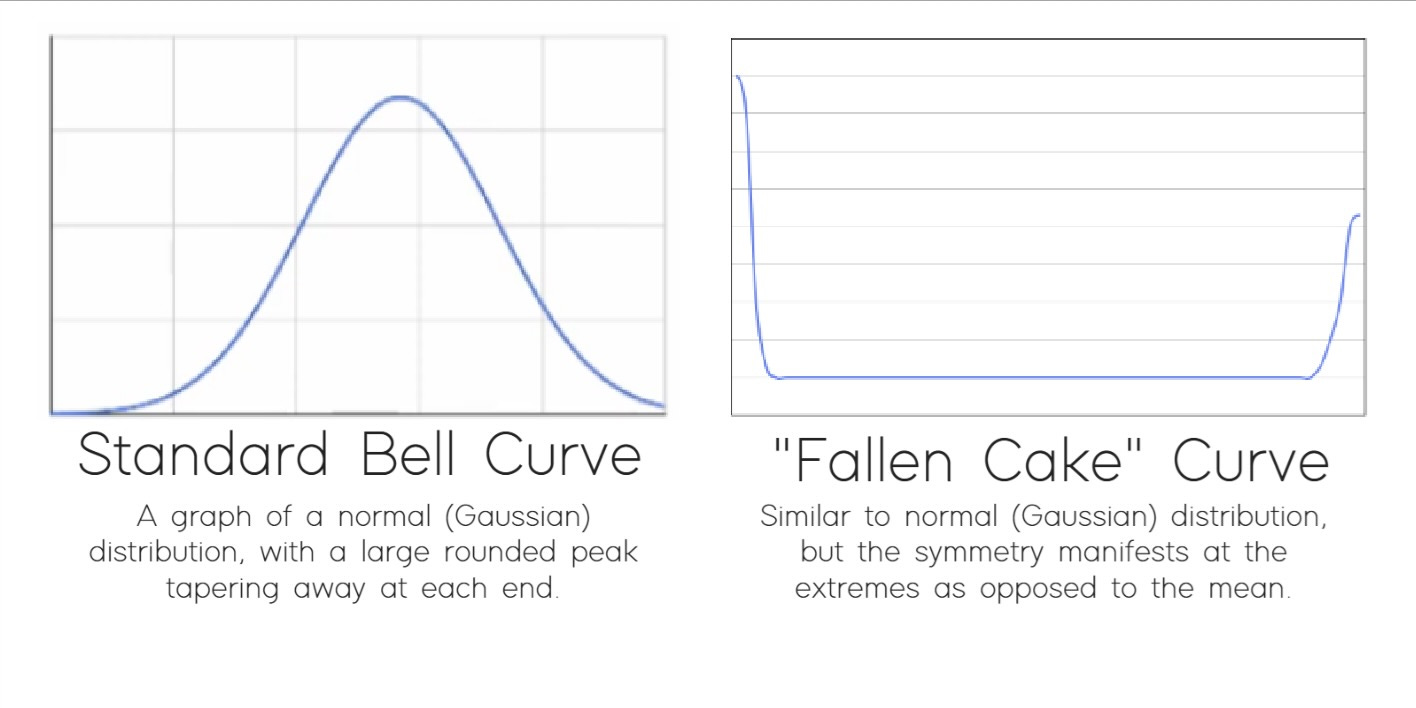
      Everyone is familiar with the old “bell curve”. It is used as an indication of distribution for many different things from school grades, to “IQ”, to the ability to afford housing, and so forth. But, there is another graph that applies to attitudes. I am sure that it has a real name but I will just call it a “fallen cake” model. Although it does not happen often nowadays (does anyone know why?), cake batter within a mold will raise uniformly across the pan and then, because of a strong vibration or other event, the middle can just fall — leaving the edges relatively high with a wide plateau in-between that looks more like a crater. Unlike the bell curve which has its peak in the “center”, a fallen cake model will have two highs — one at each end of the graph.

     The fallen cake provides the shape but not the interpretation. For attitudes on most issues (pick your favorite, or least favorite, one) — there will be a group of people actively supporting the issue and another group actively fighting against the issue. These are the two “humps” at the ends of the horizontal axis. The height of the humps is a reflection of the activity of the group.

     That big flat area in-between are people who are passive. The flat area is almost always a wide area. If the humps are about the same height then they are fairly well matched though the width does come into play as it indicates the number of people in that active group. The shape changes as various factors are involved. Those passive people still make a difference as they still control votes or taxes or other means of input. Both humps will try to make the passive folk amenable to their position. The various “controversies” about issues are indicators of the flux within attitudes.

     Homosexuality, as well as all other folk within the LGBTQIA+ area, is not new. Various accounts have been recorded as far back as there have been written records. The First Nations were well aware of the diversity within humans and celebrated them. In various studies, there have been indications that external factors can affect the numbers in diversity but they are involved with gestation factors and occur before birth. Numbers of such are not zero and never have been and have never been a choice. The width and height of the humps, indicating acceptance or xenophobia, have vacillated throughout history.

    The medical, and recreational, use of marijuana has been reflected in attitudes throughout the past 60 or 70 years. My father talked about usage of marijuana as an ordinary, non-controversial, type of recreational drug within the Navy during deployment in the Korean War. At that point, it was a “who cares” issue. But with political and idealogical involvement, the fallen cake model started mobilizing against usage and, of late (with profit models being developed), for generalized usage once again. On one side are people who don’t think it is an issue with which the government should be involved and on the other side are people who think that all vices should be rigidly controlled. People who profit from the “drug wars” are particularly opposed to legalization.

     The United States is the only “developed” country which does not provide a baseline set of health care services for all citizens. Most countries do have the opportunity to pay for private insurance but such plans are in addition to that provided within their individual universal health care plans. This is very similar to those in the US able to be covered by Medicare, with private insurer “Part B” and “Part D” able to boost your benefits above basic Medicare. Yet, after indication of the majority of the US population indicating a desire to implement Universal Health Care, it continues to face uphill struggles. I talked about this in another blog recently. It fits the fallen cake pattern. There are people actively trying to get the US to provide for Universal Health Care and others who are actively trying to maintain the existing unique for-profit healthcare business model.

     There are many attitudinal issues for which the fallen cake model can be applied — climate change, AI development and ethical issues, the death penalty, mandatory vaccinations, public education, disarmament versus weaponization, participatory democracy versus authoritarianism, and so forth. There are also issues which appear to be “settled” that are actually still part of a fallen cake model and attitudes are still in flux. Many of the social support and movement aspects are in this category. I often place a pin on a history graph, at the point where feudalism started to become less acceptable, as a starting place for improvement on general social issues. As brought out in “The Handmaid’s Tale” attitudes can backslide.

When a person is actively involved with one of these issues, it can feel like

  • There is no chance of change in attitudes (completely stable and accepted)

  • People will never agree on a new attitude (discouragement)

  • Change is “just around the corner” (enthusiasm and exultation)

     The reality is that attitudes change. Attitudes about measurable facts can change. Attitudes about emotional issues can change. What is an accepted situation can become a forbidden situation (and vice versa). Hope for change is always reasonable and apathy about the inability (though not necessarily the difficulty) to change is to be overcome.

     Hope and helplessness can, and do, co-exist.

Ideas & Interpretations is a reader-supported publication. To receive new posts and support my work, consider becoming a free or paid subscriber.

Monday, March 17, 2025

A Thought and a Word: Language to its core

     I have always been fascinated by languages (including programming languages). There are a lot of people that have the general feeling that it is “just” a matter of different words, different spellings, perhaps even a different alphabet. Or — for speech — different sounds and combinations that make a different language go together. Certainly the ways that we interact with languages — through the eyes, the ears, through the fingers and touch — are all a part of the distinctiveness of language. And, please, don’t let us forget the languages of art — of music, of sculpture, painting and drawing, photography, weaving, folk art, and all.

     But that is still on the surface. I have delved into more than a half-dozen languages in my life (more than a couple of dozen if you count programming languages), but I cannot claim fluency in any except English. For a single language, English is certainly sufficiently challenging — primarily because English is an absorbing language. If you don’t have a word in English to describe something and another language does have such a word — take it into English and make it part of the language (no promises that pronunciation or spelling will remain intact).

     This is a different approach from that of many languages. German puts two, or more, word building blocks together to expand their language. French monitors general use constantly to maintain an illusion of control over what will be considered to be part of French. Every colonial, or fought-over, region has had the invading language forced upon the people of the region, either blending languages or creating an effectively new “trade” or local dialect.

     I have talked about “if you don’t have a word for something, take it from another language”. Okay. That is what is DONE — but what does that mean?

     Languages are used for communication within a community. Everyday actions and ideas must be able to be expressed. People that live in a desert region will have a different environment affecting their language from those who live in a rainforest. It is also a reflection of the internal community. The peoples who have lived in the Russian region have been long dominated by centralized, authoritarian (and often stratified — layers of “nobility” or privilege) government and bureaucratic structures. The general people have no feeling of control so they don’t DO anything — everything is DONE TO them. In language, this is called a “passive” voice and the Russian language is built upon passivity. It also works both directions — passive in response to the environment and passive in actions because of less of a foundation of thought for active structures.

     People who have vocations, or jobs, as translators are required to pass beyond the point of word-for-word translation. Dictionary word substitutions only get oneself a small way toward expressing oneself in a different language. Professional translators have to absorb the reality that GROUPS of words, in specific CONTEXTS, have particular meanings.

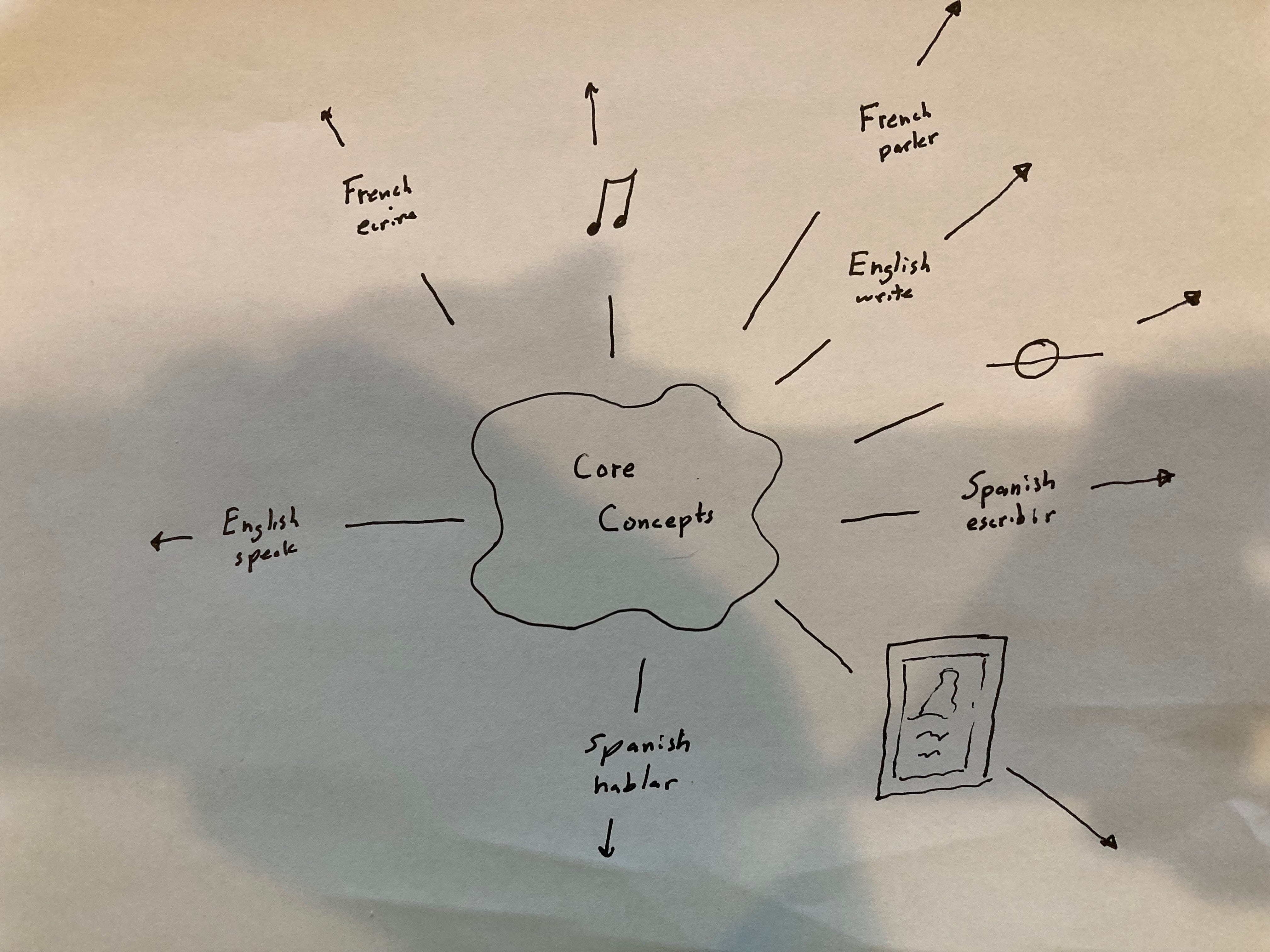
     In all these cases (and more to think about and explore), we have communication between our inner selves and the outside world. Words, lyrics, paintings, are all approximations to expressing ourselves to the outside world and hoping that others will understand what is being expressed. There is a central core concept that is sometimes best expressed in writing and sometimes expressed in song. And, if done in both, they complement one another — both offering more perspectives on an inner reality.

     In the case of translation, the listening to a language brings one close to the central core concepts that are desired to be expressed. The translator then expresses that in a different language. In many ways, artists are translators attempting to bring those core concepts to life and to others’ interpretations as much as possible. The process of translation is the process of “grokking” (deep understanding — read “Stranger In a Strange Land”) the core concepts and expressing them into the same or a different language.

     Can English be translated into English? Absolutely. There are the easy cases of translating a period dialect (“Old English” to modern English) and the more pervasive, and less blatant, act of the creator getting in touch (in whatever manner) with a core concept and then expressing it in their mother tongue. Some languages are best suited for concrete actions, situations, and activities. Such languages (for example, English, Quechua, or Swahili) express doing and existing and interactions (“I read a book today”). Other languages are better suited for emotions — such as the various artistic languages. These are not isolated from one another — prose can express emotion and painting can demonstrate actions, events, and interactions. “A drawing is worth a thousand words.” Is this a saying about the acts of translation?

     Although greatly interested, I have had very little professional experience with natural language processing as done via computational power. However, I would guess that the levels operate in much the same way. Words can translate via online dictionaries. Sentences require a gestalt of the complete thought. And essays require knowledge of history and context. Doing such, we are progressing to the central core concepts. Once obtained to the best of one’s current ability, it is possible to then express those concepts in other languages.

Ideas & Interpretations is a reader-supported publication. To receive new posts and support my work, consider becoming a free or paid subscriber.

Monday, March 10, 2025

False Savings: When a Bargain costs you more

     U.S. people love to get “bargains”. Even relatively rich people like to think that they are getting more from their money. But, often, those bargains are just not what people think they are. One example that always comes to mind for me is that of our daughter when she was purchasing perishable vegetables. But three tomatoes for $2 instead of getting a single tomato for a $1. Obviously a bargain — right? But what about if you only eat one tomato out of the three before the other two go bad? You now have paid $2 for one tomato. No longer a bargain is it? Quantities of perishable food is one category of potential false bargains.

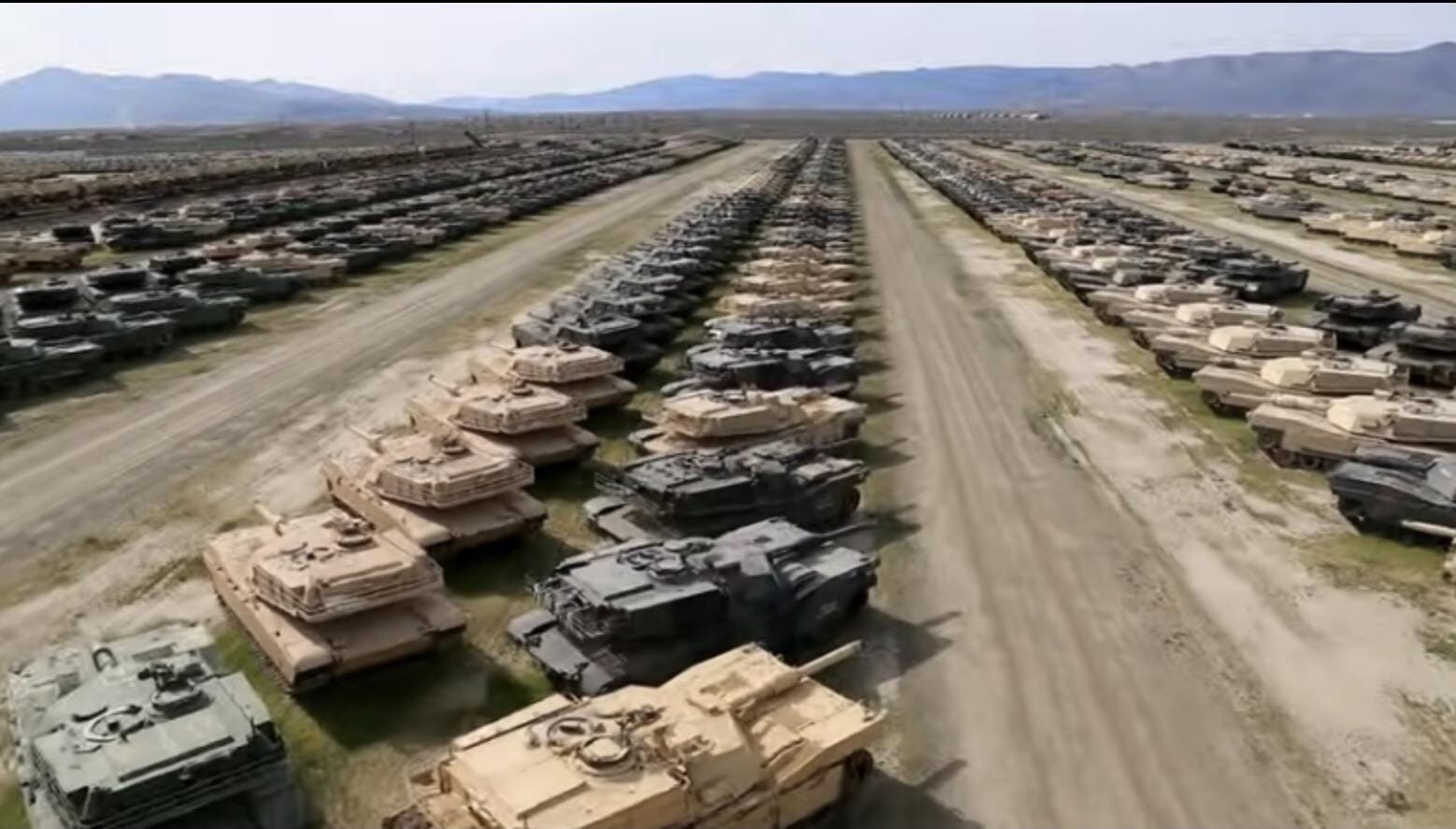
     People like to watch movies about wars (that they aren’t part of and don’t have any risks from). Tanks are always a favorite to watch. They’re so big. They obviously show a strong defence don’t they? Well, no — not within the current wars around the world. (I’m sure there are still specialized needs for them.)

     However, the money used to construct them (and store them) are important to local economies (but NOT important to any war/defence budget) — so these end up part of the many “porkbarrel” contracts which inflate the defence department’s budget. (So strange — huge amounts of known waste but “sacred” because they are (inappropriately) associated with “defence”.) This is a category of obsolescent needs.

     People in the US seem to often celebrate their lack of arithmetic skills. Who needs them? We have calculators and Yahoo and all, don’t we? We expect, when we go into a supermarket, that we will get lower prices (per unit) for large quantities in comparison to small quantities. And, most of the time, that will be true. But you have to watch it. A 32 oz. jar at $3 is NOT a bargain in comparison to a 16 oz jar at $1.25. (Another trick, whole numbers seem to be smaller.) How about 16 oz. for $1.25 and a quart at $3? Changing the units (from ounce to quart) is an acceptable ploy to mislead.

     Similar to the tanks above, maybe we just don’t need it? We have walked along in a shopping mall and often encountered a nice briefcase, in a display, for $50. But we don’t really need a briefcase and $50 seems like a lot of money. But, we are used to seeing it and thinking about it. What happens if we come back from work and see the window with a clearance sign saying “$22.50 for briefcase”. We’ve been looking at it for what seems like “forever” and it might not be there soon. So, we buy it. Nice looking briefcase gathering dust in the closet. Did we save $27.50 or spend $22.50? Both, of course — but how many such items of “bargains” do you have hidden away within your house?

     Go down to the local car lot. See that gorgeous truck there in the lot. It has the capacity to carry an entire living room’s worth of furniture just in that truck bed. You lean back and have fantasies of the neighbors all wanting to use it and thinking you are great because you have such a piece of machinery. But, what is reality? How often do you need to haul around a living room’s worth of furniture? For all purposes, how often do you need to haul around something larger, or heavier, than fits into the trunk of your compact car? Our economy loves you for it but buying something that you may use one or two days out of the year is certainly a luxury.

Ideas & Interpretations is a reader-supported publication. To receive new posts and support my work, consider becoming a free or paid subscriber.

Friday, February 28, 2025

Silence: A living interval

     As a long time Quaker (or member of the Religious Society of Friends), I have always had an extra awareness of silence, its meaning, and its uses. (Not to say that other, non-Quakers, cannot have similar awareness.) Generally, most people seem to divide silence into “comfortable” silence and “uncomfortable” silence. This is defined by periods when you think someone (perhaps yourself) “should” be speaking but aren’t — and periods when it is mutually felt that there is nothing that needs to be said. But silence can also be used as an active part of communication especially when elements exist which do not have the capacity for traditional speech — nature, God, the ill, and so forth.

     Although Quakers have experienced the same types of divisions of perspective and practice as most religions of the world have, there is usually some period, within the time set aside for worship, where there is a general silence. Some people within the Quaker community call the silent periods within worship — “expectant worship”. I prefer to call it a “living silence”.

     Believing that there is an ongoing connection to something beyond us (the exact word is not that important — God, Holy Spirit, Allah, Mother Earth, …) we sit in silence to try to listen to that which is unsaid. Some people do the same thing within an informal situation where they stroll through the woods and listen for something within themselves or, perhaps, outside of themselves. It is likely a part of a person’s spirituality but it does not necessarily have to be part of any organized religion.

     It does not always work. It requires “centering” by most of the people within the group. This centering closes the door to everyday concerns — did I lock the car, will I get the project done in time, I must remember to get milk on the way home, … The centering can also be blocked by feelings of urgency prompted by world, local, or personal events. Connection to that something else must be allowed to happen within its own time scale; it cannot be rushed. Perhaps not “real” but I have felt a sort of “electricity” in the air within the group on those occasions when the centering does work. It is a feeling that the connection is real, and active, and can lead you to wherever you need to go.

     Sometimes, it really doesn’t work. We call those “popcorn meetings” where people pop up to say something that they feel they just MUST say at the moment and then, after sitting back down, someone else “pops up” either to contribute something new and different or to comment upon previous spoken worship. Without the time to renew centering, it is doubtful (though not impossible) whether such continued messages come from anything other than our own everyday ponderings (though those ponderings may be acute and profound).

     In modern society, many (probably most) are uncomfortable with silence. Conversations are filled with”small talk” or — worse — absent minds pecking at their smartphones. I think that it is likely that the difficulty with silence is closely related to the shift in attention span to shorter and shorter intervals between “actions”.

     Drink eight glasses of water. Learn to breathe properly. Keep your back straight in the chair. And — to be added — learn to love, cherish, and appreciate the silence around you.

     Ideas & Interpretations is a reader-supported publication. To receive new posts and support my work, consider becoming a free or paid subscriber.

Lazy, lazy, tests: They are fast, easy, and non-invasive but they should never be solely relied upon

     Once upon a time (about 30 years ago), I was going through various dating services trying to find a lifemate. (Found her at a mutual me...