Showing posts with label bias. Show all posts

Wednesday, March 25, 2026

Leading, and loaded, questions: And other ways to bias questions and polls.

      “When did you stop beating your spouse?” Ludicrous, but such questions happen. By phrasing the question such that some type of foundational axiom is assumed, you bias the situation and make it very difficult for the person to answer. In a poll, the answer, “I have never beat my spouse” is highly unlikely to be part of the limited choice of answers. In a direct interview, it is easy to edit the situation to make the reader or viewer assume that there is some basis for the question. A firm denial may make the responder sound defensive. Perhaps the best response, in a verbal exchange, would be to invoke humor — respond with “that’s the question I was planning to ask you!”.

     Such questions can be called leading questions, loaded questions, presupposition, or begging the question. In the court of US law, this situation of embedding an accusation within a question, is called “leading the witness”. The same thing can occur with inexperienced counselors and can be part of the process for implanting false memories.

Some additional leading questions examples (derived from Google searching):

  • “You enjoyed the movie, didn’t you?”

  • “How much do you love our new product?”

  • “Wouldn’t you agree that our service is the best in the industry?”

    Any question that requires a “yes/no” response — that is not referring to factual data — is almost always leading. “Does 2 come after 1” is a factual question with a binary response. “Do you approve of Politician A’s desire to improve schools” is a question with two embedded biases — it states there is a politician’s desire that may, or may not, exist and it gives a vague directive that few would disagree with (“desire to improve schools”).

It is too easy to manipulate from either direction — the question or the responses.

     Have you ever encountered a poll (or a test, for that matter) where you said “Where is option E”? For polls, that is often deliberate. For tests — well, they probably don’t do it deliberately but it is probably done because of too little, or too much, experience.

What is the color of the sky?
a) Red
b) Yellow
c) Blue
d) Green

     The creator of the test PROBABLY meant the answer to be C (blue) but have you ever seen a sunset, or sunrise, that contained red, yellow, or orange? Very likely. It would have been better to rephrase the question to “What color is the sky, when not obscured by clouds, most of the time?” By the way, it is not unusual for the sky to appear green near tornadoes.

     I have seen something very similar to the following in a poll. I found it amazing that anyone would not see it as just a way to implant false information — but, apparently, many don’t see it that way. Note that it misleads on BOTH the question and the response.

How do you feel about the Democrats’ open door policy for immigration?

a) I think it is wonderful
b) I think it is terrible
c) I think all Democrats should feel ashamed
d) The policy should be squelched immediately

     Of course, Democrats have never had an “open door policy for immigration”. But the question indicates that they have had such a policy and, unfortunately, many people do not do any research on their own — so they believe it. Embedding lies within a question is a time-honored (though not honorable in any other way) method for politicians to mislead. There should be an “e” response:

e) I think the creator of this question should be seated at a blackboard and be required to write “I will not lie” 500 times.
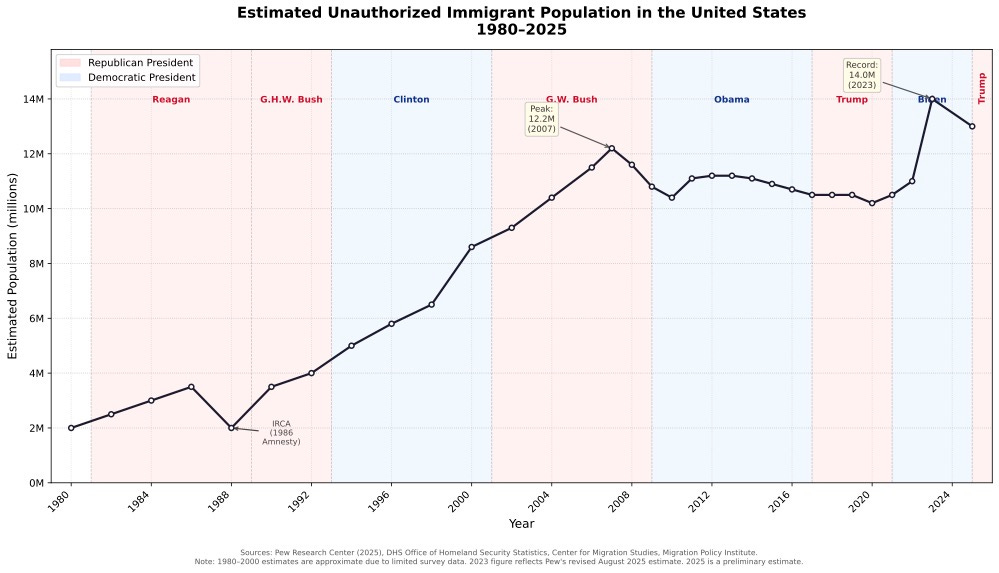
     I am sure that there are questions with embedded lies for other political party situations — but I have seen the above sent in an email. As mentioned in a recent newsletter, it is always dangerous to just believe what you read or have been told. Research, get multiple viewpoints and data sources. What you hear is NOT necessarily what exists. Polls can indirectly lead people to accept lies as truth, and a bad poll question can lead many a recipient astray.

Watch out.

Thanks for reading Ideas & Interpretations! This post is public so feel free to share it.

Ideas & Interpretations is a reader-supported publication. To receive new posts and support my work, consider becoming a free or paid subscriber.

Thursday, September 18, 2025

Bias, Prejudice, and Social Change: Sometimes it is hard to see the border

     I don’t know of anyone who isn’t biased. Yes, that includes myself. Biases come about based on our personal histories. Our families. Our experiences. Our friends. What we watch. What we listen to (and whom we do NOT listen to). What we read. All of these work together to form our personal histories. And that will cause biases whether we acknowledge it or not.

     I know that I am biased against the wealthy. (Our family called them the “suits”.) And it was reinforced by injustices that I observed while growing up. I know that I am biased towards women (growing up in a matriarchy, it could have gone either direction). It is by bringing biases to the conscious mind that we can work with them and get past them.

     Which brings us to the title of this newsletter/blog. According to some legal dictionaries I have read, bias is when you will choose something (for or against) if it is possible to do such in view of evidence and knowledge. Whereas, prejudice (I grew up with it called '“prejudism” — but the dictionaries INSIST that that is not the correct word (even dictionaries can be prejudiced)) is the same words it is based on — pre judged. I will not believe (or will only believe) something even if all of the evidence says it is not true (false). A bias, that a person is unaware of, may have very similar effects as for a prejudice.

     “To Kill a Mockingbird” is an expansion of the definition of prejudice. Everyone in the courtroom, including the judge and jurors, are fully aware and knowledgeable that Boo is innocent. But acknowledging that he is innocent would be an indictment of their entire social system. Therefore he is treated as if he were guilty.

     A prejudice is a foundation stone of a society and there are many laws, rules, and customs built on top of such foundation stones. Society must be literally rebuilt to eliminate a prejudice. There is great resistance to this because, in any society, some will benefit more from the society and others will benefit less (possibly some MUCH more and others MUCH less). This is why “To Kill a Mockingbird” is so high up on book banning lists. Those who benefit find it very difficult to surrender some of that benefit. This fits into Maslow’s hierarchy of needs (my blog about this is here — I don’t want to dig too much deeper within this note).

     Without digging deeply into Maslow, I will list the names of the needs in order — physiological, safety, love, esteem and self-actualization. Changing a society brings all of these needs into question and instability — but especially those of physiological and safety needs. From the point of view of those who benefit more, questions arise. If I treat all people fairly, will I still have a job? What will I have to give up? Can I continue to provide for my family? Will I starve?

     These are not irrational questions (but reactions may be quite irrational). If you have a society where 50% of the population gets 95% of the resources, then making it equal will greatly reduce the amount available to those that currently benefit.

     Biases and prejudices do not apply only to the “isms” (racism, anti-semitism, genderism, etc.) Society has biases (not usually prejudices as awareness of such biases can override them) to reward those who are taller, deemed more attractive, speak in a specific dialect, etc. It would not create as much of an earthquake to change, or eliminate, such biases (it possibly would if they were prejudices) but it is still NOT easy. It might require some exterior need to initiate changes. That could be (and almost definitely has been) a basis for a science fiction book.

     Biases can be reduced with awareness. The reduction of biases WILL change society and culture — but slowly as the reduction is done slowly. Elimination of prejudice has to be done deliberately with full recognition of the gains for some and the losses for others.

     That brings us back to Maslow because solving the universal base physiological and safety needs is a requirement for progress. If everyone is confident that they will be able to meet those basic needs for food, shelter, clothing, safety … then it is less difficult to shuffle the deck of society. Doing that requires the shifting of another foundation stone — that of distribution of resources.

     It’s not easy (as history shows us over and over).

Ideas & Interpretations is a reader-supported publication. To receive new posts and support my work, consider becoming a free or paid subscriber.

Monday, November 4, 2024

Polls and Surveys: Not often a many-splendored thing

     As mentioned in my 300th blog, this blog is transitioning to a substack newsletter format. If you would like to continue getting my blogs/newsletters, please click here and sign up for a free subscription (if you have money to spare, you are welcome to get a paid subscription). Thank you for reading these. I hope they are of interest, and will continue to be of interest.

     It seems that election season is usually the time for a plethora (so many that a person gets sick of them) of polls. Surveys happen all the time, for many reasons, but polls usually happen for elections. Why? Polls are aimed at the future. What do you want to happen in the future? Do you want a nuclear power station in your town? Do you want to vote for Candidate A or do you want to vote for Candidate B (occasionally the poll will be written such that a choice for “neither” is allowed)?

     A survey is more of a gathering of information about what is happening right now. Do you put on your left sock first or your right sock first (Japan loves surveys of this nature)? How do you feel about the economy? Do you think that your local new pattern of “100-year” storms every four years is caused by climate change? How many pets do you have at home?

     Like weather forecasts, it is often true that polls don’t get it right (surveys don’t also but that’s for a different subset of reasons). In fact, many times polls are used in the opposite manner. They are manipulated to create a desired output, recognizing that there is a “winner effect” where people have a tendency to change their minds in order to be part of the “winning” side.

     Even when a poll is not deliberately manipulated to give a desired output, there are problems.

  1. The questions must be created such that there is no inherent bias or assumption

  2. The polls must be filled out (or answered) by a representative group of people

  3. The people answering must have full anonymity — otherwise they may not give their honest answers.

     It is more difficult than one might think to keep bias or assumptions out of questions. “How often do you beat your spouse?” is rather blatant (though I suspect it has occurred on more than one poll). “How bad do you think the economy is?” has the same inherent assumption (that the economy is bad) as the spousal question but may not be as obvious.

     Many polls are multiple choice. But desired responses do not often align completely with one of the choices. The potential answers often have their own bias and assumption. If none of the answers matches what is wanted as the reply then there is a choice — don’t answer or choose the “closest”. But if your desired answer is the opposite of all of the listed possible answers then no answer is all you can do — and the poll will not reflect your opinion.

     It is very hard to get a representative number of people. For elections, they not only need to represent the variety of people voting in appropriate percentages but they must also be people who are going to vote. Younger generations often do not use phones for audible conversations so a phoned poll will be out-of-balance with leaving out many younger people (hopefully active voters). Although becoming less a problem as the technology continues to be more established, older people may be left out of polls if the polls are done via online methods. So, do both. But then the “middle” group may be over-represented.

     Legal voters don’t necessarily all feel comfortable in thinking about more complex issues in languages other than their home language. But polls (and surveys) cannot be created in ALL potential languages and polls are more unlikely to be answered if there is any struggle to complete them.

     We have many different physical, economic, ethnographic, and other areas of the country. Each has their own history and perspective so all must be represented in the polls. Very difficult.

     Finally, anonymity. In many countries, honest answers can be dangerous if the answers can be attributed to specific people. But even in honest democracies, attributed answers may result in unpleasant results (such as being bombarded with pleas for election money) if the person can be connected with the response. The answer may not be private within the house (or other physical location) and there may be intimidation or pressure to answer in a way not truly desired.

     Surveys can have the same types of problems but, since they deal with current existing issues, can change without causing the “chicken and egg” situations.

     The bottom line is that polls can only be treated as potential approximations. Their results should not be used to guide a person’s actions or expectations. If the poll results reinforce your opinions then be pessimistic and if they are contrary to your opinions then try even harder.

The U.S. Police Service: its history and challenges

     First of all, let’s start this newsletter with an homage to all of those good, brave, honorable, kind, generous police officers that we...