Showing posts with label lies. Show all posts

Tuesday, November 11, 2025

The Big Lie: It's still a lie -- so how do we get people to stop believing?

     “The Big Lie” is often referred to nowadays. Do they mean THE BIG LIE (Capital letters, bold)? No, that’s not quite it. Lies are common (too common) within society. Many times they are used for “social convenience”. Do you want to go out with me on Wednesday — “no, I have to wash my hair” (lying to save themselves embarrassment for saying “no”). Do you like this dress on me — “certainly, you look great” (but it really doesn’t, so you obtain short-term peace by saying “yes” even though long-term it is not be helping them). Other times, a lie is to avoid punishment or embarrassment. Of course, a pathological liar doesn’t truly know what is true or false (and doesn’t care). Pathological liars can pass “lie detector” tests because they believe whatever they say.

     No, a Big Lie is something that is unreasonable, not to be believed, outrageous. But, it keeps getting repeated — over and over and over. Many (most?) people will eventually start thinking “it keeps being repeated, maybe there is some truth to it”. This is related to “if there is smoke there must be a fire” (perhaps smoke bombs hadn’t been invented yet). And a subset of those people will start thinking “it’s said so often it must be true”. This type of brainwashing can occur even when it is the same, unreliable, person who is the only one to keep repeating the falsehood.

     If a Big Lie must be repeated many, many times to become part of the unbelievable part of your world then why would anyone continue to listen to such lies (while they still recognize them as lies)? One possible reason is that they WANT it to be true and want someone to convince them. Another is that they are “amused” by it — until it starts feeling like something to believe and be angered about. One more reason is that many people (and I am not fully not guilty) tend to “leave the channel on” — they will continue to watch/listen/gather around some television program/stream/radio broadcast that they are used to using.

     The Big Lie has certainly been around for a long, long time. It is parallel to that of hunting blinds used by duck hunters. A duck hunter will find a place with ducks around and then they will build a shelter. The shelter shouldn’t be glaring but it doesn’t really have to be hidden. At first, any ducks (or other animals that are to be targeted) will be afraid of the shelter — being new in their environment. Each successive day, they get more accustomed to it. But, at some point, they become used to it. They accept it as part of the environment. What was unusual is now normal. And the guns come out.

     Once a Big Lie has been accepted, it is very difficult to get rid of. It is now part of “normal”. Once outrageous and unbelievable, it is now everyday knowledge. A new identity has been formed which incorporates the illogic of the Big Lie. It can only be removed by methods similar to installing it in the first place or using the various methods for “deprogramming” or “debrainwashing”.
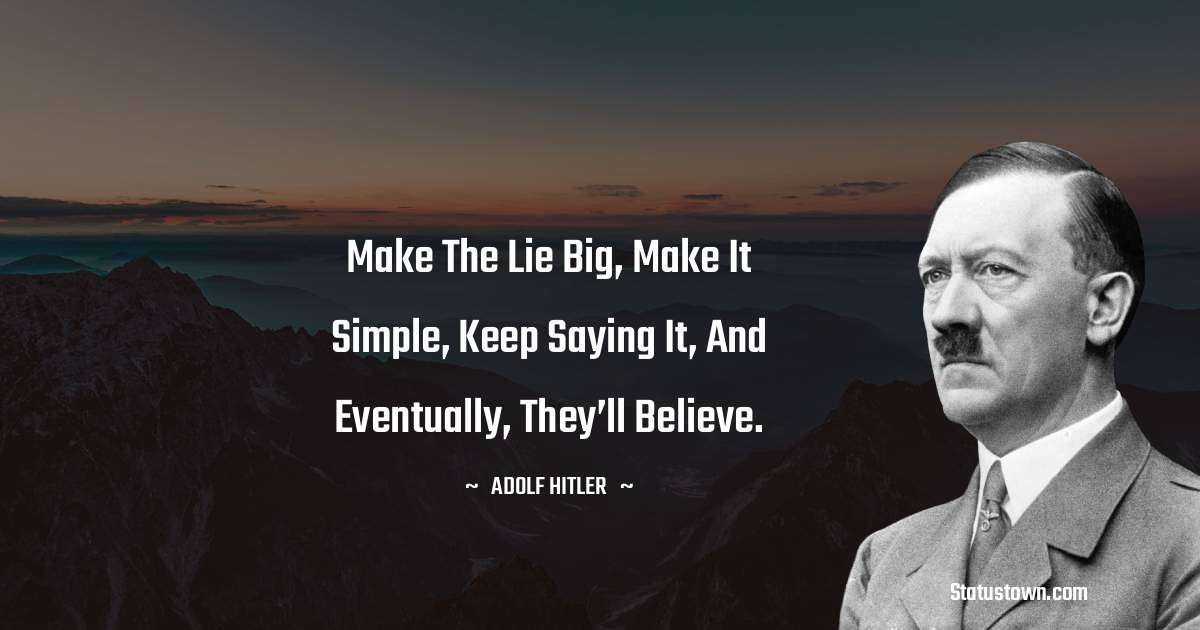
     There are a couple of defenses against Big Lies. Being solid with yourself is the biggest help — as it helps a person in many different ways and not just for resistance to Big Lies. Be comfortable with yourself, appreciate yourself, accept that your values are of importance. Alarm bells will ring louder if you are hearing from a solid place.

     The second is an old bumper sticker cliché. “Question Authority”. Actually, question everything. This is particularly unpopular with schools below the college level. Why? Well, there are conspiracy theories that I cannot disprove (very few things can be absolutely disproved) that say it is to indoctrinate students into particular mindsets. A less drastic interpretation is that questioning takes more time. Time and energy are scarce resources for our overworked and undersupported teachers. If people are trained to just accept, less time and intervention are needed to get the students to approach things as desired.

     In most universities, the opposite is typically true — questioning, research, and analysis are encouraged or even required. This is why “conservatives” firmly believe that universities are “liberal” — because they are encouraged to question. And it is a reason why “liberals” are hard to get to focus on a common effort. “Conservatives”, who are trained to obey and not investigate, are much easier to direct in common effort.

     People reading George Orwell’s novel 1984 (or “It Can’t Happen Here” by Sinclair Lewis) once wondered how could this ever happen. Currently, we have been watching it unfold. It can happen slowly. The anecdotal frog in the pot can be boiled alive if the heat is turned up slowly.

     It is up to all of us.

Thanks for reading Ideas & Interpretations! This post is public so feel free to share it.

Ideas & Interpretations is a reader-supported publication. To receive new posts and support my work, consider becoming a free or paid subscriber.


Thursday, September 11, 2025

Censorship: When a group, or individual, is terrified that the truth shall prevail over lies.

 "The real conflict is between truth and lies. One mark of a deteriorating society is when people cannot discern between truth and lies." — Ann Landers

     I used to firmly believe that, when presented with the truth and presented with a lie, the truth would always prevail (eventually). Ideally, I still think this is true, but with the advent of data silos (self-imposed restriction of information available), I no longer believe this is always so.

     A lie cannot be exposed if people choose to never to listen to the truth.

     Note that there is a huge difference between hearing and listening. Lies repeated over and over do not magically become true. And the truth presented calmly can be heard but never listened to even though it stays the truth.

     When a group, or individual, is afraid that people will believe the truth then their only option is to impose restrictions on the ability to hear/see/read that truth. Data silos are the form that it takes for self-restriction. Censorship is when restrictions are imposed from the outside. Such censorship may be enacted by governments or by local subsets of society.

     I usually do not take part in threads on the net about book banning in schools and libraries because those working to ban books rarely listen. Of late, I tried to interject a bit of rationality into a thread but pulled back quickly because they quickly started “responding” to things that were never said.

     One thread talked about removing pornography and sex from school libraries.

I asked them to name such a book.
          Hundreds of people on the thread — no one could name a book
IF someone had named a book, I would have asked for a page number or a quote
          But not one person had named a book and I have more faith in our
          hard-working librarians than I am in what is literally a mob that
          is just repeating what they hear from someone else and don’t care if it is true.

     I do know of books that contain “hard core” sexuality — though I do not seek them out. One set comes from a very popular author who also writes lesbian romance books. Another is from a New York Times bestselling author who doesn’t hold back an iota of what can be done with heterosexual bodies. But they are not in our school libraries and, frankly, I have never heard of any protests about them.

     So, what books do get banned — and why? In the list of the most-often banned books in the US, there are various reasons mentioned. “The top ten reasons books were challenged and banned included sexual content (92.5% percent of books on the list); offensive language (61.5%); unsuited to age group (49%); religious viewpoint (26%); LGBTQIA+ content (23.5%); violence (19%); racism (16.5%); drugs, alcohol, and smoking (12.5%); "anti-family" content (7%); and political viewpoint (6.5%).” [from referenced Wikipedia article].

     As mentioned above, most people who talk about banning books have not, themselves, read the book — and often don’t even know the title or author of the book (though sometimes it is ONLY the title or author that they know). But there is usually an initiator and, presumably and hopefully, that initiator of trying to ban a book HAS read the book.

     So, given the above “top ten” reasons to ban books, what are the underlying discomforts? For sexual content, it is possible that there are some books that slip past the scrutiny of even the best, eagle-eyed, librarian. And it is possible that there are some books that really should be pulled from a school library. This includes for the other stated reasons. There are books that are not suitable for particular ages — and when they have slipped past the educational guardians there usually is not much difficulty in getting them removed.

     I will also note that, even if banned, people can (and will) still read (or watch or listen to) them — just less easily. It calls out that the primary issue is that some parents want the government to control their children. Parents SHOULD be INVOLVED with their children and learn WITH their children and be PART of their children’s lives.

     But most of the criticisms I have run across are not about specific sexuality in a book but, rather, the idea that sexuality exists. A book about a mother and father raising three children is usually not disapproved of by any. But a family where two men raise three children is very likely to be objected to. Or a family where a “mixed racial” couple are raising three children. Or a family where a mother and father is raising a child who is very uncomfortable being treated as a specific gender or the child is attracted to others who are of the same gender. The root problem is acceptance of a situation different from the societal norm — not any explicit sexuality.

     Another situation is telling the tale of a situation that is not a positive one. Abuse — physical, sexual, or emotional — is not a comfortable subject. The same is true of the abuse of drugs or other substances. But people, including adolescent and younger children, do encounter such situations. Pretending that these situations do not exist is not helping children. They may be encountering such situations at home. How do they know that such situations are not normal and they should not feel terrible because they have been caught up in such situations? What if their parents are divorcing and they don’t understand, their parents cannot calmly explain, and the children may even blame themselves? In such cases, the books may be a literal “lifeline” for the children. The problem is not the book (or movie) but the reality that they feel they have no one to talk with about such problems.

     A third category enters the worlds of changed societal norms (acceptable language, behaviors, social strata, environmental or societal environments, etc.). This may be a difference between regions, countries, or periods of history. According to the current, local, set of societal norms a book may be in conflict with them. Many of the criticisms of “The Adventures of Tom Sawyer” or “The Adventures of Huckleberry Finn” arise because the completely normal and acceptable language and behaviors of THAT period of time are no longer acceptable today.

     Does rewriting history really help anyone? Does pretending that life has always been as it ideally is today help anyone? This situation keeps arising — and not just for books and movies — but legal and historical cases where today’s standards are expected to have been held by the people of yesterday or some other locale.

     A fourth major category is simply that we don’t like the way the author thinks or the things that they put into print or a movie. They don’t have the same political, religious, moral, environmental, societal, scientific, or whatever viewpoint as someone else. True, and this is yet another case where parents should be INVOLVED with their children and what they are reading and watching and listening to. We have raised children to become adults who are unable to think about subjects, to discuss subjects, to research subjects. Is forcing children to NOT learn such skills really beneficial? Does society benefit from its citizens unable to discern reality from fantasy, facts from fiction, truths from lies?

     There are some books that slip past our hardworking librarians and should not be easily accessible by children. In such cases, all should know exactly what and why something is not appropriate. In other cases, the material may not be enjoyable or positive-in-viewpoint but still reflects something that is real. In such cases, the problem is primarily that the parents are not taking the time and energy to work with their children so that all understand what is going on and the effects of the situations on everyday interactions.

“Think for yourselves and let others enjoy the privilege to do so, too.” — Voltaire

Ideas & Interpretations is a reader-supported publication. To receive new posts and support my work, consider becoming a free or paid subscriber.

How Do You Become a Champion?: growth comes in many forms

     I worked on a variation of this theme several years ago but I have since recognized that I limited the article too much. Growth does co...