The word democracy has its origin within two Greek words. These words are demos and kratos. Together, they mean power (or rule) of the people. As in the subtitle, this means that we the people have a right to be part of the decisions that direct our society. That is the foundational idea but the process of democracy was probably used prior to any written history of humanity. A group of people getting together, discussing something, and jointly making a decision is an example of “democracy” at work.
The formal version of democracy, where people vote on issues (or people), is recognized to have started in Athens (508 BC) with Cleisthenes who made the idea of general participation as part of the decision-making process part of a series of reforms.
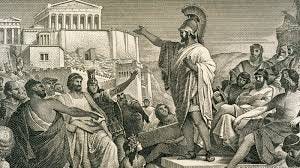
Direct versus Representative
A democracy can be set up as a direct democracy or a representative democracy. Direct democracies work best with small groups of people. When the U.S. democracy was initiated, transportation was not easy. The roads and infrastructure presented barriers to make a gathering of people for a direct democracy difficult, so it was created as a representative democracy. A substantial number of the writers of the U.S. Constitution were in favor of a direct vote limited to the “elite”. The final language was the result of compromises that left eligibility to vote vague and primarily in the hands of the states’ governments.
Qualifications and expansion of the electorate
Although left vague in the Constitution, voting was initially limited to “white”, “educated”, male property owners. New Jersey allowed women to vote (if they had property and were white) for a while but backed away from it in 1807. During the 1800s, the states slowly retreated from the requirement of owning property (this did not require an Amendment as voting privileges were state controlled).
At the time of the adoption of the post-war 15th Amendment, voting had largely eliminated the requirement of ownership of property. Note that Amendments to the Constitution are required for national coordination of rights and commerce to be consistent among the states. When each state can do as they wish, no Amendment was, or is, necessary.
The 15th Amendment officially ended the requirement for voters to be “white” males (note that “educated” had also fallen away as a requirement). Alas, if people want to get around a law, they will find ways (similar to the recent attempted “SAVE” Act within the US) to limit indirectly. Poll taxes were established to have an income requirement. Literacy tests were set up to require certain levels of education (and then it was made very difficult for the poor and non-whites to obtain education). Many of these restrictions were deemed illegal in the courts but each of them had to be fought and, even when the courts agreed that the practices were illegal, states sometimes would not enforce them (and it still happens).
The 19th Amendment expanded the right to vote (suffrage) to women in 1920 and the people of the First Nations were allowed citizenship, and voting rights, in 1924 but, since it was not done via an Amendment, it has not been universally accepted, or enforced, by all of the states.
In each of these expansions, a new set of voters was only allowed after EXISTING eligible voters agreed to the expansion (via state changes in laws or via Amendments for national changes). These expansions occurred, indicating a majority of existing voters approved of the expansion. The minority could, and did, make things very difficult for the new voters. This is still true in present days.
In 1965, the Voting Rights Act (NOT an Amendment) was enacted to strive to enforce the voting rights of those who had been granted such rights since the original Constitution. This was primarily to assist in the voting of non-white people but the Act was designed to help ALL eligible people to be able to vote. Alas, since it was an Act of Congress, once the elite, propertied, wealthy gained control of the US Supreme Court, they have been able to effectively nullify the Voting Rights Act.
The last Amendment associated with national voting qualifications has been the reduction of the federal voting age to 18 in 1971 via the 26th Amendment. This was during the last years of US involvement in Vietnam when tens of thousands of 18-year-olds were deployed, and killed, every year. That probably had something to do with passage of the Amendment.
Criticisms
As mentioned above, the “Founding Fathers” (FF) were not in agreement so they created relatively vague specifications, with states having control, to be cleaned up later. It is possible that some things (such as the War Between the States) might have been avoided had they been able to reach consensus at the time. We’ll never know.
Most of the FF were in agreement that full access to information and a well developed education were needed for successful participation in democracy and to make it thrive. Ben Franklin was in favor of making sure that the general populace qualified by having good, free, education. Others were more of the mind that wealth, allowing for extensive personal education, was needed to qualify a person to vote.
Even today, there is not a full consensus about the qualifications needed to vote. There are still issues of sexism, racism, elitism and other special qualities that people feel should disqualify people or should support them. Of course, the person doing the criticism usually feels that THEY meet those criteria.
Robert A. Heinlein felt that the right to vote, and participate in democracy, should be earned. One of his major criteria for earning the right to vote was to have served in the armed services (which, of course, he had). Personally, I don’t think that earning the right to vote is a bad one. The problem is setting up the criteria such that EVERYONE has an equal ability to earn that right.
Registration
How does one demonstrate, in a speedy and efficient fashion, that they are permitted to vote? In the United States, this process is done during registration. When applying to register to vote, documents indicating eligibility are submitted. Eligibility includes age (or birthdate), citizenship, and where they live. Characteristics which are Constitutionally mandated cannot be used as criteria for denial or removal.
Individual states still have control of purging of voter rolls. This ends up with over-purging (enthusiastic removal of voters that may, or may not, still be eligible) and under-purging (leaving non-eligible voters on the rolls which, theoretically, would allow someone to use the voting privilege of a no-longer-eligible voter).
Identification
Since identification is done at the time of registration, it speeds up the time needed to make sure the person is qualified to vote when it is time to do such. The people helping with the voting check the person’s name and address against the copy of the voting roll that they have. This is also the process that happens via mail-in ballots or other not-in-person voting. While it is conceivable that someone else might vote in place of a legally registered, and eligible voter, the process of registration makes it very difficult for an eligible voter to vote more than once.
So, what is to prevent someone else (not the eligible voter) from taking the place of the eligible voter? The process of identification varies from state to state. There have been various Congressional Acts that theoretically give more security about this. All of them continue to be described as ways to prevent voter fraud. This is very misleading. Voter fraud is almost non-existent in the U.S. because of registration and voter rolls. Extra identification possibly could help to prevent people substituting for others but that is not pertinent to the concept of voter fraud. Such Acts are primarily methods of suppression and election fraud.
Referendums
Referendums are special votes on specific issues. In concept, this is applying direct democracy to specific subsets of government issues. There are binding referendums where the legislators are supposed to have no choice but to follow the wishes of the electorate. There are also non-binding referendums which act as formal statements of preference. Unfortunately, the states have varying records of following through on referendums. Sometimes the state legislators will follow through with the voters’ wishes, sometimes not. Often, the courts are needed to enforce the results of referendums.
Suppression
Suppression and gerrymandering are the two most prevalent means of election fraud. Election fraud occurs when groups of eligible, qualified, voters are prevented from voting or prevented from having their vote have appropriate weight within elections. This is often done making use of income, race, sex, or political affiliation. In the United States, it is attempted on a regular basis to be able to get more votes than the opposition. The recent SAVE Act is an attempt at voter suppression and election fraud.
Conclusion
The United States representative democracy was designed originally to have a base definition of the electorate with specificity left to the various states. Various Amendments have mandated specific national inclusions but anything other than an Amendment can be overridden by state legislatures, with approval by the court system. Even Amendments can effectively be overridden by legislatures and/or court systems that have lost balance and objectivity. While voter fraud (individuals voting without eligibility) is very rare in the United States, voter suppression (election fraud) is an attractive method of bypassing democracy and controlling society by various individuals and groups.


No comments:
Post a Comment